What the U.S.–Kenya Health Deal Means and What Kenyans Stand to Gain
Share
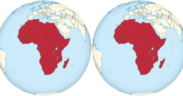
Kenya has entered a new era of health cooperation with the United States after signing a deal that both governments describe as a turning point for the future of healthcare delivery, funding, and national health sovereignty.
The Kenya–U.S. Health Cooperation Framework, signed in Washington D.C., restructures how American health aid flows into Kenya and pushes the country toward full financial ownership of key programmes by 2030.
President William Ruto hailed the agreement as “a significant strengthening of our commitment to the full actualisation of universal health coverage,” saying it will modernise hospitals, strengthen the workforce, and secure essential commodities.
For the U.S., the deal represents a cornerstone of the new America First Global Health Strategy announced in late 2025.
U.S. Secretary of State Marco Rubio and Prime Cabinet Secretary Musalia Mudavadi signed the pact, confirming Kenya as the first country globally to adopt this new model of cooperation.
The Framework now becomes the biggest bilateral health arrangement between Kenya and the U.S in more than two decades.
A Shift Away From NGOs Toward Government Control
Under the new agreement, the United States will channel health funding directly through Kenyan state institutions rather than NGOs.
President Ruto explained that “resources will be channelled directly through government institutions, eliminating third-party intermediaries” to curb wastage and improve accountability.
It is a model designed to reduce fragmentation, remove parallel systems, and build long-term state capacity.
For decades, major U.S.-backed programmes such as PEPFAR and USAID-funded HIV initiatives were run largely through external implementing partners.
The abrupt shutdown of USAID-linked programmes earlier in 2025 exposed how deeply Kenya depended on foreign-led structures, disrupting HIV prevention, malaria net distribution, and support for vulnerable children.
Also Read: Kenya Targets Local Vaccine Production by 2027
What Kenya and the U.S. Will Spend
Washington has committed Ksh 207 billion over five years, with annual conditional funding increasing gradually.
At the same time, Kenya must raise domestic health spending sharply, starting with Ksh 4.6 billion in 2027 and rising to Ksh 18.5 billion by 2031.
This progressive takeover ensures that donor support tapers as Kenya assumes full responsibility.
This approach rewards countries willing to build sustainable systems rather than rely indefinitely on donors.
The U.S. Department of State stated that its strategy focuses on ensuring American foreign assistance “must be directly justified” in strengthening partners and protecting U.S. interests.
Brad Smith, a senior advisor in the Bureau of Global Health Security, described the Kenya deal as “a model for the types of bilateral health arrangements the United States will be entering into.”
Key Areas the Framework Will Transform
- Procurement and Commodities
By December 2026, the Kenya Medical Supplies Agency (KEMSA) must be ready to take over the full procurement and distribution of all U.S.-funded health commodities.
This is one of the most demanding conditions, but also the most important for sovereignty.
A Ministry of Health brief notes the Framework introduces “a transition model from donor-driven systems to government-led, self-reliant and sustainable national health systems.”
- Workforce Absorption
Kenya will absorb 13,808 U.S.-funded health workers, including 515 laboratory staff, onto the public payroll beginning 2028.
This is expected to strengthen universal health coverage and stabilise essential services previously running on donor contracts.
- Data Protection & Digital Health
The deal requires Kenya to meet strict data privacy standards.
Health Cabinet Secretary Aden Duale assured that “only de-identified and aggregated data will be shared” and that all approvals must comply with the Data Protection Act and Digital Health Act.
- Epidemic Preparedness and Disease Elimination
The U.S. will support Kenya in adopting the 7-1-7 outbreak response model, detect an outbreak within seven days, notifying authorities within one day, and responding within seven days.
The Framework also prioritises the elimination of HIV, TB, and malaria.
Why This Deal Matters Now
The signing comes months after the U.S. froze major health funding early in 2025, closing programmes that supported HIV patients, vulnerable children, and malaria prevention.
Counties scrambled to find alternative supplies, demonstrating how fragile donor dependency had become.
For Kenya, the Framework offers stability and a roadmap out of that vulnerability.
For the U.S., it ensures partner countries can eventually sustain health gains without perpetual financial support.
Duale described the pact as one that grants Kenya “national health sovereignty by ensuring full ownership of health systems.”
Also Read: What Kenyans Stand to Gain From the Kenya–U.S. Health Cooperation Deal
What Kenyans Stand to Gain
- A More Reliable Supply of Medicines and Equipment
Direct funding to KEMSA and facility-level institutions means faster procurement and fewer stockouts that previously plagued donor-managed systems.
- Stronger Universal Health Coverage
Ruto said the Framework “prioritises the supply of modern medical equipment, the upscaling of our health workforce, and the expansion of health insurance.”
- Long-Term Stability After a Turbulent Period
The January 2025 disruptions showed how fragile donor-led infrastructure was. This Framework builds resilience.
- Opportunities for Kenyan Health Workers
Absorption of thousands of previously contract-based workers means stable salaries, pension contributions, and career progression.
- Digital Health Improvements
From electronic medical records to surveillance systems, Kenya’s digital transition will accelerate.
A Demanding but Necessary Transition
If well executed, Kenya’s health sector could emerge stronger, more independent, and better prepared for future crises.
If poorly implemented, the country risks repeating the disruptions of early 2025.
For now, both governments say the partnership is aligned, mutually beneficial, and built for the long term.
As President Ruto said, Kenya expresses “deep appreciation for choosing Kenya as the first nation to sign such a Framework.”
Follow our WhatsApp Channel and WhatsApp Community for instant news updates
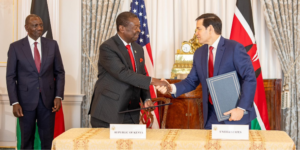
President William Ruto in Washington, D.C., in the United States, Witnessing the Signing of the Kenya–US Health Cooperation Framework, Signed by Secretary of State Marco Rubio and Prime Cabinet Secretary Musalia Mudavadi. PHOTO/ Ruto X