
Govt Clarifies Giving America Kenyans’ Health Data in New Deal
Share

The Kenyan government has moved to clarify concerns surrounding the recently signed health cooperation framework with the United States, insisting that neither personal medical records nor identifiable specimens will be handed over to American agencies.
Medical Services Principal Secretary Dr. Ouma Oluga said fears circulating among the public were misplaced and emphasized that strict safeguards were embedded in the agreement.
PS Oluga stressed that Kenya had been firm during negotiations, particularly on the issue of specimens.
He explained that although the U.S. had expressed interest in specimen-sharing, the negotiating team declined the request.
“I have to mention that we did not negotiate a specimen-sharing agreement. And we agreed with our American counterparts. Yes, this is something that they really wanted, but we said, wait a minute, no, we will not do it,” Oluga said.
He added that Kenyans’ personal data would remain protected under the exclusive management of the Kenyan government.
“Your personal medical records will not be shared with the US,” Oluga added.
Also Read: What the U.S.–Kenya Health Deal Means and What Kenyans Stand to Gain
Kenya Says Only Aggregated Data Will Be Shared
The PS sought to assure the public that only non-identifiable, summary-level data would be relayed under the agreement.
He said the government had established robust access controls to ensure information is handled appropriately.
Medical Services PS Dr Ouma Oluga allays data fears, saying, “Kenya will only share aggregated data with the US to monitor implementation.”
He further detailed the negotiation process, explaining that Kenya’s team of experts ensured national interests were safeguarded.
“I had a team of 93 people, extremely accomplished professionals in this country, negotiations is about two things. One is the, what do you want? But how we get it is our mechanism as the people negotiating,” Oluga lamented.
Joint Testing to Continue, Not Specimen Transfer
Oluga clarified that while the government rejected specimen-sharing, joint pathogen testing would continue in facilities where Kenya and U.S. agencies already collaborate, such as KEMRI and CDC laboratories.
“So what we agreed, is that we will continue to test specimens together. Because they are already here and we are already working together. So it’s a partnership between Kenya and the U.S,” said Oluga.
He noted that Kenya relies on international partnerships for specialized testing, vaccine trials, and regulatory processes, citing the country’s limited capacity for some complex laboratory work.
“Now, our partnerships is important for our health care system, we leverage on that because the U.S. already has that capacity,” Ouma added.
Samples Are De-identified Before Testing
The PS said samples used in joint lab work carry no personal identifiers, a longstanding global scientific practice.
“No, when we do testing of specimens, we blind them. By the time it leaves hospital, it’s no longer Oluga. It doesn’t have an identity. It is a sample.”
He added that such practices comply with international health regulations and that information generated belongs exclusively to Kenya.
“That information belongs to Kenya. It doesn’t belong to the U.S. government. And it’s at that laboratory where both of our people are working.”
Also Read: What Kenyans Stand to Gain From the Kenya–U.S. Health Cooperation Deal
Access to Aggregated Data Strictly Controlled
Oluga explained that the agreement includes formal request procedures and approval layers involving the Digital Health Agency and designated data controllers.
“This data sharing, and it is sharing, so that means it’s both ways, it’s aggregated data, there has to be a request in terms of what information do you need.”
He said the government has consolidated all previously fragmented health systems, from TB and HIV records to vaccine and blood systems, into a single national platform now fully controlled by the state.
“We have now taken them from hands of third parties, to government. And so right now, we can confirm, that your data is in the hands of the government alone.”
Data Restricted to Six Areas of Cooperation
The PS clarified that only aggregated data relating to the six areas of cooperation, surveillance, workforce support, data systems, maternal and child health, and two related pillars can be requested by the U.S.
“It is specifically for the implementation of this cooperation framework. So anything that is outside of this cooperation framework, you don’t have authority to ask me for that data.”
He emphasized that Kenya already shares aggregated health statistics internationally under WHO frameworks, and the U.S. request is simply an alternative mechanism following its shift away from certain WHO processes.
“I just wanted to allay fears that there is nothing that is strange out of all of this,” Oluga concluded.
Follow our WhatsApp Channel and WhatsApp Community for instant news updates
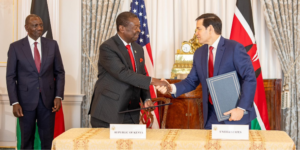
President William Ruto in Washington, D.C., in the United States, Witnessing the Signing of the Kenya–US Health Cooperation Framework, Signed by Secretary of State Marco Rubio and Prime Cabinet Secretary Musalia Mudavadi. PHOTO/ Ruto X