Duale Reveals Which Kenyan Health Data Will Be Shared with the U.S. and Why
Share
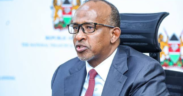
Health Cabinet Secretary (CS) Aden Duale has revealed the categories of Kenyans’ health data that will be shared with the United States (US) in the new $2.5 billion Health Cooperation Framework.
Speaking on December 9, Duale said the US will share Kenyans’ health data, mainly identifying information and not individual data.
Duale explained that the government will share de-identified data, which is data without names or locations.
“Mainly, the data we are sharing is data within the health sector. And we are not sharing data of individuals. There’s something called de-identified data. In this document, you’ll see it. De-identified data means data that doesn’t have personal data. Doesn’t have the address, doesn’t have the name, doesn’t have the location, doesn’t know the person. In terms of we are sharing the data, is the data on our HIV prevalence, on TB, on malaria?” Duale said.
He said the US government will also access aggregated data, which consists of patterns of “how”.
“Then we have something called aggregated data. And aggregate data is a combination of data, patterns of how. And that’s why sometimes we release county by county. I’m saying any data within the four areas that I have told you about within the framework of this cooperation,” he said.
Duale gave an example using the prevalence of HIV data and TB, stating that the sharing will include the prevalence rates, number of people using ARVs, and those dying from TB.
“Let me give you an example of HIV data. What is the prevalence rate? How many Kenyans are using ARVs? Okay, how many Kenyans are dying of TB? In this document, in the main framework, you see there are close to 5,321 Kenyans who die of TB,” he said.
Also Read: How Kenya Plans to Improve SHA and Health Systems in New UK Deal
Why Kenya is Sharing Health Data
Duale said Kenya and the US have now become partners, hence the need to share data for planning and monitoring.
He stated that the US is now a key investor in the health sector, and the government plans to allocate its resources.
“We have become partners. They are our core investors. We plan with their resources. We monitor and evaluate. If we have invested in HIV, for example, through NASCOP, HIV, TB, malaria, we will invest them through NASCOP, particularly HIV and TB,” Duale said.
He explained that the data will allow both parties to know the investment made in the health sector, commodities bought, surveillance, epidemics, and indicators.
Also Read: Govt Clarifies Giving America Kenyans’ Health Data in New Deal
“Now, for us and them to know the investment we have made in this sector of our health, what are the indicators? What are the data? These are basic data. What are the indicators? We are buying commodities. We are scaling our laboratories. We are dealing with surveillance and epidemics in our region, in our country, through the Kenya National Public Health Institute,” Duale said.
“Those institutions, basically, NASCOP deals with scientific data, and that scientific data is data that we share with the people of Kenya, that we share with our partners, that we share with global institutions like WHO, like USAID. That is how data is shared. But as I told you, the fear that Kenyans have is, do we share their individual personal data? That has been insulated.”
Follow our WhatsApp Channel and WhatsApp Community for instant news updates
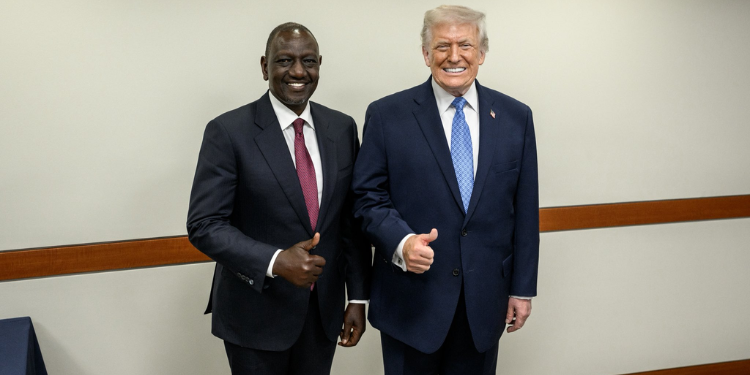
Kenya’s President William Ruto poses for a photo with U.S President Donald Trump. PHOTO/PCS.
You Might also Like