Ruto Reveals How Proceeds from Safaricom and Kenya Pipeline Company Sales Will Be Utilized
Share
President William Ruto has revealed that proceeds from the ongoing privatisation of key state interests, including shares in Safaricom and the Kenya Pipeline Company (KPC), will partly be channelled towards strengthening research and development in Kenyan universities.
Speaking during a graduation ceremony at NIRU University, the Head of State said the government had issued firm policy directions to ensure that funds realised from asset sales directly support the country’s long-term development agenda, particularly through investment in human capital and innovation.
In his address, the President underscored that research funding would form a mandatory allocation within the broader framework guiding utilisation of privatisation proceeds, positioning higher education institutions at the centre of Kenya’s socio-economic transformation strategy.
Privatisation Proceeds Earmarked for Research
“Our human capital. Even at the moment as we undertake our privatisation process, I have given clear instructions to the Ministry of Finance that part of those proceeds will go to all the areas we have mentioned,” Ruto stated.
He continued, “but some percentage must go to the research fund so that our universities, including this university, can apply for resources so that we can build and create new knowledge for us to be able to transition our country to a first world country.”
The President’s words indicate a clear policy change to set aside a certain percentage of the privatisation funds for research funding, which has always been underfunded.
The government is clearly setting its priorities straight by linking the sale of assets to the creation of knowledge.
Also Read: How to Buy KPC Shares for as Little as Ksh900 Using Your Phone
Master Plan Targets 2% GDP for Research
“In addition, I would like to draw your attention to the Kenya Research Financing and Capacity Strengthening Master Plan 2026-2036, which provides a clear roadmap for closing the research financing gap,” he said.
According to Ruto, “The plan envisions scaling up national investment in research and development to 2% of our GDP, as envisioned in the science, technology and development plan.”
He described the strategy as, “a critical step towards sustained national development,” noting that increased domestic funding for research would reduce reliance on external donors while enhancing Kenya’s competitiveness in science, technology and innovation.
Also Read: Safaricom Explains How Users Can Increase Their M-Shwari Loan Limit in 2026
Universities Challenged to Be Future-Oriented
Turning to the academic sector, the President challenged universities to increase their ambition and make their programs relevant to the continent’s priorities.
“Ladies and gentlemen, looking forward, I challenge this university to remain intellectually ambitious and future-oriented by continuously developing cutting-edge programs that are responsive to Africa’s development imperatives and the realities of the global economic crisis,” Ruto said.
He ended by thanking the stakeholders who contributed to the development of the research agenda, saying, “I would like to extend my thanks to all of you who have contributed to this initiative.”
The President’s statement is part of the government’s efforts to restructure state assets and use domestic resources for development financing.
By allocating a portion of the proceeds from the privatization of state assets to research and innovation, the government is indicating that the sale of state assets will not only be used for development financing but will also be used to help Kenya transform into a knowledge-based, first-world economy.
Follow our WhatsApp channel for instant news updates
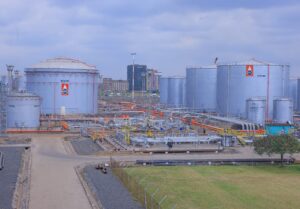
Kenya Pipeline Company Plant in Mombasa. PHOTO/ KPC website.
You Might also Like