
Thousands of Jobs at Risk as Middle East Tensions Hit Kenya’s Flower Exports
Share

Kenya’s flower industry is facing one of its toughest periods in recent years, with farmers dumping unsold flowers, exporters recording heavy losses, and thousands of jobs at risk.
The crisis has been triggered by escalating conflict in the Middle East, which has disrupted vital air cargo routes and sharply increased export costs.
The country’s floriculture sector is now under intense pressure, as the ripple effects of the conflict hit both key markets and essential logistics channels.
The Middle East plays a critical role in Kenya’s flower trade, accounting for between 10 and 15 per cent of exports.
The region also serves as a major transit hub for shipments destined for Europe and other global markets.
“So the last six or seven weeks have been very difficult for growers and exporters of cut flowers and ornamentals from Kenya,” said Kenya Flower Council CEO Clement Tulezi.
Air cargo capacity on some routes has dropped by as much as 30 %, while globally, nearly a fifth of capacity has been taken offline. This reduction has significantly affected the movement of perishable goods such as flowers.
Rising Freight Costs Squeeze Exporters
The disruption has caused freight costs to surge dramatically, further straining exporters already operating on thin profit margins.
Freight charges have risen from about 3 dollars per kilogram to as high as 5 dollars, nearly doubling operational costs.
“So it’s almost double the number in terms of money that we were using to export,” Tulezi stated.
As a result, shipment delays have stretched to as long as 48 hours, forcing farmers to discard flowers that cannot reach markets in time.
Also Read: UAE Logistics Coordination Strengthens Trade Continuity for Kenya’s Key Export Corridors
Farmers Forced to Dump Large Volumes
Over the past three weeks alone, the industry has recorded losses of about 620 million dollars, with a significant portion linked to flowers that perished before reaching consumers.
“About 20 to 25 % of our produce we are throwing away, right? Which is substantial… why are we throwing away, because the freight cost is too high, I cannot send to Europe?” Xflora Group MD Inder Nain said.
Kenya Risks Losing Global Market Share
Experts say the disruption is giving competitors an advantage, especially producers in South America who are not affected by the current logistics challenges.
“South Americans, who are our biggest competitors, are not affected by this. So they are able to take up the gap where we export. So there is no vacuum in the market; someone else will come in to fill. And if that market is taken away, regaining it becomes almost impossible,” Tulezi noted.
At the same time, demand is weakening in some destinations, further compounding the crisis.
“And the Middle East is actually the third most important market for us. The first is Europe, the second is the UK, and the third, of course, is the Middle East,” said Tulezi.
Also Read: Kenya Met Issues Red Alert Over Extreme Weather Threat
Jobs and Export Earnings at Risk
Kenya’s floriculture sector generates more than Ksh 110 billion in export earnings annually and supports hundreds of thousands of jobs across the country.
Industry leaders warn that prolonged disruptions could significantly affect foreign exchange inflows and employment levels, with many companies already under financial pressure.
To cushion the sector, industry players are urging government intervention, including the urgent release of about Ksh 10 billion in pending VAT refunds to ease cash flow challenges.
Calls for Government Support and New Cargo Routes
Exporters are also calling for expanded cargo capacity and the introduction of more direct flight routes to reduce reliance on disrupted transit hubs.
“We are in business, we have to make a profit, margins are important for us to keep margins and jobs. It’s a must that these things work; if they don’t work, we will have no choice but to look at austerity measures and implement them,” Tulezi stated.
Authorities say they are working with Kenya Airways, other carriers, and logistics partners to secure alternative cargo routes.
Efforts are also underway to improve efficiency at the Port of Mombasa and Lamu Port to reduce delays.
The government is further engaging shipping lines to help contain rising freight and insurance costs.
Follow our WhatsApp channel for instant news updates
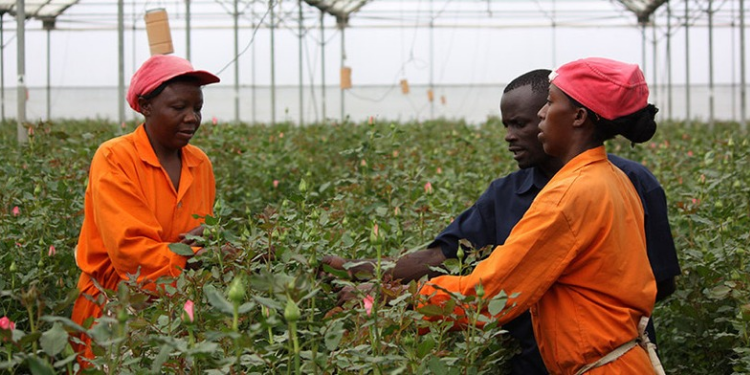
Farmers tending to flowering plants in a greenhouse. PHOTO/KFC