
East Africa Growth Race: Uganda Tops 2026 IMF Economic Outlook
Share

Uganda and Rwanda are expected to lead economic growth in the East African Community (EAC) in 2026, according to the latest forecast from the International Monetary Fund (IMF).
The forecast places Uganda at the top with an estimated 7.5% growth rate, followed closely by Rwanda at 7.2% highlighting the region’s continued resilience despite growing global economic uncertainty.
Other EAC member states are projected to record moderate to strong growth, although regional momentum is expected to slow slightly compared to 2025 due to external shocks, including rising global commodity prices and geopolitical tensions.
EAC 2026 Growth Forecast Rankings
Based on IMF projections, the expected economic growth rates among key East African economies in 2026 are:
Uganda – 7.5%
Rwanda – 7.2%
Tanzania -5.9%
Democratic Republic of the Congo -5.9%
Kenya -4.5%
South Sudan – 4.1%
Burundi – 3.8%
The projections reflect continued expansion across the East African region, supported by infrastructure investment, trade growth, and domestic reforms.
IMF Praises Africa’s Strong Recovery in 2025
Speaking on the region’s economic outlook, Abebe Aemro Selassie, Director of the African Department at the IMF, said Sub-Saharan Africa recorded one of its strongest growth performances in years during 2025.
“In 2025, economic activity accelerated across nearly all country groups, with regional growth reaching 4.5 %, the fastest pace in over a decade,” Selassie said.
He credited the improvement to sound policy decisions taken across many countries.
“Countries such as Ethiopia and Nigeria reaped the benefits of macroeconomic reforms, exchange rate realignments, subsidy reductions, and strengthened monetary policy frameworks,” he added.
According to Selassie, the reforms produced measurable gains, including improved fiscal balances and reduced inflation levels across the region.
Also Read:IMF and World Bank Act as Global Energy Prices Surge Amid Middle East Conflict
Inflation Fell as Fiscal Positions Improved
The IMF noted that stabilization policies adopted across Africa led to falling inflation and improved fiscal health.
“Inflation fell to a median of 3.4% at the end of 2025, down from 4.8% the year before,” Selassie stated.
He further noted that fiscal deficits narrowed, public debt levels declined, and current account balances improved in several countries.
“In short, 2025 was a year of hard-won stabilization gains, and policymakers across the region deserve credit for achieving them,” he said.
These gains created a strong foundation for growth entering 2026, although new risks have since emerged.
Middle East Conflict Poses Fresh Economic Risks
Despite the strong recovery recorded in 2025, the IMF warns that 2026 could present new challenges due to geopolitical instability, particularly conflict in the Middle East.
Selassie noted that the war has created fresh economic pressures for African economies.
“The war in the Middle East is a major new external shock. Oil, gas, and fertilizer prices have surged. Shipping costs have risen, and trade with Gulf partners has been disrupted,” he explained.
He added that tourism and remittance inflows are also expected to decline, placing additional pressure on regional economies.
As a result, the IMF has revised its regional growth outlook downward.
“We have accordingly revised our growth forecast downward to 4.3% in 2026, some 0.3% points below our pre-war projection,” Selassie said.
Uneven Impact Expected Across Countries
According to the IMF, the economic shock will affect countries differently depending on their energy and resource profiles.
Oil-exporting nations may benefit from increased revenues, while oil-importing economies-many of which are in East Africa-face rising costs and worsening trade balances.
Selassie warned that the effects could be significant for vulnerable economies.
“Oil importers, particularly non-resource-rich and fragile states, face deteriorating trade balances, rising living costs, and limited buffers,” he said.
He also cautioned that declining international aid is compounding economic pressures across the continent.
“What we are seeing now appears more structural, and it is falling hardest on the region’s most vulnerable countries, fragile states, and low-income economies,” he added.
Kenya Maintains Steady Growth but Trails Regional Leaders
Within the EAC, Kenya is projected to record 4.5% growth in 2026, placing it fifth among its regional peers.
While Kenya’s growth rate appears lower compared to Uganda and Rwanda, economists note that larger economies often experience steadier, more moderate growth due to their diversified sectors and mature markets.
Kenya’s economy is expected to remain supported by agriculture, financial services, and infrastructure investments, even as global economic pressures intensify.
Also Read:KRA Sends WhatsApp Tax Alerts to Selected Kenyans With a Deadline
Structural Reforms Key to Future Growth
Looking ahead, the IMF emphasized the need for continued reforms to sustain economic growth across the region.
Selassie urged governments to maintain fiscal discipline while protecting vulnerable populations.
“Countries must keep inflation expectations anchored and protect the most vulnerable through targeted, time-bound support,” he said.
He also stressed the importance of long-term structural transformation.
“Accelerating structural reforms is essential to unlock private-sector-led growth,” Selassie noted, pointing to governance reforms, improved business environments, and stronger financial markets as key priorities.
Regional Integration and Technology Seen as Growth Drivers
The IMF highlighted regional cooperation as another critical factor in strengthening economic resilience.
Selassie pointed to the role of the African Continental Free Trade Area (AfCFTA) in boosting trade and reducing economic vulnerability.
He also emphasized the importance of technology adoption, particularly artificial intelligence, in improving productivity across sectors.
“Productivity growth is the long-term prize. The responsible adoption of AI in agriculture, health, and public services can be transformative,” he said.
However, he warned that technological advancement requires investments in infrastructure, including reliable electricity and digital systems.
IMF Urges Countries to Defend Recent Gains
Despite ongoing challenges, the IMF expressed confidence in Africa’s ability to withstand economic shocks, noting that the region has demonstrated resilience in recent years.
Selassie concluded by urging policymakers to safeguard the progress made in 2025.
“The gains of 2025 are definitely worth defending. The policy choices that are being made now will determine the extent to which these gains are preserved,” he said.
He also reaffirmed the IMF’s commitment to supporting African nations.
“As always, the IMF stands ready to support countries with financing, policy advice, and capacity development,” Selassie added.
Follow our WhatsApp channel for instant news updates
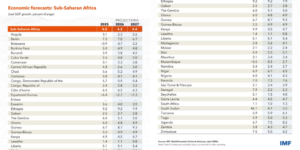
EAC 2026 Economic Growth Forecast
PHOTO/IMF