Ruto Breaks Silence on Alleged Fallout With IMFvc
Share
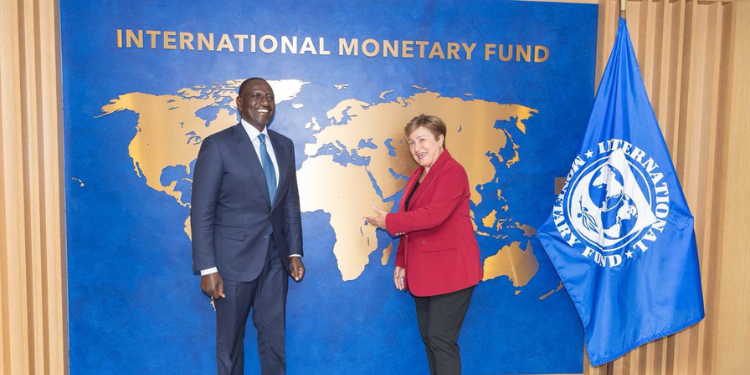
President William Ruto has denied claims of a falling out between the government of Kenya and the International Monetary Fund (IMF) regarding financial support.
While speaking on March 10, Ruto stated that there was no falling out between Kenya and the IMF, but instead, there was an agreement on the handling of financial support.
According to Ruto, the government of Kenya will borrow money from the IMF only if need be, but will instead use its own resources to undertake other projects.
The president argued that continued borrowing is unsustainable and that the government is now prioritizing alternative financing mechanisms.
“We have also decided that we are going to be innovative. We are going to be creative in how we do public assets. It is no longer tenable for us to continue borrowing. That is why we have said we are not taking any borrowing resources unless it is absolutely necessary,” Ruto said while responding to claims of tensions between Kenya and the IMF.
The president further rejected reports suggesting that Kenya’s new financial approach has strained its relationship with the international lender, maintaining that cooperation remains intact.
“I see some people say there has been a disagreement between Kenya and the IMF. There is no disagreement. We have just agreed on what to do. We have agreed that if we need your money, we will come for it. If we don’t need it, we will do with the resources we have. I mean, how does that amount to a disagreement? Are we together? Yes. I mean, is it wrong to be able to stand on your own and do your own stuff? Is that a weakness or a strength?” he posed.
Shift Toward Alternative Financing
Ruto explained that the government has adopted alternative instruments to finance development projects, including securitization and asset-backed funding models.
According to him, these mechanisms have already begun to support infrastructure projects across the country.
“To me, so what have we done? We have decided to have alternative instruments of financing our development. We went the route of securitization. Many people told us, oh you are going to do this because of securitization. Members of parliament when I negotiated with you and I told you guys forgo these seven shillings, it will help us raise money. We raised Ksh 175 billion,” he said.
The president noted that the funds enabled the government to resume stalled infrastructure projects, particularly in road construction.
“We returned all the contractors to our roads. We paid them. Today, we have 6,000 kilometers of road going on in Kenya. We have 90% of our contractors back on site. And new roads are now being contracted because we decided not to continuously depend on the budget,” he added.
Also Read: “People Are Mad”: Ruto Responds to Claims of Ksh 50 Billion Loss at SHA
Talanta Stadium and Sports Fund Reforms
Ruto also defended the government’s decision to use the national sports fund to finance the construction of the Talanta Stadium, saying the fund had historically been underutilized.
“We are doing the same with Talanta. Look, when I say innovative, I was explaining today in the morning how did we decide to finance Talanta. The sports fund has been a fund that has been there forever. That sports fund has not achieved much,” he said.
He criticized previous management of the fund, saying resources were often spent on small projects with minimal impact.
“You find a few small projects there. Most of the money is lost. Another project there. Some capo in some place. Some gate in some place. We decided that instead of spending this money with no accountability, let us consolidate it and do a big project,” Ruto stated.
He defended the decision to commit long-term funding from the sports fund toward the project.
“Today, somebody was saying William Ruto has pledged for 15 years money from the sports fund. Yes, we have done it. But at least we have Talanta stadium complete standing here. Tell me, sports fund has been there for 20 years. Which other project has it done? Can you show me one project?” he asked.
Tourism Levy and Bomas Redevelopment
The president also revealed that the redevelopment of Bomas of Kenya is being financed through the tourism levy rather than borrowing or direct parliamentary budget allocations.
“We are building Bomas of Kenya using the tourism levy. Tourism levy has never done anything for this country for the last 30 years. Nothing. Today, that money is building Bomas. That is how thinking out of the box looks like,” Ruto said.
According to the president, the government’s strategy is designed to avoid further debt accumulation.
“If we had gone to borrow money to build all this, we would be in trouble. So we have decided to think outside the box,” he added.
Also Read: Safaricom’s Ziidi Fund Wins Global Fintech Award at Mobile World Congress 2026
Privatization and Infrastructure Fund Strategy
Ruto also addressed criticism over the government’s decision to sell a stake in Kenya Pipeline Company through an initial public offering at the Nairobi Securities Exchange.
“When we discussed about selling a stake in Kenya Pipeline, many people say you want to sell the family jewelry. But we have done privatization before. We privatized Kenya Airways, we privatized KCB, we privatized Safaricom. But today we cannot account for the proceeds of that privatization,” he said.
Ruto insisted that the current privatization efforts are structured differently, with proceeds being directed to the National Infrastructure Fund to support major development projects.
“This morning I rang the bell at Nairobi Securities Exchange and we collected Ksh 106 billion from the sale of our stake in Kenya Pipeline IPO. And we are going to put that money in the National Infrastructure Fund,” he said.
He explained that the fund will enable the government to leverage the capital to finance large-scale projects.
“The National Infrastructure Fund gives us a different leverage. It multiplies that Ksh 106 billion ten times, not through magic, no, through innovation, creativity and financing,” Ruto stated.
The president concluded by saying the funds will support projects such as energy expansion, dam construction and improvements at Jomo Kenyatta International Airport.
“That is how we are going to have additional resources to do our roads, generate more energy and build infrastructure. We have already landed a contract for Jomo Kenyatta. About Ksh 15 billion is going to go there, and that Ksh 15 billion is going to enable us to raise 150 billion,” he said.
Follow our WhatsApp channel for instant news updates
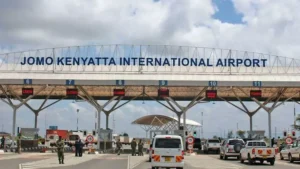
A photo of JKIA entrance. PHOTO/Courtesy.