
Kalonzo Raises Alarm Over Treasury Plan to Control County Funds as Constitution Turns 16
Share

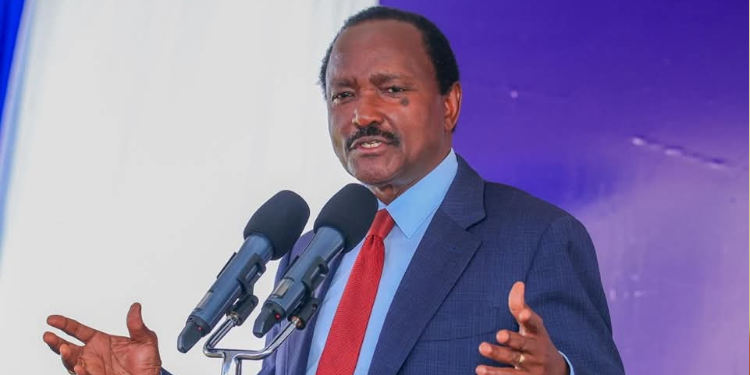
Wiper Party leader Stephen Kalonzo Musyoka has warned against a National Treasury proposal to bring all 47 counties into a single national account controlled from Nairobi, arguing that the plan could undermine devolution.
Musyoka issued the warning on Thursday, August 27, 2026, as Kenya marked 16 years since the promulgation of the Constitution of Kenya, 2010.
He also renewed his call for the equitable share allocated to counties to rise from 15 percent to 35 percent.
Kalonzo criticised Kenya’s record in implementing the Constitution, saying the country has failed to match the document’s provisions with its actions.
“We have a first-class Constitution and second-class compliance. The document itself is not our problem. Our problem is the distance between the text we celebrate every August and the conduct we tolerate for the other eleven months,” he said.
Kalonzo Warns Over Delayed County Funds
On devolution, Kalonzo said counties routinely wait four or five months for funds that Article 219 requires the national government to transfer without undue delay and without deduction.
As a result, he said, county governments borrow from commercial banks at interest while waiting for money that is already due to them.
Citing figures from the Controller of Budget’s reports as at December 2025, Musyoka said counties owed Ksh 163.74 billion in pending bills, up from Ksh 128.94 billion four years earlier.
He added that Nairobi County alone owed suppliers Ksh 81.79 billion, while public hospitals in the counties were waiting for Ksh 26.87 billion in Social Health Authority claims.
Against this backdrop, Musyoka questioned whether Treasury should take greater control of county finances.
He said a Treasury that has failed for four years to release the 15 percent equitable share on schedule cannot be trusted to hold a county’s entire revenue and determine, week by week, what a governor may spend.
Instead, Kalonzo pointed to Article 225, which provides a lawful route to stop funds where there is a serious breach, subject to Parliament’s approval and a public reason.
Meanwhile, he restated the Wiper Patriotic Front’s position that the equitable share under Article 203 should rise from 15 percent to 35 percent.
Also Read: How One of the Architects of Kenya’s New Constitution Was Assassinated
Kalonzo also committed that, under his administration, the county disbursement schedule would be gazetted and published monthly.
He said interest on late transfers would accrue against the national government rather than the county.
In addition, he pledged that no function would be transferred to counties without the funding needed to support it.
However, Musyoka also turned his attention to county leadership, telling governors that Nairobi is not their only problem.
He said governors must maintain clean audit trails, describing accountability as the price of holding public office rather than a courtesy to their counties.
Questions Over 2027 Election
Turning to elections, Musyoka linked the Constitution directly to the collapse of the 2007 tally, which resulted in the deaths of more than 1,100 Kenyans and the displacement of more than 600,000 people.
Also Read: Kalonzo Says He Has No Problem Handing Over Power After One Term
He said his questions about the Independent Electoral and Boundaries Commission (IEBC) are a matter of national security rather than positioning for the 2027 General Election.
Specifically, Musyoka questioned whether the voter register is open to audit, whether election technology is being procured transparently and can be tested before polling day, and whether the boundaries review remains within constitutional timelines.
He warned that electoral failures could trigger consequences far beyond the legal system.
“A stolen or mismanaged election does not remain a legal problem,” he said. “It becomes a security problem, then a humanitarian one, and then a scar that outlives the people who caused it. We must not be taken there again,” he said.
Finally, Musyoka ruled out supporting any constitutional amendment that shrinks devolution, weakens the independent commissions, tames the Judiciary, adjusts term limits or engineers offices to settle elite bargains.
He said Articles 255 to 257 place the power to amend the Constitution with the people rather than the powerful.
Follow our WhatsApp channel for instant news updates.
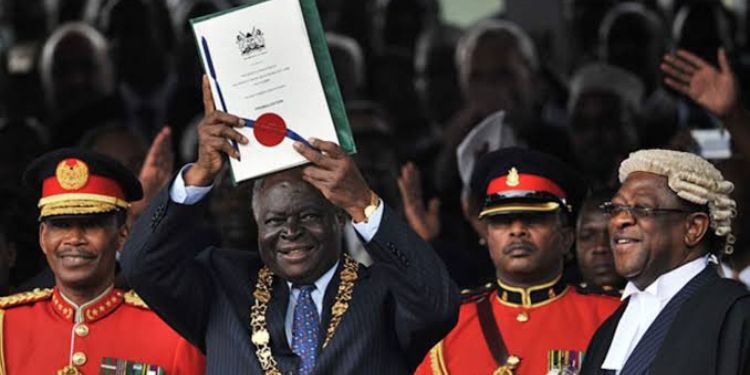
Photo of The Late President Mwai Kibaki lifting a copy of Kenya’s new constitution at Uhuru Park in Nairobi on August 27, 2010. PHOTO/ NATION.