
Yemen: Houthi Group Expands Amid Security and Political Shifts
Share

Several years ago, the United Nations brokered a truce between the Yemeni government and Ansar Allah, commonly known as the Houthis, which came into effect on April 2, 2022.
The agreement provided for a halt to offensive military operations by land, sea and air inside Yemen and across its borders. It also allowed fuel and petroleum-product vessels to enter the ports of Hodeidah.
Despite the truce, however, Yemen continued to experience security developments in several areas, alongside political and military shifts in the south that ultimately strengthened Saudi Arabia’s influence over the Yemeni government’s decision-making.
In the second half of this year, the truce effectively faded amid renewed exchanges of military strikes between the Houthis and Saudi Arabia.
On Tuesday, the Houthis attacked four cities in southern Saudi Arabia, a US ally, injuring more than 70 people and triggering fires at oil facilities. The attacks appeared to represent a significant expansion of the conflict, which has continued to reverberate across the Middle East for six months.
According to Reuters, the Houthis, who control most of Yemen’s densely populated areas, including the capital, said they had launched a large-scale operation deep inside Saudi territory.
The group said it used drones and missiles to target a Saudi air base in the southern city of Khamis Mushait, facilities belonging to Saudi state-owned oil company Aramco near Abha, the border city of Najran, and Jazan, a major coastal city overlooking the Red Sea that hosts a refinery and power plant.
Reuters reported on Friday that satellite images showed smoke rising on Thursday near the Saudi East-West oil pipeline. Saudi Arabia did not confirm an incident in the area, while neither the Kingdom’s General Authority for Media Regulation nor Aramco had responded to requests for comment on the smoke visible in images whose authenticity Reuters verified.
The Fall of Bab al-Mandab
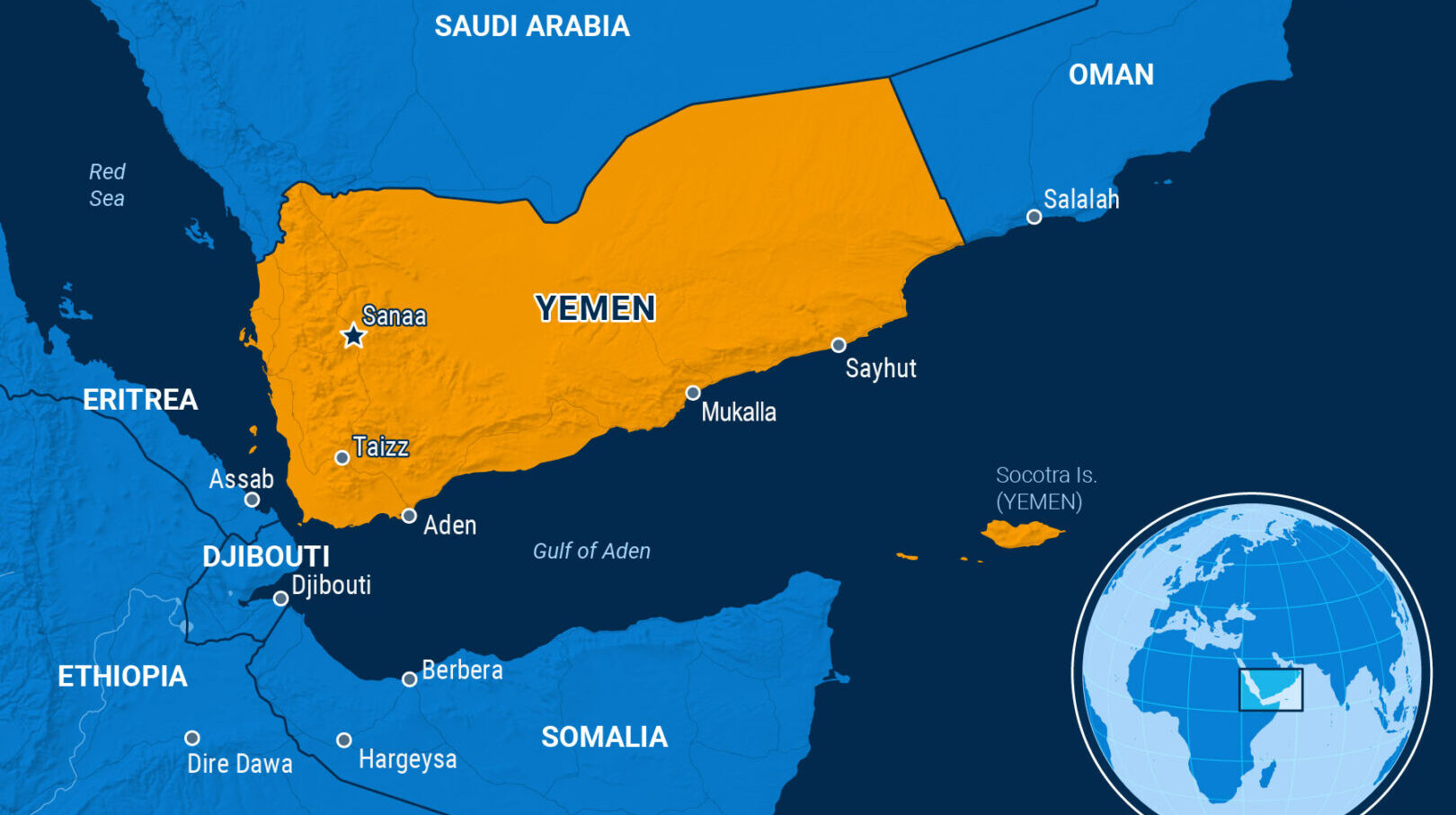
In another significant development, the Houthis seized a strategically located coastal town and an island in Yemen’s Bab al-Mandab Strait, while a Yemeni government source told Agence France-Presse that the Iran-backed group had taken full control of the country’s western coast.
An official told Reuters and Agence France-Presse that boats carrying armed Houthi fighters reached Perim, also known as Mayyun Island, which divides the strait into two shipping lanes, after government forces withdrew from the island on Thursday.
Also Read: Saudi Arabia Brings European, African, and South American Mercenaries to Guri Jebel
The official, speaking on condition of anonymity, said: “The Houthis have completed their control of the Bab al-Mandab area and Mayyun Island, located in the middle of the strait.”
The reported takeover of the area could have major implications for maritime security, given Bab al-Mandab’s importance as a strategic gateway linking the Red Sea with the Gulf of Aden and the wider Indian Ocean.
Meanwhile, Axios reported, citing US officials, that Saudi Crown Prince Mohammed bin Salman held two telephone calls with US President Donald Trump on Thursday and urged him to launch strikes against the Houthis.
Trump rejected the request, according to the report, while US officials said the administration does not currently intend to take direct military action against the Houthis.
Axios reported that US concerns were growing over the rapidly escalating conflict in Yemen, with Washington seeking to strengthen its support for Saudi Arabia while avoiding direct military involvement.
The publication added that US military and civilian officials had told their Saudi counterparts in recent weeks that Trump’s directives called for US forces to concentrate on Iran and securing the Strait of Hormuz, while avoiding the opening of another military front.
The developments have also raised questions over Saudi Arabia’s security commitments with its regional partners.
On August 7, Saudi Arabia signed the Mecca Mutual Defense Agreement with Pakistan and Turkey, based on the principle that an attack on any one of the three countries constitutes an attack on all three.
When Pakistani Foreign Ministry spokesman Sajjad Haider Khan was specifically asked about whether Pakistan would mount a military response under the agreement to Houthi attacks, he said: “There is nothing of the sort under discussion now… When the time comes, we will act in accordance with the agreement.”
A Security Dilemma
Yemeni researcher Yaqoub al-Sufyani argued that many of the major battlefield gains made against the Houthis had been linked to the presence of effective local forces on the ground.
He said the UAE had played a direct and pivotal role in establishing, supporting and backing such forces, both in southern Yemen and along the western coast.
According to al-Sufyani, Riyadh allowed “hardline ideological Yemeni forces, including currents linked to political Islam and the Muslim Brotherhood and hostile to the Southern Transitional Council, to gradually shift the Saudi compass from confrontation with the Houthis toward confrontation with its allies and partners in the anti-Houthi camp.”
Also read: City Lawyer Arrested Over Alleged Forged Signatures, Accused of Biting Police Officers
He continued: “The UAE went from being the most important military partner on the ground to an adversary in the calculations of some Yemeni forces, and the Southern Transitional Council and southern forces that had fought the Houthis came to be presented to Riyadh as the threat that needed to be contained.”
He argued that Saudi Arabia consequently lost “a regional ally with direct experience on the Yemeni battlefield, as well as local forces that had demonstrated their ability to fight on the ground.”
Political analyst Abdul Qader Abu al-Laym similarly argued that the UAE had been a key force behind military gains against the Houthis.
“There is no escaping the recognition that the UAE was the most sincere, the most organized, and the most experienced, and that it was behind the liberation of the western coast and all the southern provinces through its support, arming, and training of the Giants Brigades and the southern armed forces, which fought the fiercest battles and achieved the greatest victories,” he said.
Failure to Manage the Yemen File
Yemeni media figure Nora al-Jarwi argued that the latest developments demonstrated the growing influence of Iran and the failure of Saudi Arabia’s approach to Yemen.
“With Iranian support, the Houthis are the ones who have taken control of Yemen’s western coast. They are nothing more than tools in Iran’s hands, whose influence now extends from the Strait of Hormuz to Bab al-Mandab, threatening Yemen, the region, and international maritime navigation,” she said in a post.
She added: “Saudi Arabia must acknowledge that its policy in Yemen has failed, and that this failure has caused humanitarian, political, and military disasters for which Yemenis have paid with their blood and their future.”
According to al-Jarwi, the political “legitimacy” established by Saudi Arabia and administered under its influence has also failed.
She argued that Riyadh should withdraw from Yemeni decision-making and allow Yemenis to determine their own political future by establishing an independent leadership and government focused on restoring the state.
Such a government, she said, should determine how to deal with the Houthis, whether through negotiations or military action—based on Yemen’s interests rather than those of Saudi Arabia or any other external power.
“Enough meddling in Yemen. Yemeni blood is not cheap, and Yemen’s sovereignty is not a bargaining chip. Saudi Arabia must end its tutelage and leave Yemen to the Yemenis,” she stressed.
Follow our WhatsApp channel for instant news updates
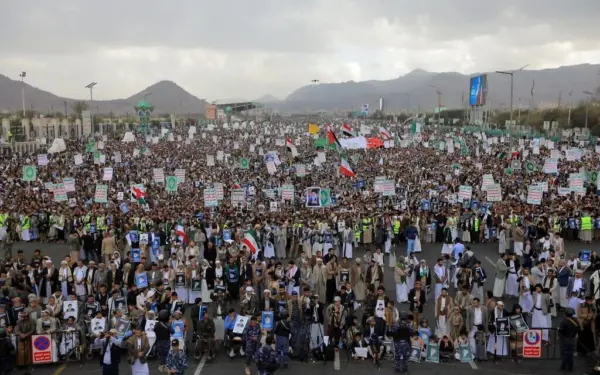
Houthis rally in solidarity with Iran and Lebanon, amid the US-Israeli conflict with Iran, in the Yemeni capital Sanaa on March 6, 2026. (Mohammed HUWAIS / AFP)