Boost for Kenya’s Health Sector as South Korea Pledges Billions for Maternal Care and Vaccines
Share
Kenya has intensified its strategic cooperation on matters of health with South Korea after high-level talks designed to expedite investments in maternal healthcare, vaccines, and improved resilience in the country’s health system.
The engagement signals a deepening of bilateral ties as Nairobi seeks to leverage international partnerships to address persistent gaps in healthcare delivery.
During a diplomatic meeting, Aden Duale confirmed that discussions with Seoul’s envoy focused on priority areas aligned with Kenya’s long-term health agenda.
“On a courtesy visit, I hosted the Ambassador of the Republic of Korea to Kenya, H.E Kang Hyung-Shik, for discussions on strengthening bilateral cooperation in the health sector, with a particular focus on maternal and child health, an enduring national priority,” he said.
Key in the discussions was South Korea’s commitment to investing in maternal and child health in Kenya through various funding agencies and research institutions within the country.
Multi-Million Investments in Maternal Health
Central to the discussions is a Ksh 2.1 billion (USD 14 million) project scheduled for implementation between 2025 and 2030 to establish a Level 5 Specialized Medical Centre in Kitengela, Kajiado County.
According to Duale, the initiative will be instrumental in addressing critical maternal and neonatal health challenges.
“We reviewed the Korea International Cooperation Agency’s (KOICA) support, including the USD 14 million project (2025–2030) to establish a Level 5 Specialized Medical Centre in Kitengela, Kajiado County, aimed at reducing maternal and neonatal mortality,” he stated, adding that the programme builds on “ongoing efforts in community empowerment, health worker training and mobile health services.”
In addition, Kenya is benefiting from a Ksh 907 million (USD 6.05 million) Health System Strengthening Project running from 2021 to 2026.
The initiative is designed to expand access to quality care by reinforcing community health systems and improving emergency response mechanisms.
“We also noted the USD 6.05 million Health System Strengthening Project (2021–2026), which is enhancing access to quality care through strengthened community health systems and emergency response services,” Duale said.
Also Read:Digital Health Agency Announces 70 Jobs – How to Apply
Vaccine Development and Technology Transfer
Beyond infrastructure and service delivery, the partnership is expanding into pharmaceutical innovation and vaccine production.
Kenya is collaborating with SK Bioscience and the International Vaccine Institute to advance research, manufacturing capacity, and technology transfer.
“Moreover, we welcomed continued collaboration with institutions such as SK Bioscience on vaccine manufacturing and technology transfer and the International Vaccine Institute (IVI) on research and development,” Duale noted.
The cooperation extends to academic and research institutions, including Inha University Hospital and Korea Advanced Institute of Science and Technology (KAIST), which are supporting Kenya in emergency training, biomedical research, and innovation.
“We also acknowledged the contributions of KOICA, Inha University Hospital and the Korea Advanced Institute of Science and Technology (KAIST) in emergency training, research and biomedical innovation,” he added.
Also Read:How to Easily Add Your Spouse to SHA Health Coverage Online
Supporting Universal Health Coverage Goals
The strengthened partnership is expected to reinforce Kenya’s push toward Universal Health Coverage and the rollout of the Social Health Authority.
Duale says the collaboration aligns with a people-centred primary healthcare model designed to ensure equitable access to services.
“These partnerships support Kenya’s health agenda, including the attainment of Universal Health Coverage (UHC) through a people-centred primary healthcare approach and the operationalization of the Social Health Authority (SHA) for sustainable health financing,” Duale stated.
He further outlined Kenya’s strategic priorities, including strengthening local pharmaceutical manufacturing through the Kenya BioVax Institute, expanding digital health systems, and enhancing workforce capacity.
“We further highlighted priorities in strengthening local pharmaceutical manufacturing through the Kenya BioVax Institute, advancing digital health, building a resilient health workforce and enhancing pandemic preparedness and surveillance,” he said.
As Kenya positions itself as a regional health hub, officials underscore the importance of sustained global partnerships in delivering long-term impact.
“Kenya remains committed to mutually beneficial, sustainable partnerships that advance health outcomes and global health security,” Duale concluded.
Follow our WhatsApp channel for instant news updates
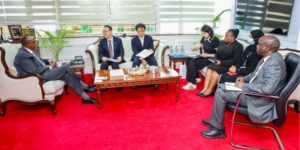
Health CS Aden Duale chairing a meeting at his office together with Ambassador of the Republic of Korea to Kenya, H.E Kang Hyung-Shik and some of the members of the health docket. PHOTO/ Duale X
You Might also Like