Government Responds to Reports of Street Families’ Burial at Lang’ata Cemetery
Share

There have been allegations brought forward regarding the bodies taken from the Nairobi Funeral Home and later buried in Lang’ata Cemetery being from street families, and this has caused a public outcry and renewed concern surrounding the ability of state protection mechanisms to protect vulnerable populations.
As a result, Kenya’s government has launched an investigation into these assertions.
In a statement issued on Monday, Labour and Social Protection Cabinet Secretary Hanna Wendot said her office had taken note of the matter “with the seriousness it deserves,” signalling the government’s intention to establish facts around the controversial burials.
“In response to the reports of bodies that were retrieved from Nairobi Funeral Home and interred at Lang’ata Cemetery alleged to be street families, I wish to inform the public that my office has taken note of the matter with the seriousness it deserves,” Wendot said.
She disclosed that immediate consultations had already been convened to address the issue, underscoring inter-agency coordination in the response.
Investigations Launched Into Deaths
“In this regard, this morning, I held a consultative meeting with officers from the Street Families Rehabilitation Trust Fund (SFRTF) and concerned government agencies,” the Cabinet Secretary stated, adding that investigations are ongoing to establish critical details surrounding the deaths.
According to Wendot, authorities are seeking to determine “the identity, age, gender, cause of death and any other relevant details that will provide clarity on the circumstances surrounding the reported deaths.”
She emphasized that no conclusions would be drawn before the investigative process is complete.
The government also used the meeting to assess broader policy implementation related to street families across the country.
Also Read:Autopsy Reveals Cause of Death of Nairobi Street Families
Review of Street Families Rehabilitation Policy
“The meeting also reviewed the implementation of the National Street Families Rehabilitation Policy,” Wendot said, noting that County Street Families Rehabilitation Chapters have been “established and operationalised in thirty-eight (38) counties.”
She explained that these county chapters are designed to play “a critical role in coordinating rehabilitation interventions and ensuring that services are effectively decentralised and brought closer to the communities in need.”
The policy framework aims to move rehabilitation efforts away from ad hoc responses toward structured, community-based support systems.
The revelations, however, have intensified public debate on whether existing policies are adequately protecting street-connected individuals, especially in urban centres like Nairobi.
How did the Families die? Background Info
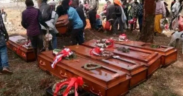
The controversy started when it was reported that a number of the bodies that were moved from the Nairobi Funeral Home and buried at Lang’ata Cemetery were the bodies of homeless people who died in unknown circumstances.
Post-Mortem Results from similar incidents of homeless people in Nairobi have shown that people have generally died of things such as pneumonia or of exposure to bad weather, usually during the cold and wet months.
The conditions homeless people face puts them at an increased risk of illness.
They tend to live in inadequate housing, don’t have access to the medical system, are usually malnourished and are exposed to the elements.
The civil society have been advocating for better living conditions for homeless populations for a long time.
All these factors can lead to the deaths of homeless people in situations that could have been preventable.
Also Read:Kenya Railways Sends Message to Nairobi Residents Amid Matatu Strike
Public and Civil Society Reaction
The Undugu Society of Kenya (USK), one of the country’s longest-serving organisations supporting street-connected children and families, faulted the state’s response, saying recent government measures fail to address the root causes of the deaths.
“These deaths expose the harsh realities of street life and the failure of state agencies to protect the most vulnerable,” said Eric Mukoya, Executive Director of Undugu Society of Kenya.
“Waiving hospital bills, mortuary fees or burial costs is insufficient; it does not address the underlying causes of exclusion, poverty and harassment faced daily by street-connected children and youth,” he added.
The organisation called for transparent investigations, accountability across government agencies, and long-term, rights-based interventions rather than emergency responses after deaths occur.
Undugu further stressed that justice for street families, “cannot be substituted with charity,” urging authorities to prioritise legal identity documentation, access to healthcare, and protection from abuse.
Follow our WhatsApp channel for instant news updates

Caskets Bearing the Remains of 10 Street Children Who Died Under Misterious Circumstances. PHOTO/ File