

KICD Pledges to Complete Resource Centre to Boost CBC Rollout
Share
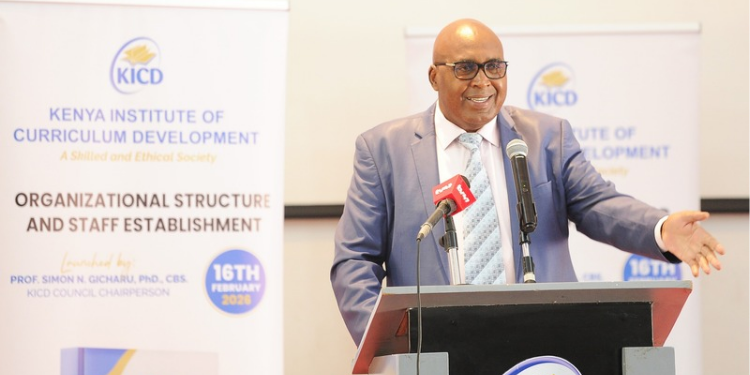
The Kenya Institute of Curriculum Development (KICD) has renewed its commitment to finalise its long-delayed Educational Resource Centre (ERC), positioning the facility as a strategic anchor for the full implementation of the Competency-Based Education(CBE).
The institute says the centre will provide expanded technical space for curriculum experts and researchers to design, pilot and refine teaching approaches aligned to emerging disciplines under CBE, including aviation and marine sciences.
Speaking on Tuesday, February 17, during the unveiling of new human resource management instruments, KICD Council Chairperson Prof Simon Gicharu underscored his determination to see the project concluded before the end of his tenure.
“Before my term as Chairman of KICD Council ends, I want to see the ERC completed. We have done what was needed of us as Council, and now I look forward to having the centre operational. I do not want to leave the project that has taken 15 years incomplete. I am not known to start a project and stop without seeing it through to completion,” he said.
Delayed Project Back on Track
Construction of the ERC at KICD’s headquarters along Murang’a Road began in 2011 and was initially scheduled for completion within four years.
However, persistent funding constraints stalled progress for over a decade.
Last year, the institute announced it would inject Ksh 400 million to accelerate the first phase of the six-phase development plan.
Works have gained momentum and the first sections of the building will soon be ready for use.
According to Prof Gicharu, operationalising the centre will significantly expand KICD’s institutional capacity to support CBE delivery nationwide.
He noted that the additional space will enable structured experimentation and modelling of new instructional methodologies required for specialised learning areas.
He dismissed concerns that subjects such as aviation and marine sciences are too complex for mainstream schools, arguing that digital tools have lowered entry barriers.
“Simulation, even in our phones, can be able to help learners understand how planes operate… I want to see the simulation being applied in our ERC centre so that we can be able to live during our times,” he said.
Drawing from a recent council visit to Mount Kenya University, Malindi Maritime Academy, Prof Gicharu said exposure to maritime simulators demonstrated how technology can substitute expensive physical equipment.
“During these digital times, we don’t need to really carry decommissioned planes and ships to be able to teach aviation and marine sciences,” he said.
KICD Chief Executive Officer Prof Charles Ong’ondo confirmed that the initial floors of the building would soon be functional.
“A lot of work is going on at the ERC. We shall make sure that the first three floors are functional. This Council will go down in history as the Council that ensures a building that had stalled for over 20 years is active and performing the role that it was meant to do,” he said.
Also Read: KLB Clarifies Withdrawal of Curriculum Textbooks by KICD
New HR Instruments to Tighten Standards
The ERC update came alongside the launch of three governance and human resource instruments: Career Guidelines, a Human Resource Policies and Procedures Manual, and a revised Organisational Structure and Staff Establishment framework.
Prof Gicharu described the reforms as a structural shift aimed at aligning KICD’s workforce with the demands of national education reforms.
“The review of the Instruments took cognisance of the prevailing situation at the Institute. For instance, the review addressed the issue of stagnation. The career ladder for a number of careers has been opened up,” he said.
“For instance, diploma holders will now have a chance of going all through from the entry point at KICD Grade nine KICD Grade 5, which is a Principal officer level. Previously, Diploma holders had only one move under the Common Establishment framework. This is a game changer,” Gicharu said.
Also Read: KICD Approved Textbooks for ICT, Media and Power Mechanics for CBE
He added: “The Council will continuously use the Instruments to enhance the Human Resource capacity of the Institute. Indeed, over the last year, several staff serving under Common Establishment have been promoted, while others have also been promoted to higher grades through competitive interviews.”
Prof Ong’ondo termed the framework progressive and confirmed that it had received approval from the Public Service Commission.
“These instruments will give us the direction to take the institute in line with our strategic plan,” he said, adding that the policies clarify entry requirements, job grading and promotion pathways while strengthening equity in recruitment.
“I sit on other boards, and I can assure you that this is one of the most prospective HR instruments in the history of parastatals in this country,” he said.
Follow our WhatsApp channel for instant news updates

KICD structure image. PHOTO/pixels