

Shame as Nairobi Apartment Lists Tenants With Rent Arrears on Public Notice Board
Share

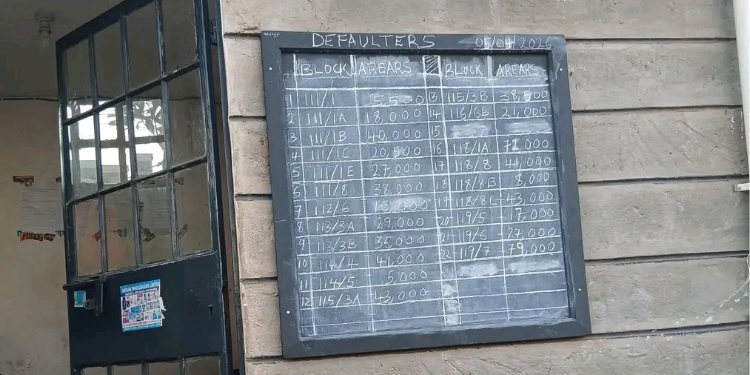
An image captured at the entrance of Crescent Court Apartments in Nairobi West is creating a debate on tenants’ rights, landlord actions, and the issues around rent arrears in the Kenyan urban housing market.
It portrays a blackboard hung on one of the walls at the entrance adjacent to an open door that is easily seen by all visitors coming in or out of the property.
At the top of the board, the words “DEFAULTERS” are boldly written, below which are apartment numbers with corresponding amounts of rent arrears that each occupant owes.
The defaulters’ notice is dated April 2026 and has several apartment numbers with varying amounts of unpaid rents worth hundreds of shillings.
Since the notice board is situated in a public place, any defaulter of rent is easily seen by everyone visiting or living in the apartments.
As outlined in the statement that follows, the rent arrears issue appears to be the most challenging problem facing Kenya’s rental industry, considering that both the tenant and landlord face significant challenges, with the former having problems meeting rent while the latter faces loss of income due to rent arrears.
It should be noted at this point that in Kenya’s laws regarding rental agreements, steps need to be taken in case of rent arrears, and both the tenant and landlord have been considered during the establishment of such laws.
The main challenge faced here is that in most cases, neither of them understands these laws fully.
Public Shame vs Proper Legal Process
The act performed at Crescent Court Apartments, whereby the landlord displays tenants with outstanding balances, is one that exists in the gray zone and can be considered illegal in Kenya.
Although it is legal for landlords to reclaim their money from tenants, it is not within the confines of the law to conduct yourself in a manner that will infringe on the tenant’s rights.
The law clearly states how a landlord should proceed upon finding his or her tenants behind on payments.
This includes making demands for payment, providing notice of termination, or applying through a court or tribunal.
Public shame is nowhere mentioned as an acceptable procedure.
Rent Arrears in Kenya
Rent arrears occur when the tenant is unable to pay rent on time.
This is generally considered a default of the rental agreement terms and conditions since the tenant should have made the payment before the deadline.
For instance, if a tenant does not make payments for two consecutive months, it is considered a breach of the rental contract.
However, there is a significant difference between the two situations.
In case a tenant delays one month’s rent payment, the landlord can forgive the delay.
If the tenant delays paying rent for several months, then the landlord has grounds to pursue legal remedies.
Also Read: Why Nairobi Landlords Are Being Arrested
Available Legal Actions Against Arrears for Tenants
In cases of rent arrears, landlords may choose to pursue legal actions against the tenant.
These include giving a formal written warning, proceeding with distress for rent via the services of certified auctioneers pursuant to the Distress for Rent Act (Cap 293), and seeking a possession order from an arbitrator or the court.
However, all these processes come with very strict guidelines, for example, distress for rent has to be undertaken using certified auctioneers and following the inventory procedure.
The failure to adhere to such guidelines makes the entire process illegal and the person conducting such an action faces criminal charges.
It is important to mention that landlords cannot take any self-help measures on their own.
It includes acts like changing the locks or removing tenants without obtaining a court order.
Tenant Defences
There exist several ways through which a tenant can defend themselves from a claim that they owe their landlord.
One way is by disputing any false claim, particularly if they had paid but the payment was never received.
The evidence here could be proof in the form of bank slips, M-Pesa confirmation slips, and so forth.
Also Read: Populism Without Production: Why Ruto’s Gimmicks Can’t Build an Economy
In addition, tenants can cite defences on the basis that the landlord has not fulfilled their own obligations towards their tenant, for example, providing a comfortable environment to live in.
Under some circumstances, courts will give time to the tenants to sort out their arrears, particularly when this is due to temporary hardship and the tenant comes up with a repayment schedule.
Negotiation: An Effective Approach
In most cases, negotiation is always the best approach.
Tenants are able to repay the arrears slowly while still paying the ongoing rent.
This saves the landlord from undergoing legal processes and having an empty house.
An effective repayment strategy involves recognizing the debt, establishing a monthly payment, and having a repayment period set.
Follow our WhatsApp channel for instant news updates

Photo of Royal Apartments in Nyali. PHOTO/Royal Apartments