Ivory Towers on Credit: How Kenya’s Public Universities Drifted into Insolvency
Share

By Dr. Luchetu Likaka
Kenya’s public universities are no longer in a financial squeeze; they are in a state of quiet insolvency.
For years, the signs were visible but conveniently ignored, ballooning pending bills, delayed salaries, stalled projects, and recurring audit red flags.
Today, the façade of institutional stability remains, but beneath it lies a system that is structurally unable to meet its obligations without external rescue.
This is not a temporary downturn.
It is the cumulative result of policy choices, governance failures, and a deeply flawed funding model.
The most authoritative lens into this crisis is the Auditor-General’s reports, which paint a consistent and troubling picture.
A significant number of public universities are operating with negative working capital,meaning their short-term liabilities exceed their short-term assets.
In plain terms, they cannot pay their bills when they fall due.
Liquidity Crisis Across Institutions
Institutions such as the University of Nairobi, Kenyatta University, and Egerton University have all been flagged for serious liquidity challenges.
In some cases, audit reports explicitly state that these universities can only continue operating through government support or the goodwill of creditors.
That is not resilience; it is dependency.
The scale of indebtedness is staggering.
The University of Nairobi, long regarded as the country’s premier institution, carries billions in debt alongside persistent cash flow problems.
Kenyatta University follows closely, weighed down by obligations that far exceed its internally generated revenue.
Perhaps most alarming is Egerton University, whose pending bills have climbed to levels that dwarf its annual operating capacity.
Similar patterns are evident in Moi University, Jomo Kenyatta University of Agriculture and Technology, and the Technical University of Kenya.
This is not a crisis of a few mismanaged institutions; it is a sector-wide collapse in financial viability.
Expansion Without Sustainable Financing
At the heart of this insolvency is a fundamental contradiction in Kenya’s higher education policy.
Over the past two decades, access to university education expanded dramatically.
New campuses were opened, student enrolment surged, and institutions diversified their programmes.
But this expansion was not matched by sustainable financing.
Government capitation, the backbone of public university funding has consistently fallen short of actual costs.
In many cases, disbursements have been delayed or only partially honoured, leaving universities to operate on financial deficits that compound over time.
The state, in effect, mandated expansion without funding it.
To bridge this gap, universities turned to parallel or self-sponsored programmes, effectively commercializing access to education.
For a time, this model generated significant revenue and masked deeper structural weaknesses.
But as market saturation set in and regulatory scrutiny increased, this income stream declined.
What remained was a cost structure built for expansion but a revenue base that could no longer sustain it.
The result is the classic anatomy of insolvency: shrinking income, rising obligations, and growing reliance on debt.
Also Read:Imperial Bank Places Nafas World Auto Under Receivership
Unsustainable Wage Bills
Compounding this is the issue of wage bills.
Auditor-General reports repeatedly highlight that personnel costs consume an unsustainable share of university budgets, often exceeding two-thirds of total expenditure.
Universities became politically convenient spaces for employment expansion, absorbing staff beyond what their finances could support.
Once entrenched, these wage commitments proved nearly impossible to reverse, locking institutions into rigid expenditure patterns even as revenues declined.
In effect, universities are spending tomorrow’s income to pay yesterday’s employment decisions.
Equally damaging has been the erosion of financial governance.
Audit findings across multiple institutions reveal unsupported expenditures, weak internal controls, and unreliable financial records.
This is not merely poor bookkeeping; it is a breakdown in institutional discipline.
Without credible financial data, planning becomes guesswork, leakages go unchecked, and accountability is diluted.
In such an environment, debt does not just accumulate, it accelerates.
The Burden of Pending Bills
The rise of pending bills illustrates the depth of the problem.
These are not strategic investments or long-term capital projects; they are unpaid obligations for routine operations-suppliers, statutory deductions, utilities, and basic services.
When an institution consistently fails to meet these obligations, it signals a shift from financial stress to operational insolvency.
Universities are effectively borrowing from suppliers, tax authorities, and staff to sustain daily functions.
It is a model that can only hold for so long before creditors push back.
Yet, despite this bleak picture, the system has not collapsed.
Universities remain open, students continue to graduate, and academic calendars, though strained, persist.
But this apparent stability is misleading.
It is sustained through deferred payments, emergency government interventions, and the silent tolerance of creditors.
In reality, the sector is surviving on borrowed time, postponing failure rather than resolving it.
The consequences are already visible.
Academic quality is under pressure as institutions cut costs and defer investments in infrastructure and research.
Staff morale is eroding under the weight of delayed salaries and uncertain futures.
Development projects remain incomplete, turning campuses into landscapes of stalled ambition.
More critically, the system is ill-prepared for future demands, including the financial and infrastructural pressures that will accompany the full implementation of the Competency-Based Curriculum at university level.
Also Read:Court Petition Filed to Wind Up SACCO Giant Over Ksh 12.5B Deficit
The Path Forward
What emerges, ultimately, is a stark conclusion: Kenya’s public universities are insolvent not because they failed to grow, but because they grew without discipline, without alignment between policy and financing, and without the governance structures necessary to sustain that growth.
Insolvency, in this context, is not an event,it is a condition that has been gradually normalized.
The path forward will not be easy.
It will require difficult decisions—restructuring institutions, rationalizing programmes, enforcing financial accountability, and rethinking the funding model.
But the alternative is far worse: a slow, unmanaged decline in which institutions continue to exist in name, but without the financial or academic substance that once defined them.
Kenya’s universities were built as engines of knowledge and opportunity.
Today, they stand as a cautionary tale of what happens when ambition outruns capacity.
The question is no longer whether reform is necessary.
It is whether the country has the resolve to confront the scale of the problem before the system reaches a point of no return.
Follow our WhatsApp channel for instant news updates

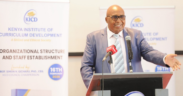
Dr. Luchetu Likaka PhD is a Distinguished Consultant Criminologist and Sociologist, Boasting over 15 years of Experience in the Field. PHOTO/ Luchetu Likaka