

Finance Bill 2026 : Full Breakdown of New Tax Proposals and Exemptions
Share

The Finance Bill, 2026 introduces changes to Kenya’s tax laws.
The National Assembly says the aim is to raise revenue, improve compliance, close tax loopholes, and modernise the tax system.
The government says the money collected will help fund roads, healthcare, education, water, security, and public services.
1. Pension Benefits for Dependants Will Not Be Taxed
The Bill proposes that pension money paid to dependants of a deceased person will not be taxed.
This means spouses, children, and dependants will receive full pension benefits without deductions.
“Beneficiaries will receive the full amount without tax deductions.”
2. Encouraging Investment in Real Estate (REITs)
The Bill removes Capital Gains Tax when property is transferred into Real Estate Investment Trusts (REITs).
REITs allow people to invest in property like malls, apartments, and commercial buildings together.
The government says this will attract more investors into real estate.
3. Mobile Phone Tax to Be Paid on Activation
The Bill changes how excise duty on mobile phones is collected.
Instead of paying tax at import or factory level, tax will be charged when a phone is activated on a mobile network.
The government says this will simplify tax collection and reduce abuse in import valuation.
4. Finance Bill Explained: Higher Dividend Tax for East African Investors
The Bill removes the reduced 5% tax rate for East African investors.
All non-resident investors will now pay a 15% withholding tax on dividends from Kenyan companies.
5. Betting Winnings Will Be Taxed at 20%
The Bill introduces a 20% tax on betting, gaming, and lottery winnings.
A further 5% excise duty will still apply on deposits into betting accounts.
“The aim is to protect the public and raise revenue from the betting sector,”the notice read.
6. Tax on Mining and Petroleum Profits Sent Abroad
Foreign mining and oil companies will pay a 15% tax when sending profits out of Kenya.
This applies when money is repatriated to parent companies overseas.
7. Merchant and Software Fees Classified as Royalties
The Bill treats fees paid to payment networks like Visa and Mastercard as taxable service fees.
It also classifies software licensing payments as royalties for withholding tax purposes.
8. Lower Tax for Petroleum Contractors
Corporate tax for non-resident petroleum contractors drops from 37.5% to 30%.
The government says this will attract more investment in the oil and gas sector.
9. VAT Changes on Hire Purchase Sales
Only businesses licensed under the Hire Purchase Act will qualify to separate financing charges from VAT.
This closes loopholes where some businesses reduced VAT unfairly.
10. All Suppliers Must Issue Invoices
All businesses supplying goods and services must issue invoices.
This rule aims to improve transparency and make tax collection easier.
Also Read: Finance Bill 2026: Relief as Death Benefits Remain Tax-Free
11. VAT on Digital Financial Services
The Bill introduces VAT on digital financial services, such as:
- Payment gateways
- Mobile payment systems
- Digital financial platforms
- Merchant services
12. VAT Rules for Tour Operators
Only licensed tour operators will qualify for VAT exemptions.
The Bill also defines what counts as “in-house supplies” in tourism.
13. Duty-Free Limit Increased for Travellers
Returning passengers can now bring goods worth up to USD 2,000 without paying VAT.
This is a major increase from the previous USD 300 limit.
“The change reflects inflation and higher global prices.”
14. VAT Exemptions on Key Goods
The Bill removes VAT on selected goods, including:
- Medical equipment like dialyzers
- Electric motorcycles and bicycles
- Solar and lithium batteries
- Scrap metal
- Bioethanol stoves
- Sugarcane transport
- Electric buses
- Telecom equipment
- PPP infrastructure projects
The aim is to reduce costs and support clean energy and infrastructure growth.
Also Read: Will Finance Bill 2026 Make Bottled Water Expensive? Mbadi Clarifies
15. Tax Amnesty for Old Debts
The government will waive penalties and interest on tax debts up to December 31 2025.
Taxpayers must pay the main tax or agree on a payment plan with KRA.
16. Stronger KRA Recovery Powers
The Kenya Revenue Authority will have stronger powers to recover unpaid taxes.
It can demand payment directly from banks, employers, or business partners of tax defaulters.
17. VAT Exemption for PPP Projects
Public-Private Partnership (PPP) infrastructure projects will not pay VAT on goods and services used directly in them.
This supports major projects like roads, energy, airports, and water systems.
18. Fake News and Clarifications
The National Assembly has warned the public about fake versions of the Bill circulating online.
It clarifies that:
- There is no tax on freehold land
- No conversion of land ownership rules
- No tax on M-Pesa transactions
- No new tax on digital content or marketplaces
- No increase in resident rental income tax
Follow our WhatsApp channel for instant news updates
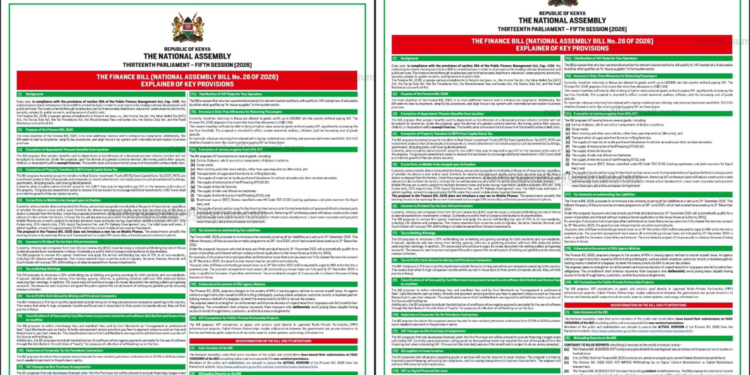
Key Provisions on the 2026 Finance Bill Explained
PHOTO/Nation