
Ruto Issues 9-Point Directive After Cutting Consolidated Cargo Benchmark to Ksh2 Million
Share

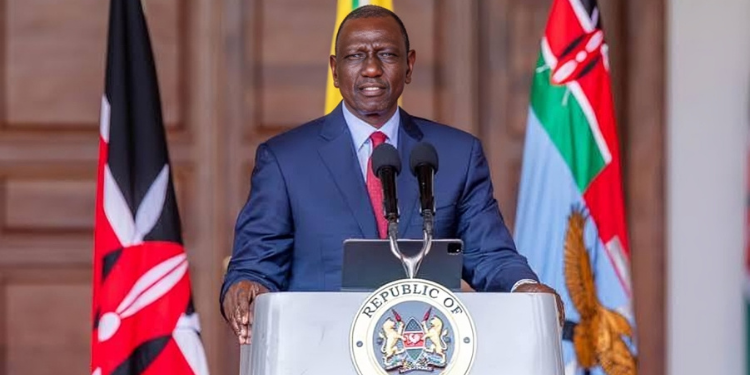
President William Ruto has announced measures to ease the cost of doing business for traders after the government agreed to reduce the benchmark for general consolidated cargo from Ksh3.2 million to Ksh2 million.
According to a statement dated September 2, the agreement follows consultations among the President, traders, and stakeholders in the consolidated cargo sector regarding concerns about taxation, cargo clearance, and the handling of imported goods.
“The President’s intervention follows recent disagreements between traders and the Kenya Revenue Authority (KRA) over the applicable benchmark for consolidated cargo, which had raised concerns among traders about the rising cost of doinamong the President, traders, and stakeholders in the consolidated cargo sector regarding concerns about taxation, cargo clearance, and the g business and its impact on thousands of small and medium-sized enterprises,” read part of the statement.
Ruto Unveils 9 Measures to Lower Costs for Kenyan Traders
Under the new agreement, the Kenya Revenue Authority (KRA) will reduce the applicable benchmark for general consolidated cargo from Ksh 2.5 million to Ksh 2 million.
However, existing rates for ready-made garments, footwear and fabrics will remain unchanged, as well as the newly negotiated rates for air cargo.
Ruto said the Advance Cargo Declaration requirement will also be removed as part of efforts to streamline the clearance process and facilitate legitimate trade.
Additionally, KRA will develop and publish an exclusion list identifying goods that will not qualify for clearance under the general consolidated cargo system to give traders greater certainty over which goods can be cleared through the consolidated cargo framework.
Also Read: Ruto Issues Fresh Directive on KRA Import Benchmark After Protests
The government stated that all cargo consolidators will undergo fresh vetting and registration by KRA under the agreement, with the registration deadline set for October 15, 2026.
They will also be required to provide a comprehensive list of individual traders and importers whose goods they handle.
Government to Reserve Selected Jobs and Retail Trade for Kenyans
Furthermore, Ruto said the government will facilitate the establishment and operation of designated de-consolidation centres in Nairobi and Mombasa.
According to the President, the centres are expected to allow consolidated shipments to be separated efficiently for individual traders while improving cargo handling and clearance.
Additionally, the initiative will reduce unnecessary logistical and administrative costs faced by importers.
The government further stated that Kenya Railways will reduce the charge for transporting cargo from the Inland Container Depot (ICD) to the Bomaline De-consolidation Centre from Ksh58,000 to Ksh10,000 with immediate effect.
This reduction is aimed at easing logistics costs for traders using the designated route.
Ruto also noted that his government will expand existing legislation to reserve retail trade and specified lower-level jobs for Kenyan citizens.
At the same time, foreign investment will continue to be encouraged in areas where it brings capital, technology, value addition and quality employment opportunities.
The directive seeks to balance protection of local businesses and employment opportunities with the need to attract productive foreign investment.
Also Read: Sets Record Straight on Ksh 3.2M Cargo Rule as Traders Plan Nationwide Protests
New Committee to Track Progress on Trader Reforms
He highlighted that the National Government will work with county governments to create a more conducive environment for traders.
The Government plans to leverage the County Aggregation and Industrial Parks (CAIPs) programme while protecting legitimate businesses from what it described as unnecessary harassment, intimidation and disruption.
This is intended to improve the operating environment for traders and strengthen support for small and medium-sized enterprises across the country.
As part of the directives to improve trading in the country, the government said it will establish a multi-stakeholder committee, chaired by the Cabinet Secretary for Investments, Trade and Industry, to oversee implementation of the agreement.
The committee will bring together KRA, relevant Government agencies, traders, consolidators and other key stakeholders.
It will address emerging issues and monitor implementation, with quarterly progress reports submitted to President Ruto.
Follow our WhatsApp channel for instant news updates.

Traders protest KRA’s new KSh3.2 million cargo benchmark near the Nairobi National Archives on Friday, August 28, 2026.PHOTO/ Courtesy.