
Inside Bill Seeking to Give IEBC Greater Control Over Election Technology
Share

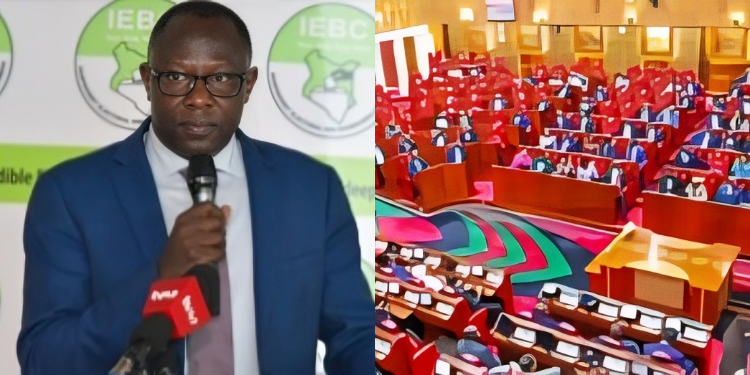
The National Assembly has approved at Second Reading a Bill that proposes changes to how Kenya’s election technology is owned, accessed and scrutinized, including provisions that would give the Independent Electoral and Boundaries Commission (IEBC) ownership of intellectual property rights in election technology.
The Elections (Amendment) (No. 2) Bill, 2024, Senate Bill No. 29 of 2024, formed part of electoral reforms arising from recommendations of the National Dialogue Committee (NADCO).
Parliament debated the Bill at Second Reading on October 6, 2026, before approving it at that stage.
The proposed amendments seek to align the Elections Act with the Constitution, the Political Parties Act and various court decisions.
They also address the management of election technology, transmission and declaration of results, as well as access to election information.
Moving the Bill, George Murugara said the amendments would clarify the respective roles of political parties and the IEBC, particularly in relation to party nominations and the registration of candidates.
IEBC to Own Election Technology
Under Clause 23, the Bill proposes amendments to Section 44 of the Elections Act covering the use of technology during elections.
The provision would require the IEBC to secure intellectual property rights over technology it procures for elections.
“In procuring the election technology, the commission shall ensure that intellectual property rights to the technology vest in the commission,” reads the Bill.
Beyond ownership, the proposed changes would also place requirements on companies supplying election technology.
A supplier would have to meet specified legal, professional and procurement requirements before providing technology to the commission.
The Bill further proposes that election servers be hosted in Kenya.
It would also require the systems to remain accessible for scrutiny by candidates, courts and other persons authorized under the law.
Also Read: Inside New Bill Set to Change How Kenyans Share Financial Data
Candidates and Courts to Scrutinize Technology
For election technology, the proposed law sets out a specific requirement for access to systems used in elections.
“The commission shall ensure that the technology is accessible and available for scrutiny by candidates, courts and such other persons as required under the law,” reads the Bill.
In addition, the proposed amendments would require the IEBC to establish a mechanism for the live-streaming of results as announced at polling stations to facilitate public information.
Access to Election Information
Meanwhile, the Bill proposes measures to give authorized persons access to information relating to election technology without a charge where the commission provides the information in soft copy.
“The Commission shall ensure access to information including any technology used in elections and shall not charge fees where the information requested is provided in soft copy,” the proposed legislation states.
For scrutiny involving votes, the Bill also sets specific timelines for the commission to facilitate access to the requested information.
“Where an access request is made pursuant to scrutiny of votes, the commission shall facilitate access in the case of a presidential election, within three days of the date of the request and in the case of any other elective position, within seven days of the date of the request,” reads the Bill.
Also Read: Inside Big Kenyan Projects Whose Costs, Promises and Status Remain Unclear Years Later
The proposed access provisions would operate subject to the Constitution, the Access to Information Act, the Elections Act, the Data Protection Act and the IEBC Act.
Requests for information in hard copy could attract fees prescribed under the law.
Separately, National Assembly Speaker Moses Wetang’ula had directed the Joint Committee on Legal Affairs and Justice to fast-track consideration of electoral reform proposals.
“The committee is expected to review the proposals and recommend to the House any appropriate amendments for inclusion in the electoral amendment Bill that forms part of the priority business for this part of the session,” Wetang’ula said.
The Bill now proceeds through the remaining parliamentary stages before it can become law. It would also require presidential assent before taking effect.
Follow our WhatsApp channel for instant news updates

A photo of the Independent Electoral and Boundaries Commission (IEBC) Chairperson Erastus Edung Ethekon (center) briefs the media on April 30, 2026, on the completion of the Enhanced Continuous Voter Registration (ECVR) with fellow IEBC Commissioners. PHOTO/ KNA