Ruto’s Affordable Housing Plan Faces Funding Challenges as 176 Projects Stall
Share
President William Ruto’s Affordable Housing Programme faces a Ksh 118.3 billion funding shortfall in the 2026/27 financial year, with 176 projects stalled as of the end of June 2026, as the government implements a housing portfolio estimated to cost about Ksh 1.8 trillion.
The Parliamentary Budget Office (PBO), in its 2026 Budget Watch report, said the State Department for Housing and Urban Development requires Ksh 228.3 billion to finance ongoing projects during the 2026/27 financial year.
However, the approved 2026/27 budget allocated Ksh 110 billion to the department, leaving a Ksh 118.3 billion funding gap that could affect implementation of the Affordable Housing Programme.
According to the PBO, the government is implementing 1,186 projects across four portfolios with a combined estimated cost of about Ksh 1.8 trillion.
Affordable Housing Projects Spread Across Four Key Portfolios
The first portfolio contains 227 affordable housing projects estimated to cost Ksh 825 billion, while the government has assigned 329 institutional and student housing projects an estimated cost of Ksh 634 billion.
Another 216 projects cover social housing and slum upgrading, with an estimated cost of Ksh 228 billion. The programme also includes 414 social and physical infrastructure projects valued at Ksh 71 billion.
Since the government launched the four portfolios in 2023, it has set 2032 as the target year for completing the projects.
By the end of June 2026, the government had spent Ksh 198 billion on development against a total project cost of about Ksh 1.758 trillion.
“When compared to the total project cost, the overall actual expenditure as at the end of FY 2025-26 is 11 percent,” the PBO said.
That expenditure left approximately Ksh 1.56 trillion of the estimated project cost yet to be financed.
Also Read: Ruto Announces Construction of New City
176 Affordable Housing Projects Have Stalled
Funding constraints have slowed implementation across the four housing portfolios, with 176 projects making no progress for more than 12 months as of the end of June 2026.
By the close of the 2025/26 financial year, 1,010 projects remained ongoing while 176 had stalled.
The stalled portfolio included 16 affordable housing projects, 91 institutional and student housing projects, 22 social housing and slum upgrading projects, and 47 social and physical infrastructure projects.
Under the PBO’s definition, a stalled project has stopped progressing for more than 12 months because of funding shortages, contractor abandonment or bureaucratic delays.
Institutional and student housing recorded the largest share of stalled projects, with 91 of its 329 projects affected.
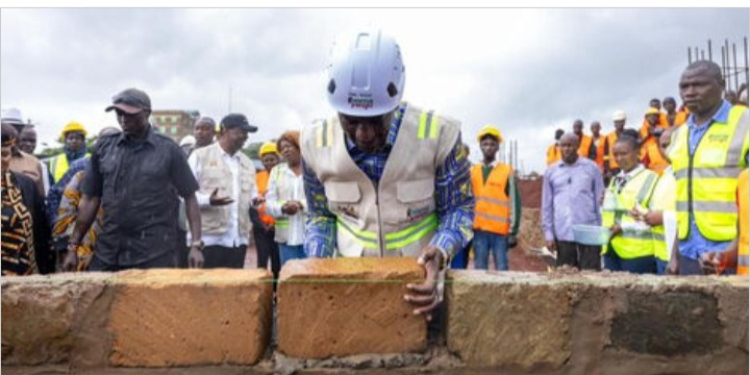
President William Ruto laying the foundation stone of the Mbale County Strategic Market, March 19, 2026. PHOTO/ PCS.
Housing Levy Collections Reach Ksh 205.7 Billion
Meanwhile, the government collected Ksh 205.7 billion through the Affordable Housing Levy between the 2023/24 and 2025/26 financial years.
Collections stood at Ksh 53.4 billion in 2023/24 before rising to Ksh 73.2 billion in 2024/25. The amount increased further to Ksh 79.1 billion in 2025/26.
From the Ksh 202.8 billion spent through the National Housing Development Fund, the government directed Ksh 198 billion towards development and Ksh 4.8 billion to recurrent expenditure.
Development spending included Ksh 118 billion on affordable housing, Ksh 40 billion on social housing and slum upgrading, Ksh 18 billion on institutional and student housing, and Ksh 22 billion on social and physical infrastructure.
PBO Warns of Further Project Delays
The budget office warned that the financing shortfall could expose the programme to additional financial and operational challenges.
“This funding shortfall is likely to expose the AHP to more fiscal and operational challenges since it will be unable to support an uninterrupted implementation path across the entire portfolio. These challenges include stalling of projects due to lack of funding, project cost overruns due to penalties for delayed payments to contractors and escalation in construction input prices due to delayed construction periods,” the PBO said.
Additionally, the PBO identified a mismatch between the timing of levy collections and project payment obligations.
“This risk of stalling becomes particularly acute since the payment cycles for projects are not concurrent with the annual AHL collection cycle, thereby causing unexpected cash flow constraints,” the PBO said.
Also Read: Ruto Fires Back at Sifuna Over Promise to Give Police Affordable Houses
PBO Calls for Focus on Ongoing Projects
The budget office wants the government to shift its focus from expanding the housing project pipeline to completing projects already under implementation.
“The key policy requirement for FY 2026-27 would be a transition from pipeline expansion towards active portfolio management,” the PBO said.
Under the recommendation, the government should sequence projects according to contractual exposure, completion status, infrastructure readiness, expected social and economic returns and realistic prospects for uptake.
The PBO also recommended directing funding towards projects approaching completion so the government can turn them into occupiable and saleable homes and generate revenue for the National Housing Development Fund.
For projects still at preliminary stages, including contractor mobilisation, site handover and procurement finalisation, the government should establish adequate financing before proceeding.
Finally, the PBO recommended ring-fencing Housing Levy resources for projects already under contract and approaching practical completion.
Such an approach would help the government concentrate available resources on projects closer to completion while managing financial pressures across the wider housing portfolio.
Follow our WhatsApp channel for instant news updates

Affordable Housing project in Nairobi South
PHOTO/Boma Yangu