
Experts Raise Alarm Over Push to Grant EACC Prosecutorial Powers
Share
Kenya’s fight against corruption faces heightened scrutiny as calls grow to grant prosecutorial powers to the Ethics and Anti-Corruption Commission (EACC), with experts warning that such a move could weaken anti-corruption efforts.
This comes amid rising concern over graft, with a recent EACC report indicating that Kenya loses over Ksh 608 billion annually to corruption, equivalent to 7.8 percent of the country’s gross domestic product.
The legal fraternity regards this as a national disaster because corruption in Kenya has turned out to be an economic problem.
Corruption cases, according to players in the legal fraternity, should be taken very seriously because they are “draining the lifeblood” of the nation.
It should be noted that the size of the loss shows that there are very deep-rooted networks of corrupt individuals.
However, as Parliament considers changes that could expand EACC’s mandate, opposition has emerged from civil society and legal practitioners who question the commission’s capacity to take on prosecutorial duties.
A lobby group, Sheria Mtaani, has sharply criticized the proposal, stating that EACC has failed in its core mandate of investigating corruption cases effectively.
Sheria Mtaani maintains that granting the agency prosecutorial authority would erode the system of checks and balances enshrined in law.
“The current legal framework, which separates investigative and prosecutorial functions, is deliberately designed to safeguard public interest and ensure checks and balances,’’ the lobby group said.
Legal Concerns and Institutional Tensions
Sheria Mtaani has threatened to move to court to block any attempt by Parliament to strip the Office of the Director of Public Prosecutions (ODPP) of its constitutional mandate.
The group argues that Kenya’s pre-2010 experience demonstrated the risks of concentrating investigative and prosecutorial powers in a single institution.
“Courts have already pronounced themselves. The EACC should stick to its lane. Let them remain investigators, the way the DCI has remained as an investigator. DPP should handle their constitutional mandate of deciding whether to charge or not to charge,” the group added.
The Law Society of Kenya (LSK) has also weighed in, warning that the country is facing mounting institutional strain.
In its inaugural statement for the 2026–2028 term, LSK President Charles Kanjama described the situation as “acute constitutional stress,” cautioning that public confidence in governance and justice systems is steadily eroding.
Some lawyers have gone further, suggesting that certain legislators may be pushing for the changes for personal reasons, including avoiding scrutiny ahead of the 2027 general elections.
Also Read: Inside the Ksh2 Billion NYS Scandal as EACC Targets Senior Officials
Questions Over EACC’s Performance
Critics argue that EACC’s track record does not justify an expanded mandate.
Lawyer Brown Kimei pointed to weak investigations as a key problem undermining successful prosecutions.
“Weak investigations lead to weak cases. We have seen a trend where EACC arrests suspects, only for cameras. ODPP cannot be entirely blamed for incompetence by investigators,’’ he said.
Legal experts emphasize that investigators typically serve as witnesses in court, while prosecutors build and present cases.
Combining the two roles, they argue, would create a conflict where an officer could act as investigator, witness, and prosecutor simultaneously.
Former police spokesperson Charles Owino echoed these concerns, warning that expanding EACC’s powers could create a dangerous concentration of authority.
“You see, there’s nothing special about EACC. Because all those officers in EACC, I think I taught them at the DCI Academy. They are just police officers. It’s only that they now have a big name, EACC, and a mandate. But it’s the same. I don’t see the difference between them and officers in the crime branch in Kilimani Police Station here in Central,” Owino lamented.
“I don’t see any major difference. But it’s just a big name. But what I can say, equally, if you give EACC the mandate to prosecute directly without going through a certain institution to assess what they have done, it can also become a monster. It can also maliciously prosecute people. So, the reason why we have various arms of government is for the purposes of checks and balances. So, you cannot give EACC what you are trying to imagine,” the former vocal NPS spokesperson added.
“Let them go through ODPP. If you think ODPP is not efficient, then change ODPP,” Charles Owino stated.
Also Read:EACC Partners With Anne Waiguru and Kirinyaga County to Fight Corruption
Inconsistencies and Increasing Criticism
Nevertheless, EACC maintains that its record is favorable, citing the increased number of cases won by the agency, as well as increased asset recovery.
The agency reports that it filed 79 cases of asset recovery worth Ksh 4.8 billion, recovered Ksh 3.4 billion, and saved Ksh 16.5 billion from potential loss due to intelligence-based action.
There were also 54 cases that were completed, and convictions doubled from 12 to 33.
However, rights organizations claim that the progress made is minimal, especially considering that at least 25 high-profile cases of corruption have been shelved over the last three years because of insufficient evidence.
The figures illustrate that, in a total of 213 corruption cases pending in courts, only 54 have been resolved, with 33 convictions, 15 acquittals, and six withdrawn cases, mainly due to poor investigations. In addition, less than 10 percent of stolen money is recovered every year.
According to international reviews, the situation is also not promising.
The 2025 Corruption Perception Index places Kenya at number 130 out of 181 nations, scoring 30 out of 100, compared to the previous year’s score of 32.
The survey states that Kenya is one of the nations where corruption is still a major problem, lacking signs of improvement.
Rwanda and Tanzania are leading in East Africa.
Follow our WhatsApp channel for instant news updates
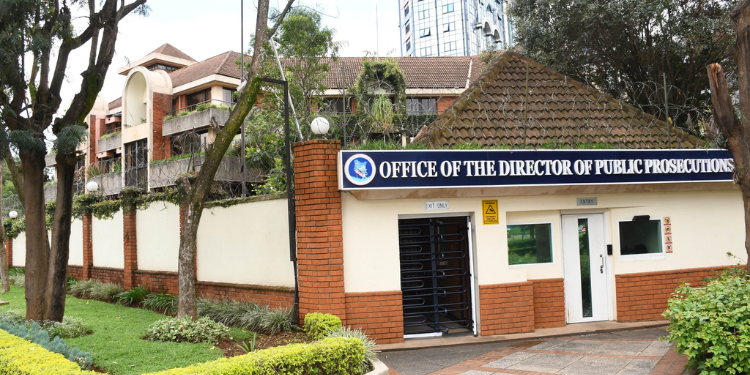
The Office of the Director of Public Prosecutions (ODPP) headquarters. PHOTO/ODPP.
You Might also Like