
Kenya’s Food Basket Under Threat as Drought and Floods Strike at Once
Share

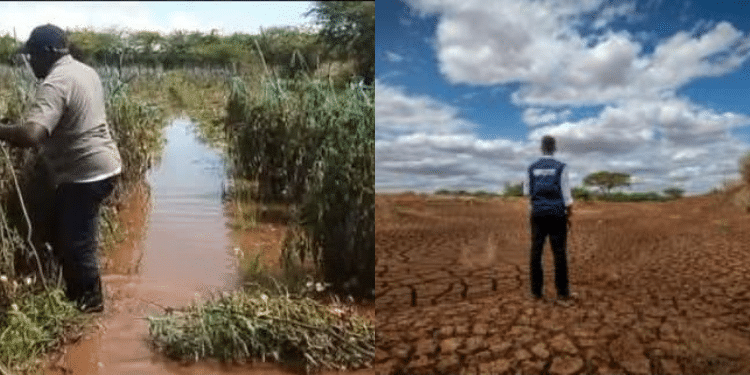
Kenya’s agricultural sector continues to face intensifying climate shocks. Droughts now shift into floods within the same seasons, while rainfall patterns grow more erratic.
These changes disrupt farming cycles and threaten food production and livelihoods across the country.
The Kenya Meteorological Department (KMD) and humanitarian agencies warn that Kenya now experiences a “drought–flood cycle,” where one extreme follows another with little time for recovery.
The Kenya Meteorological Department warns farmers to prepare for unpredictable planting conditions.
It highlights delayed rainfall onset, dry spells and sudden heavy downpours that can damage crops.
“The season is expected to be characterised by a normal to late onset, with intermittent dry spells, while occasional heavy rainfall events are likely to occur in several parts of the country,” KMD said.
KMD also warns that heavy rains continue to raise flood risks in several regions as soils remain saturated and river levels rise.
Floods and Drought Across Kenya
Kenya now faces two extremes at the same time. Floods continue to affect several parts of the country and these areas include:
- Nairobi
- Kiambu
- Murang’a
- Nakuru
- Kisumu
- Migori
- Bungoma
- Mombasa
- Kwale
- Tana River
At the same time, drought persists in other regions:
- Mandera
- Turkana
- Garissa
- Marsabit
- Wajir
Also Read: Kenya Met Issues Heavy Rainfall Forecast for Several Counties Over the Next 7 Days
Deepening Food Insecurity
Recent reporting shows the scale of the crisis. While floods damage farms in some regions, ASAL areas face severe water shortages.
Over 3.3 million people already face acute food insecurity, including 400,000 people in emergency conditions (IPC Phase 4) in counties such as Mandera, Turkana and Garissa.
Up to 90% of open water sources in parts of the Northeast have dried up, even as other regions struggle with flooding.
Looking ahead, the situation is expected to worsen.
The IPC projects that between April and June 2026, about 3.7 million people in ASAL counties may face IPC Phase 3 or worse, driven by below-average long rains and continued livelihood losses.
Humanitarian Pressure and Farming Losses
CARE Kenya warns that farmers now face repeated shocks that destroy both crops and recovery efforts.
It said that the situation continues to worsen as drought-affected households now face flooding.
“The situation is extremely worrying. Communities are being hit from both sides. First by years of drought, and now by destructive floods,” it stated.
CARE added that floods wipe out harvests, destroy livelihoods, and cut off access to markets.
“For people who were already struggling to grow enough food, watching their farms disappear underwater is heartbreaking. Their harvests are gone, their income has vanished, and the fear of how they will feed their children is growing by the day. With markets cut off, bridges washed away, and entire fields waterlogged, recovery will take months, perhaps longer, unless we act now to support them,” CARE Kenya said further.
Also Read: Kenya Shifts Drought Strategy as State and Counties Re-tool Agriculture Projects
What Farmers Can Do
Experts and agricultural advisory services continue to urge farmers to adjust farming practices as climate patterns shift.
KIPPRA research recommends stronger climate adaptation because rainfall patterns no longer remain reliable for planning.
It stresses that farmers must adjust quickly to survive recurring shocks.
Extension and climate advisories commonly recommend the following actions:
- Plant drought-tolerant and early-maturing crop varieties
- Diversify crops instead of relying on a single staple
- Follow Kenya Meteorological Department seasonal updates before planting
- Use water harvesting and small-scale irrigation where possible
- Avoid planting in flood-prone or waterlogged fields
- Adopt climate-smart agriculture practices to reduce risk exposure
Experts also stress timely action based on official forecasts rather than traditional planting calendars.
Kenya now faces a compounding climate crisis where drought and floods occur within the same season. Agriculture remains highly exposed because it depends on rainfall.
As extremes intensify, experts warn that farmers must adapt quickly while national systems strengthen resilience to protect food security and livelihoods.
Follow our WhatsApp channel for instant news updates
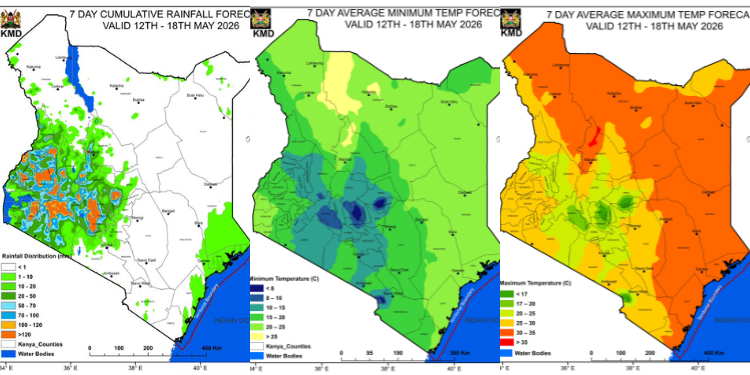
A photo collage showing the rainfall forecast and the maximum and minimum temperature forecasts for the period between May 12 and May 18 2026. PHOTO/Kenya Met