
The Hidden Reason Thousands of Women Entrepreneurs Are Choosing Pochi la Biashara
Share

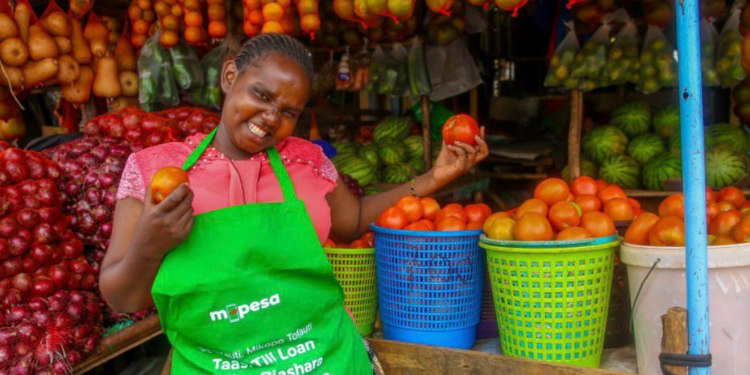
For years, personal M-Pesa wallets doubled as business tills. Today, an increasing number of women entrepreneurs are choosing to separate the two.
Safaricom markets Pochi la Biashara as a tool that helps customers keep personal and business finances apart. But according to the Global System for Mobile Communications Association (GSMA) report, there is a deeper reason behind its growing adoption among female micro-entrepreneurs.
For women running kiosks, salons, food stalls and mitumba businesses, the appeal goes beyond convenience. It comes down to trust.
The report found that women value four key benefits: protection from financial loss, greater privacy, improved record-keeping and stronger financial discipline.
Protection Against Costly Payment Reversals
For many small traders, profit margins are razor-thin. A single payment reversal can erase an entire day’s earnings.
Unlike ordinary M-Pesa transactions, where customers may request payment reversals after sending money, Pochi la Biashara provides an added layer of protection by separating business transactions from personal funds.
That distinction makes unauthorized reversals more difficult and gives business owners greater confidence that money received will remain available for business operations.
For entrepreneurs who restock daily, that security is critical. Knowing that sales revenue is protected allows them to plan purchases, manage inventory and operate with greater certainty.
Greater Privacy and Financial Control
Privacy also emerged as a major factor driving adoption.
For many women, transaction notifications viewed by family members or relatives can create pressure to spend business income on household needs before it is reinvested.
Pochi la Biashara keeps business transactions separate from personal M-Pesa activity, allowing entrepreneurs to decide when—and whether—to transfer profits into their personal accounts.
According to the report, this separation gives women greater control over their finances because business money remains dedicated to business until they choose otherwise.
Rather than simply protecting data, the product helps establish clear financial boundaries.
Better Records, Better Access to Credit
Many micro-enterprises operate without accounting software or formal bookkeeping systems. Daily sales are often tracked mentally, written in exercise books, or not recorded at all.
That becomes a challenge when business owners seek loans from banks, SACCOs, or other lenders, which typically require transaction histories and evidence of consistent turnover.
Pochi la Biashara automatically records every transaction, providing daily, weekly and monthly summaries that can serve as proof of business activity.
Those digital records make it easier for entrepreneurs to demonstrate cash flow and improve their chances of accessing financing.
Helping Business Owners Resist Everyday Spending
Another advantage highlighted in the report is the discipline created by separating business and personal money.
When household expenses and business income sit in the same wallet, small withdrawals—for transport, groceries, or emergencies- can gradually eat into working capital.
While each withdrawal may seem insignificant, the cumulative effect can leave traders without enough money to restock.
Pochi la Biashara introduces an extra step before business funds can be spent personally. Entrepreneurs must first transfer money from the business wallet into their personal M-Pesa account, creating both a practical and psychological barrier against impulse spending.
The report found that many women see this built-in separation as a form of financial discipline that helps preserve business capital.
For businesses operating without financial buffers, that discipline translates into confidence that tomorrow’s stock will not be sacrificed to meet today’s expenses.
Why Trust Matters More Than Convenience
Kenya’s fintech conversation often focuses on speed, convenience and cashless payments.
But the women featured in the report were already comfortable using digital payment platforms. They already relied on M-Pesa and Lipa na M-Pesa. Faster transactions were not the challenge.
Instead, they wanted solutions to everyday business risks: payment reversals, limited financial privacy, poor record-keeping and the temptation to spend business money on personal needs.
Rather than winning customers through speed, Pochi la Biashara appears to have gained traction by addressing those risks.
The strongest message was not simply “go digital.” It was that business money could be better protected.
A Product Designed Around Real Business Challenges
The report suggests that Pochi la Biashara resonates because it was designed around the realities facing women entrepreneurs rather than around technology alone.
Its key strengths include:
- Protection against unauthorized payment reversals.
- Greater privacy and control over business finances.
- Automatic transaction records that support access to credit.
- Built-in discipline that helps preserve working capital.
For Safaricom, Pochi la Biashara may be another digital payment solution. For thousands of women entrepreneurs, it represents something more valuable: peace of mind.
It offers confidence that today’s earnings will still be available to restock tomorrow, that business finances will remain separate from household demands, and that reliable records will be available whenever they are needed.
When profit margins are measured in a few shillings, trust can matter far more than convenience.
The report also found that 60.3% of women micro-entrepreneurs who adopted Pochi la Biashara said face-to-face engagement by Safaricom staff in marketplaces influenced their decision, while traditional advertising, including posters and mass media campaigns, had little impact.
Follow our WhatsApp channel for instant news updates
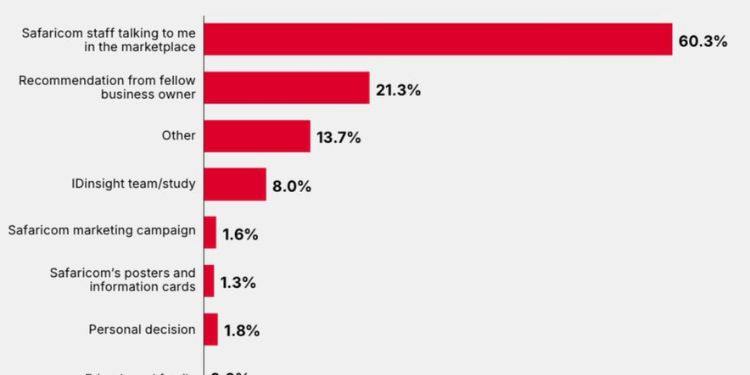
60.3% of women micro-entrepreneurs said Safaricom staff talking to them in the marketplace convinced them to use Pochi la Biashara, while mass ads and posters barely registered. Credits Safaricom