Court Rules Second Wife in Void Marriage Still Has Succession Rights
Share

The High Court has ruled that a woman who was married as a second wife, although her husband was still in a monogamous marriage, can still be recognised as a wife for purposes of inheritance.
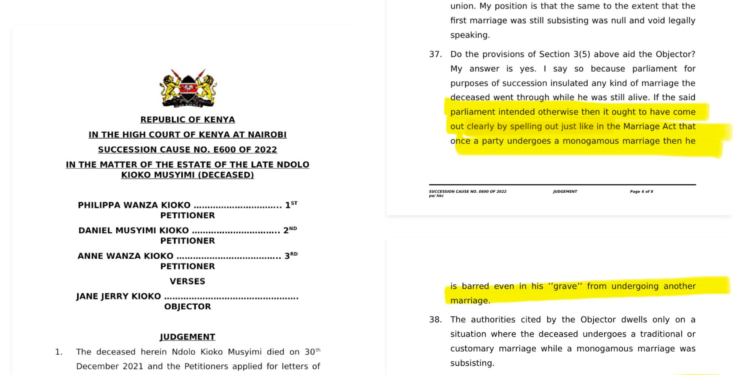
In a judgment delivered on July 2, 2026, Justice H.K. Chemitei held that Section 3(5) of the Law of Succession Act protects such spouses in succession matters, even where the marriage itself is void under the law.
The ruling was made in In re Estate of the Late Ndolo Kioko Musyimi (Deceased).
The succession case arose after the death of Ndolo Kioko Musyimi on December 30, 2021.
His children from the first marriage petitioned the court for letters of administration.
However, Jane Jerry Kioko objected, arguing that she was also the deceased’s wife and should be included in the administration of his estate.
Evidence presented in court showed that the deceased married his first wife under the African Christian Marriage Act in 1987. Although they later divorced, the divorce was only finalized in 2020.
Meanwhile, the deceased had undergone a customary marriage with Jane Jerry Kioko in Tanzania in March 2015 before later contracting a civil marriage with her in June 2015. The union produced two children.
Court Found the Second Wife Marriage was Legally Invalid
Justice Chemitei found that the second marriage was void because the deceased’s first monogamous marriage had not yet been dissolved.
“There is no doubt that the marriage between the Objector and the deceased was illegal by virtue of the fact that his marriage with DW1 was still subsisting. The same was monogamous and what the deceased did could easily pass as bigamy,” the judge stated.
However, the court also found that there was sufficient evidence showing that the deceased paid dowry, lived with the objector as husband and wife, publicly recognised her as his wife and had two children with her.
Also Read: Why This Employee Won His Case but Still Left Court Owing Millions
Section 3(5) Protects Spouses in Succession Cases
Justice Chemitei said Section 3(5) of the Law of Succession Act gives protection to spouses in such circumstances when it comes to inheritance.
The judge quoted the law, which states,”Notwithstanding the provisions of any other written law, a woman married under a system of law which permits polygamy is, where her husband has contracted a previous or subsequent monogamous marriage to another woman, nevertheless a wife for the purposes of this Act…”
According to the judge, Parliament deliberately ensured that succession rights would not be defeated simply because the marriage was legally invalid.
“My answer is yes. I say so because Parliament, for purposes of succession, insulated any kind of marriage the deceased went through while he was still alive,” Justice Chemitei said.
He further observed that although the marriage was null and void in law, that did not prevent the objector from qualifying as a wife under the Law of Succession Act.
Also Read: Meet the Kenyan Lawyer Who Took Jesus Christ’s Crucifixion Case to an International Court
Court Appoints Objector as Administrator
The court allowed the objection and declared Jane Jerry Kioko to be a wife of the deceased for succession purposes.
Justice Chemitei appointed her as one of the joint administrators of the estate alongside the existing administrators.
The judge noted that the main issue to be determined later would be how the estate should be distributed, especially because questions had been raised over whether some of the properties formed part of the first marriage’s matrimonial property.
He added that the objector, together with her two children, qualifies as beneficiaries under Sections 3(5) and 29 of the Law of Succession Act despite the legal invalidity of the marriage.
Follow our WhatsApp channel for instant news updates
Court Rules Second Wife in Void Marriage Still Has Succession Rights
PHOTO/Nelson Kiala