

Former District Commissioner Loses Big as Court Draws Red Line on Abuse of Power
Share


The Court of Appeal has maintained that public officers are not protected from personal liability when they abuse their offices and act maliciously against citizens.
In a landmark case arising from Nakuru, the court upheld a decision that held a former District Commissioner personally liable for malicious prosecution, raising important questions about the limits of State protection for public officials.
The appeal involved Joseph Motari Mosigisi, who served as the District Commissioner of Rongai District at the time of the events in question.
Six citizens sued him, arguing that he had acted maliciously and caused them harm through a prosecution that was not justified.
A lower court had awarded each of the six petitioners Ksh 800,000 in general damages and ordered that the money attract interest until payment in full.
The former District Commissioner challenged the decision, arguing that any liability arising from actions performed in the course of his duties should be borne by the Government and not by him personally.
What the Court Said About Legal Protection for Public Officers
Public officers carry out duties on behalf of the State. Because of this, the law generally protects them from personal liability when they perform their duties lawfully and in good faith.
The Constitution also provides safeguards for public servants.
Article 236 protects public officers from victimisation or punishment for carrying out their functions lawfully.
At the same time, Articles 10 and 234 establish principles that guide public service and the exercise of public power.
These protections exist to ensure officers can perform their duties without fear of personal lawsuits for every decision they make.
Also Read:Court Issues Fresh Directives on 9 Detained Utumishi Girls Fire Suspects
When the Protection Ends
The court emphasized that legal protection is not unlimited.
Judges noted that the law protects lawful actions carried out in the course of duty but does not shield officers who abuse their authority.
The court agreed with the principle that a public officer who acts outside the lawful scope of their office and causes harm through malicious conduct can be sued personally.
As the judgment explained, an officer who acts outside the authority of the office is effectively acting on a “frolic of his own” and cannot expect taxpayers to bear responsibility for the consequences.
Also Read: LIVE BLOG: Masengeli Defends Roadblocks as Police Arrest Several Protesters in Nairobi CBD
The Key Test: Malice
The court made it clear that not every mistake by a public officer results in personal liability.
A decision can be wrong without being malicious.
For a public officer to lose legal protection, the court must find that:
- The officer acted outside their lawful authority
- The officer acted maliciously rather than in good faith
- A citizen suffered actual harm because of those actions
Without proof of these elements, the normal protections available to public officers remain in place.
Balancing Public Service and Citizens’ Rights
The case highlights a difficult constitutional balance.
On one hand, public officers need protection to make difficult decisions and enforce the law without fear of personal financial ruin.
On the other hand, citizens have constitutional rights that must be protected when public power is abused.
The judgment attempts to strike that balance by maintaining immunity for lawful conduct while allowing personal liability where courts find malice and abuse of office.
Court’s Findings
The judges noted that the former District Commissioner was not found liable simply because the prosecution failed.
Instead, liability arose because the court found that he acted maliciously and outside the lawful exercise of his authority.
The judgment stated that,”A Public Officer who conducts himself in a flagrant manner and acting on his own frolic can be sued personally.”
The court also upheld the earlier award of Ksh 800,000 in damages to each petitioner, together with interest and costs.
Follow our WhatsApp channel for instant news updates.
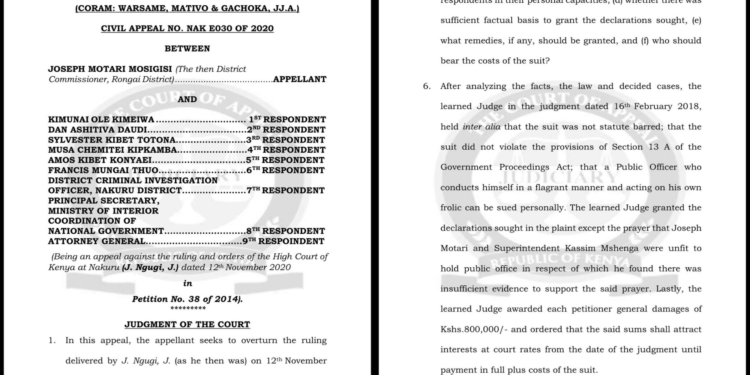
Court of Appeal Statement on Public Officers Abusing Office
PHOTO/LLM