

Govt Rolls Out System to Identify and Trace Animals: How it Works
Share

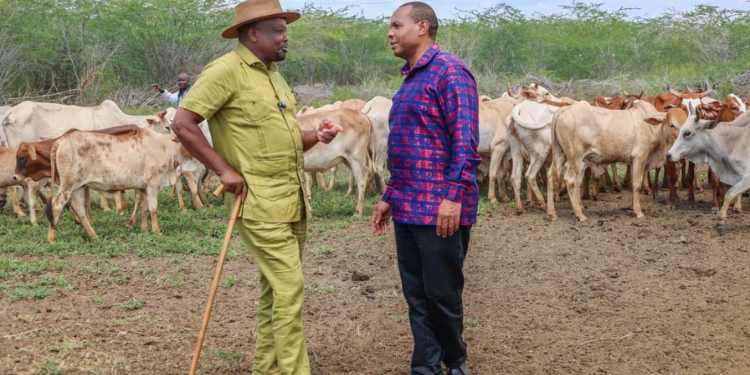
The Government has intensified the nationwide rollout of the Animal Identification and Traceability (ANITRAC) system to modernize Kenya’s livestock sector and improve global competitiveness.
Cabinet Secretary for Agriculture and Livestock Development Senator Mutahi Kagwe led a livestock sensitization and tagging exercise in Kurawa, Tana River County, following last week’s national launch of the programme in Nyeri.
The CS was accompanied by Tana River Senator Danson Mungatana and officials from the Directorate of Veterinary Services (DVS) during the exercise.
Together, they engaged livestock farmers and local leaders on the critical role ANITRAC will play in transforming Kenya’s livestock industry.
CS Kagwe explained that ANITRAC is more than a livestock tagging exercise because it establishes the foundation of a modern livestock economy.
Under the system, every registered animal receives a unique digital identity that guarantees complete traceability from its source to the market.
Farmers Urged to Embrace Livestock Registration By the Government
Moreover, the CS observed that international meat trade increasingly depends on traceability because buyers demand proof of an animal’s origin, movement history, and health status.
He urged farmers to fully cooperate with the ongoing livestock registration exercise to strengthen Kenya’s export competitiveness.
Kagwe added that the Government is deliberately pursuing lucrative livestock markets in Europe, the Middle East, and other international destinations.
Furher, he emphasized that success will depend on Kenya’s ability to demonstrate credible livestock identification and traceability that meets global standards.
Also Read: Gachagua Questions Government’s Handling of Intelligence Before Protests
Meanwhile, CS Kagwe noted that Kenya has an estimated 77 million livestock, making the sector one of the country’s most strategic economic pillars.
Currently, livestock contributes approximately 12 percent of Kenya’s Gross Domestic Product (GDP) and about 40 percent of the agricultural GDP. Additionally, the sector supports the livelihoods of millions of Kenyans, particularly those living in the Arid and Semi-Arid Lands (ASALs).
ANITRAC to Drive Jobs, Exports, and Economic Growth
Kagwe explained that ANITRAC will strengthen disease surveillance and control while reducing livestock theft and improving national food safety standards.
At the same time, the programme will restore consumer confidence and increase the value of Kenyan livestock and livestock products in both domestic and international markets.
Also Read: Government Announces Plan to Issue 3 Million National ID Cards
He also highlighted that ANITRAC ear tags and electronic identification chips are manufactured locally, thereby creating employment opportunities, supporting local industries, and demonstrating Kenya’s capacity to produce world-class agricultural technologies.
CS Kagwe pointed to the Government’s investment in the newly established Kenya Leather Industrial Parks as another major milestone.
According to him, these facilities will enable Kenya to export value-added leather products instead of raw hides and skins. Consequently, linking a reliable traceability system with local processing and manufacturing will strengthen industries, create more employment opportunities, and ensure livestock generates greater value for farmers and the national economy.
Finally, CS Kagwe reaffirmed that the Government intends to transform livestock from a traditional livelihood into a modern commercial enterprise that creates wealth and drives industrialization.
Ultimately, the nationwide rollout of ANITRAC will continue across all counties while accelerating livestock registration, strengthening animal health systems, expanding market access, increasing farmer incomes, and building a more resilient livestock sector.
Follow our WhatsApp channel for instant news updates.

Agriculture CS Mutahi Kagwe and Tana River Senator Danson Mungatana ed a livestock sensitization and tagging exercise in Kurawa, Tana River County on Thursday, July 16, 2026. PHOTO/ Kagwe X.