

How Kenya Is Taking on Foreign Companies Accused of Hurting Local Industries
Share


The Kenya Trade Remedies Agency (KETRA) is playing a key role in protecting local industries from unfair trade practices that threaten businesses, jobs, and investments.
Established under the Kenya Trade Remedies Act of 2017, the agency investigates unfair imports and recommends measures that help create a fair business environment for Kenyan manufacturers and producers.
According to KETRA’s Acting Chief Executive Officer, Samuel Chemisto, the agency was established to ensure that local industries compete fairly in both domestic and international markets.
“KETRA was created to safeguard Kenya’s domestic industries against unfair import trade practices,” Chemisto said.
KETRA operates under the Ministry of Investments, Trade and Industry and implements trade remedies in line with World Trade Organization (WTO) rules.
The agency was established as Kenya expanded its participation in regional and international trade agreements, including the African Continental Free Trade Area (AfCFTA), the East African Community (EAC), and the Common Market for Eastern and Southern Africa (COMESA).
As trade grows, local industries can face challenges from unfairly priced imports, subsidized products, and sudden import surges. KETRA investigates such cases and recommends solutions.
Understanding Trade Remedies
Trade remedies are legal measures used by governments to protect domestic industries from unfair competition.
The three main types include:
- Anti-Dumping Measures
These are applied when imported goods are sold at unfairly low prices compared to their prices in the exporting country.
- Countervailing Measures
These address unfair advantages created by foreign government subsidies.
- Safeguard Measures
These provide temporary protection when a sudden increase in imports threatens local industries.
Chemisto explained that these measures are not intended to block international trade.
“They are meant to restore fair competition and ensure trade remains fair, competitive, and supportive of economic growth.”
Kenya Supports Local Industries and Job Creation
KETRA says protecting local industries helps preserve jobs, encourages investment, and strengthens Kenya’s industrial sector.
The agency supports manufacturers and producers by investigating complaints and recommending action when unfair trade practices are detected.
According to Chemisto, local industries contribute significantly to Kenya’s economy through production, innovation, and employment.
“By implementing trade remedies, KETRA helps create a level playing field for Kenyan manufacturers and producers.”
The agency also boosts investor confidence by ensuring businesses operate under fair market conditions.
How KETRA Conducts Investigations
KETRA conducts investigations professionally and in line with Kenyan law and WTO regulations.
The process begins when affected industries submit evidence showing they have suffered harm from unfair imports.
Investigators then collect data, consult stakeholders, verify information, and hold public participation sessions.
Importers, exporters, manufacturers, and other interested parties are allowed to present their views before recommendations are made.
Once investigations are completed, KETRA submits recommendations to the Cabinet Secretary for Investments, Trade and Industry for action.
Research and Data Drive Decisions
Research forms a critical part of KETRA’s work.
The agency studies import volumes, pricing trends, market conditions, profitability, production levels, and employment data before making recommendations.
“Research and data analysis are critical in trade remedies investigations because all decisions must be evidence-based and compliant with international standards.”
KETRA says this approach ensures fair and transparent decisions that protect Kenya’s economic interests.
Also Read: Why Eastleigh Traders Prefer Cash Over M-Pesa Payments
Supporting Kenya’s Economic Agenda
The agency contributes to the government’s Bottom-Up Economic Transformation Agenda (BETA) by protecting industries against unfair imports.
KETRA believes strong local industries create more jobs, attract investment, and support sustainable economic growth.
The agency says fair trade practices help domestic businesses expand and compete effectively both locally and internationally.
Working with Key Stakeholders
KETRA collaborates with several institutions to strengthen trade enforcement.
- Ministry of Investments, Trade and Industry
- Kenya Revenue Authority (KRA)
- Kenya Trade Network Agency (KenTrade)
- Kenya Bureau of Standards (KEBS)
- Kenya Association of Manufacturers (KAM)
- Kenya National Chamber of Commerce and Industry (KNCCI)
The agency also works with importers, exporters, manufacturers, trade associations, and international organizations.
Also Read: Kenya Rises as Africa’s AI Powerhouse, Eyes UAE Digital Corridor Deal
Key Achievements Since Its Establishment
Since its formation, KETRA has increased awareness of trade remedies across the country through workshops, training programs, and stakeholder engagement activities.
The agency has also strengthened partnerships with industry groups and regional trade institutions to improve enforcement and investigation processes.
These efforts have helped create a stronger framework for protecting Kenyan industries from unfair trade practices.
Challenges Facing the Agency
Despite its progress, KETRA faces several challenges.
These include limited public awareness of trade remedies, increasing complexity in global trade, and budget constraints that affect outreach and capacity-building programs.
Many small and medium-sized enterprises (SMEs) may not fully understand the legal protections available to them when facing unfair competition.
KETRA’s Vision for the Future
KETRA aims to build a fair, competitive, and resilient economic environment that supports Kenya’s industrial growth and economic transformation.
The agency plans to continue strengthening its institutional capacity, enhancing stakeholder engagement, and improving awareness of trade remedies across the country.
“KETRA’s vision is to build a fair, competitive, and resilient economic environment that supports Kenya’s industrialization and economic transformation agenda.”
Follow our WhatsApp channel for instant news updates
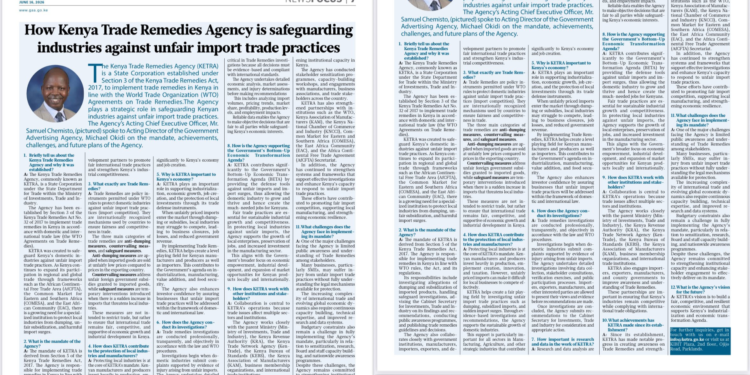
How Kenya Protects Local Industries from Unfair Imports
PHOTO/Trade Kenya