
How the Government Can Turn Semi-Arid Counties into Food Baskets
Share

According to the World Bank and other sources, Arid and Semi-Arid Lands (ASALs) occupy more than 80% of Kenya’s landmass. These areas generally experience low and highly variable rainfall. Arid areas receive about 150–550 mm of rainfall annually, while semi-arid areas receive about 550–850 mm.
Kenya has 23 counties classified as ASALs, with nine classified as arid and 14 as semi-arid.
The ASALs are home to about 36% of Kenya’s population and account for a significant share of the country’s livestock. Most households in these areas depend on a combination of pastoralism and small-scale agriculture for their livelihoods.
Many ASAL communities face high levels of poverty, limited infrastructure, and vulnerability to droughts and other climate-related shocks.
What if the government can prioritize transforming this 80% landmass into thriving food baskets?
“Kenya’s ASALs present a significant opportunity to rethink agricultural development. Rather than viewing these regions primarily through drought, food insecurity and humanitarian intervention, Kenya can develop them as centres of climate-resilient agriculture, livestock production and agro-industrial activity,” Faith Okello, an agricultural and soil scientist, said.
Speaking to Hivileo, Ms. Okello said such a transformation must reflect ecological realities.
She explained that the objective is not to convert every arid landscape into conventional farmland, but to match land use to local conditions, invest in water security, strengthen pastoral economies and build value chains that withstand climatic shocks.
“Two priorities deserve particular attention: livestock transformation and the financing and institutional support that make agricultural investment viable,” she stated.
Realistic Agricultural Potential
Ms. Okello said the potential of ASALs is substantial but highly differentiated, with opportunities including drought-tolerant crops, livestock and pastoral production, irrigated horticulture, agroforestry, rangeland restoration, beekeeping, indigenous crops and value addition.
She emphasized that the greatest opportunity lies in integrating these activities into regional food systems rather than treating crop farming and livestock production as competing sectors.
Further, Ms. Okello said a climate-resilient crop strategy should prioritise varieties that tolerate drought, mature quickly, require relatively few external inputs and have viable markets.
She emphasized that Kenya should move beyond reliance on maize and other water-intensive crops.
Similarly, Griffins Wamoto, an agronomist, said the government prioritize drought resistance crops like sorghum, millet, cowpeas, sweet potatoes, cassava, peas among others.
The crops need various conditions and have different advantages as described by Ms. Okello as follows:
- Sorghum: Suited to relatively dry conditions; useful for food, animal feed and brewing, with potential for contract farming and processing.
- Finger millet and pearl millet: Important for food security and suitable for dryland environments; potential for flour and nutritious food products.
- Green grams (mung beans): Short growing cycle and income potential; useful in crop rotation and diversification.
- Cowpeas: Provide food and fodder and can contribute to soil fertility through nitrogen fixation.
- Pigeon peas: Deep-rooted, relatively drought-tolerant and useful for intercropping and soil improvement.
- Cassava and sweet potatoes: Potential food-security crops in suitable zones, subject to appropriate varieties and growing conditions.
- Selected high-value opportunities include indigenous vegetables, dryland fruits, sesame, aloe and other commercially useful indigenous plants, where sustainable production and markets are established.
- The guiding principle should be market-led diversification, not crop diversification for its own sake. New crops should be supported by market access, processing and reliable water supplies.
Irrigation and Water Management
Irrigation can reduce dependence on erratic rainfall and improve production reliability.
However, Ms. Okello warned that it should be treated as a water-management strategy rather than simply an infrastructure project.
Wamoto mentioned that the government can use solar irrigation along seasonal rivers.
Ms. Okello echoed this view, explaining that solar-powered irrigation can reduce fuel costs where sustainable water sources exist, and grid electricity is unavailable or expensive.
Wamoto said the government should focus on installing solar-powered pumps on shallow aquifers rather than relying solely on drilling boreholes.
Both experts agreed that drip irrigation is best suited to these regions because it delivers water directly to plant roots and supports the production of vegetables, fruit trees and other high-value crops.
Wamoto also pointed out that sand dams, subsurface dams, water pans and appropriately designed reservoirs are well suited to ASAL regions.
“They can capture seasonal runoff for domestic use, livestock and carefully planned agriculture,” Ms. Okello said.
Priorities include investing in water harvesting before expanding irrigated acreage; establishing community-managed schemes; financing efficient equipment; training farmers in water budgeting; monitoring groundwater extraction; and promoting safe wastewater reuse where appropriate.
According to Ms. Okello, irrigation should complement rain-fed farming and pastoralism, not replace them.
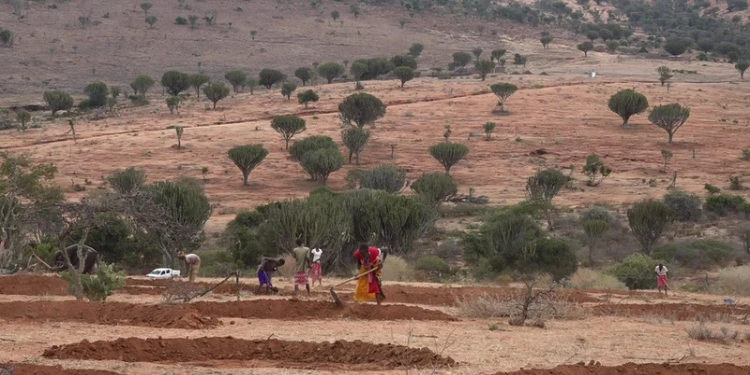
According to the World Bank and other sources, Arid and Semi-Arid Lands (ASALs) occupy more than 80% of Kenya’s landmass. PHOTO/https://iucn.org/
Soil Restoration and Integration with Pastoralism
Restoring degraded soils is essential to improving agricultural productivity in Kenya’s ASALs, but farming should complement rather than replace pastoralism, which remains a key livelihood in many dryland communities.
According to Ms. Okello , this can be achieved by applying the following measures:
- Conservation agriculture: Minimum soil disturbance, permanent soil cover and crop rotation.
- Agroforestry: Suitable trees and shrubs can improve soil structure, provide fodder and reduce erosion.
- Organic matter restoration: Compost, manure and crop residues improve soil structure and water retention.
- Contour farming and terracing: Useful in erosion-prone landscapes.
- Controlled grazing: Reduces pressure on recovering rangelands.
- Water harvesting: Captures runoff to support vegetation regeneration.
- Targeted fertiliser application: Soil testing helps identify deficiencies and guide appropriate inputs.
“A sustainable model should protect livestock corridors and traditional grazing routes, establish negotiated grazing agreements, develop fodder banks, promote integrated crop-livestock systems, support community-led rangeland restoration and recognise customary land rights,” Ms. Okello said.
Also Read: It’s Sunny, So Where Is the El Niño Rain? Here’s What Kenya’s Weather Forecast Actually Means
Livestock Breeds and Production Systems for Dry Conditions
In many arid counties, livestock provides food, income, savings, social security and cultural continuity.
Therefore, the experts said livestock should be central to Kenya’s ASAL transformation strategy.
Ms. Okello explained that the shift should be from measuring success by herd size to measuring productivity, animal health, market value, and rangeland sustainability.
Here are the livestock breeds that experts said are suitable for ASAL areas, their advantages, and their productivity rates:
- Boran cattle: Indigenous to East African production systems and associated with adaptation to hot environments and use of natural grazing.
Improve productivity through animal health, selective breeding, nutrition, and market-oriented production.
- Red Maasai sheep: An indigenous breed valued for adaptation to local conditions, with potential for meat production and community-based breeding.
- Galla goats: Relevant to arid and semi-arid environments; browsing ability and meat and milk production create opportunities for smallholder and pastoral enterprises.
- Somali and other indigenous camel populations: Important in the most arid environments, with potential for milk, meat and livelihood support.
Ms. Okello said crossbreeding can improve selected traits but should be approached cautiously.
“Introducing exotic genetics without adequate feed, water, veterinary care and management can produce animals poorly suited to local conditions,” she said.
According to Wamoto, priorities should include conserving indigenous genetic resources, community-based selective breeding, performance recording, controlled crossbreeding where justified, and access to quality breeding animals.
Use of Technology in Agriculture
Wamoto said the government can use technology to improve agricultural activities in these regions through weather forecasting, pest and disease surveillance, and adequate water uptake for crops and fodder.
Similarly, Ms. Okello said technology can strengthen resilience through digital livestock identification, mobile veterinary services, satellite-based rangeland monitoring, drought and disease early-warning systems, digital market information and index-based livestock insurance.
“These tools should complement local knowledge,” she said.
She stated that index-based livestock insurance can pay when independently measured forage or drought indicators cross predefined thresholds.
Ms.Okello said insurance is not a substitute for veterinary care, water infrastructure, grazing management, or social protection.
“Its value depends on transparent triggers, affordable premiums, timely payouts, and clear communication,” the scientist said.
She recommended a livestock-first climate-resilience strategy linking indigenous breeds, sustainable grazing, animal health, feed security and commercial value chains.
Indigenous Crops and Traditional Knowledge
Pastoral and farming communities hold generations of knowledge about seasonal rainfall, pasture availability, animal behaviour, drought preparation and locally adapted crops.
Ms.Okello said this knowledge can complement scientific research through the following interventions:
- Document and conserve indigenous seed varieties; establish community seed banks.
- Support farmer-led seed selection and multiplication.
- Integrate traditional weather indicators with modern meteorological forecasts.
- Promote indigenous food processing and preservation.
- Support knowledge exchange between experienced producers and younger generations.
- Involve pastoral communities in designing rangeland restoration programmes.
Indigenous crops can create economic opportunities when linked to nutrition programmes, institutional procurement and commercial processing. Traditional knowledge should be treated as a source of innovation.
Improving Access to Finance, Inputs, Insurance and Extension
Access to capital, risk management, appropriate inputs and reliable technical support determines whether agricultural potential becomes productive investment.
Ms. Okello said the government should establish an ASAL Agricultural Development Fund or dedicated financing window for water harvesting, irrigation, livestock breeding, animal health, fodder, storage, processing and indigenous crops.
Besides, the government can introduce credit guarantees that share a defined portion of lender risk and expand lending to smallholders, pastoral cooperatives, women- and youth-led enterprises, processors and fodder producers.
Also Read: Government Warns of Potential Food Crisis and Rising Prices
The government can also design flexible repayment schedules around harvests, livestock sales and longer-term infrastructure investments.
Ms. Okello said the state must also define fair restructuring arrangements for drought-affected borrowers.
The experts also suggested supporting well-governed cooperatives to aggregate demand for credit, inputs, equipment and market services.
On affordable and appropriate inputs, Faith gave the following recommendations
- Use targeted subsidies for climate-resilient seeds, suitable fertilisers, fodder seeds and efficient irrigation equipment.
- Support local agro-dealers and distribution centres to reduce access costs for seeds, veterinary medicines, feed and equipment.
- Strengthen community seed systems and local seed multiplication.
- Enable bulk procurement through farmer organisations and cooperatives.
- Enforce quality assurance against counterfeit seeds, substandard veterinary products and adulterated products
Extension Services
The experts also made recommendations to the government on how to improve extension services in ASAL regions to make them more productive.
Some of the highlighted strategies include:
- Recruit and deploy ASAL-specialised extension officers trained in dryland agronomy, livestock nutrition, rangeland restoration, water harvesting, soil conservation, climate risk and marketing.
- Train community-based resource persons who can provide basic support and connect producers to professional services.
- Integrate crop and livestock extension so advice reflects the relationship between crops, livestock, water and rangelands.
- Use mobile services for rainfall forecasts, planting windows, disease alerts and market prices, while retaining in-person support.
- Build partnerships among universities, research institutions, county governments and farmer organisations for demonstration farms and participatory research.
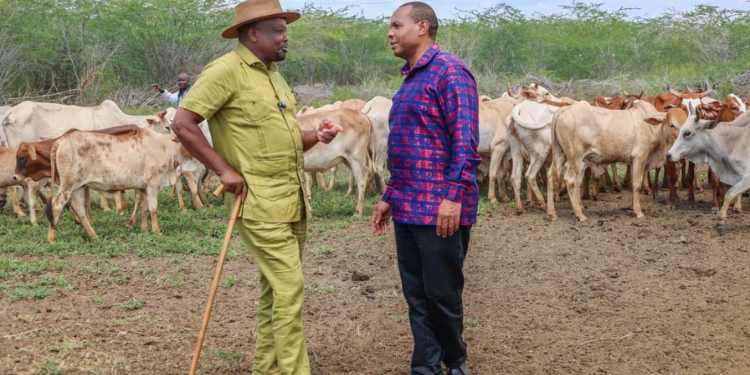
Agriculture CS Mutahi Kagwe and Tana River Senator Danson Mungatana ed a livestock sensitization and tagging exercise in Kurawa, Tana River County on Thursday, July 16, 2026. PHOTO/ Kagwe X.
Infrastructure and Partnerships
They agreed that infrastructure is critical to the government’s efforts to transform dry and semi-arid counties.
Ms. Okello said government should prioritise all-weather rural roads, community water infrastructure, livestock markets, milk cooling centres, grain storage, local processing, veterinary laboratories, solar cold chains and digital connectivity.
“Government can enable private investment in inputs, irrigation equipment, processing, feed, logistics, insurance and digital extension, with clear performance standards and protections for small producers,” Ms. Okello said.
Implementation Roadmap
Most importantly, Ms. Okello provided a 10-year roadmap that the government can follow to turn this vision into reality.
| Phase | Priority Actions |
| Years 1–2: Build foundations | Map agricultural potential and water; identify priority value chains; establish baseline data; strengthen extension and community institutions; pilot credit guarantees and insurance; rehabilitate priority water and market infrastructure. |
| Years 3–5: Expand investment | Scale efficient irrigation and water harvesting; expand indigenous livestock breeding; develop fodder enterprises; establish aggregation, storage and processing; expand finance and insurance; strengthen cooperatives and market links |
| Years 5–10: Develop regional economies | Build integrated crop-livestock value chains; attract processing and logistics investment; expand viable dryland enterprises; strengthen market connections and sustainable rangeland management; evaluate outcomes and redirect investment based on evidence. |
Suggested Performance Indicators
Indicators should be disaggregated by county, gender, livelihood system, and ecological zone to reflect differences between communities.
| Area | Indicator |
| Crop production | Yield stability across seasons |
| Livestock | Animal productivity, mortality and market value |
| Financing | Number of producers accessing affordable credit |
| Insurance | Coverage, claims settlement time and retention |
| Extension | Share of producers receiving relevant advisory services |
| Water | Reliability and sustainability of access |
| Land restoration | Changes in vegetation cover and soil condition |
| Markets | Post-harvest losses and transport costs |
| Livelihoods | Household income and food security |
Follow our WhatsApp channel for instant news updates
President William Ruto inspects the Horn of Africa Gateway Development Project Package II, Lot 2, along the Tarbaj–Kotulo (64km) A13 road section in Tarbaj Constituency, Wajir County on June 2, 2026. PHOTO/PCS