REVEALED: Fees Parents Could Pay in Senior Schools if Govt Adopts New Proposal
Share
Parents could be forced to dig deeper into their pockets to educate their children in senior schools if a new fees proposal by principals is adopted by the government.
The proposed structure, presented by school heads, outlines significant changes in the amount parents would contribute across different categories of senior schools, with boarding and day schools expected to record new charges.
The proposal indicates that parents with learners in Cluster One (C1) schools could pay Ksh 87,781 annually after government capitation, up from the current Ksh 53,554.
For Cluster Two and Three (C2 and C3) schools, the proposed parent contribution stands at Ksh 83,622 compared to the current Ksh 40,535.
For Category Four (C4) schools, which include county schools, parents could pay Ksh 7,675 annually under the proposed structure, compared to zero currently after government support adjustments.
The figures are contained in a new fees framework presented by principals, who argue that the current funding model no longer reflects the cost of running schools.
“Parents will pay more to educate their children in public schools if proposals made by principals to the government for a new fee structure are adopted,” principals said as quoted by the Nation.
The proposal shows that teaching and learning materials, meals, repairs, transport, administration, utilities, staff salaries, activities, medical services, and other operational needs have all been factored into the new structure.
For C1 schools, the total proposed cost per learner rises to Ksh 110,025 from the current Ksh 75,798 before government support is deducted.
In C2 and C3 schools, the proposed total cost stands at Ksh 105,866 compared to the current Ksh 62,779.
Principals Cite Rising Fee Costs and Delayed Funding
The school heads said the current fee structure was last reviewed in 2015, adding that inflation, increased operational expenses, and delayed government funding have placed pressure on institutions.
The document was presented to the Principal Secretary for Basic Education, Mr John Ochieng, during the annual Kenya Secondary Schools Heads Association (Kessha) conference in Mombasa County.
“The document puts the new fees for day scholars at Ksh 7,675, to be reviewed annually,” the principals said as quoted by Nation.
The proposal indicates that boarding schools remain the most expensive due to feeding and accommodation costs.
Kessha estimates that meals, including breakfast, lunch, and dinner, have become a major expense for parents and schools.
Also Read:How the Ksh 784.5 Billion Education Budget Has Been Allocated
In boarding schools, food remains the largest expenditure item.
Kessha said it now costs approximately Ksh 9,042 per year to cover breakfast, lunch, and dinner per parent.
Kessha National Chairman Willy Kuria said the current funding arrangement has left schools struggling to meet operational demands, with school administrators warning that the existing model cannot continue.
“The principals said that the current funding model is no longer sustainable amid rising inflation, escalating operational costs, and persistent delays in government capitation,” Kuria said as quoted by the Nation.
The proposed fees also take into account the expansion of learning requirements under the Competency-Based Education (CBE) system, which has introduced more subjects requiring specialised equipment and facilities.
Also Read: OPINION: Removing Prof. Julius Bitok Will Not Fix Kenya’s Education Crisis
CBE expansion adds pressure on school resources
Principals said new learning pathways have increased the demand for laboratories, technical equipment, teaching materials, and other resources needed to support learners.
The principals also raised concerns over the increasing cost of implementing Competency-Based Education (CBE), particularly after the expansion of subject choices in secondary schools.
Subjects such as music and dance, French, fine art, sports and recreation, electricity, aviation, home science, building and construction, theatre and film, marine and fisheries, and media technology have increased resource needs in schools.
“In order for schools to sustain and effectively teach these subjects, additional resources are required,” Mr Kuria said as quoted by the Nation.
He added that many schools lack modern equipment required to deliver the new curriculum, with outdated facilities making it difficult to meet learning demands.
“Old-model computers are no longer suitable for current learning requirements,” Mr Kuria said as quoted by the Nation.
The association further argued that although the government provides infrastructure grants for classrooms and laboratories, schools still lack funds to equip the facilities.
“No grants are provided for desks, chairs, laboratory stools, equipment, chemicals, and other essential furniture needed to make these facilities operational,” Mr Kuria said as quoted by the Nation.
Follow our WhatsApp channel for instant news updates
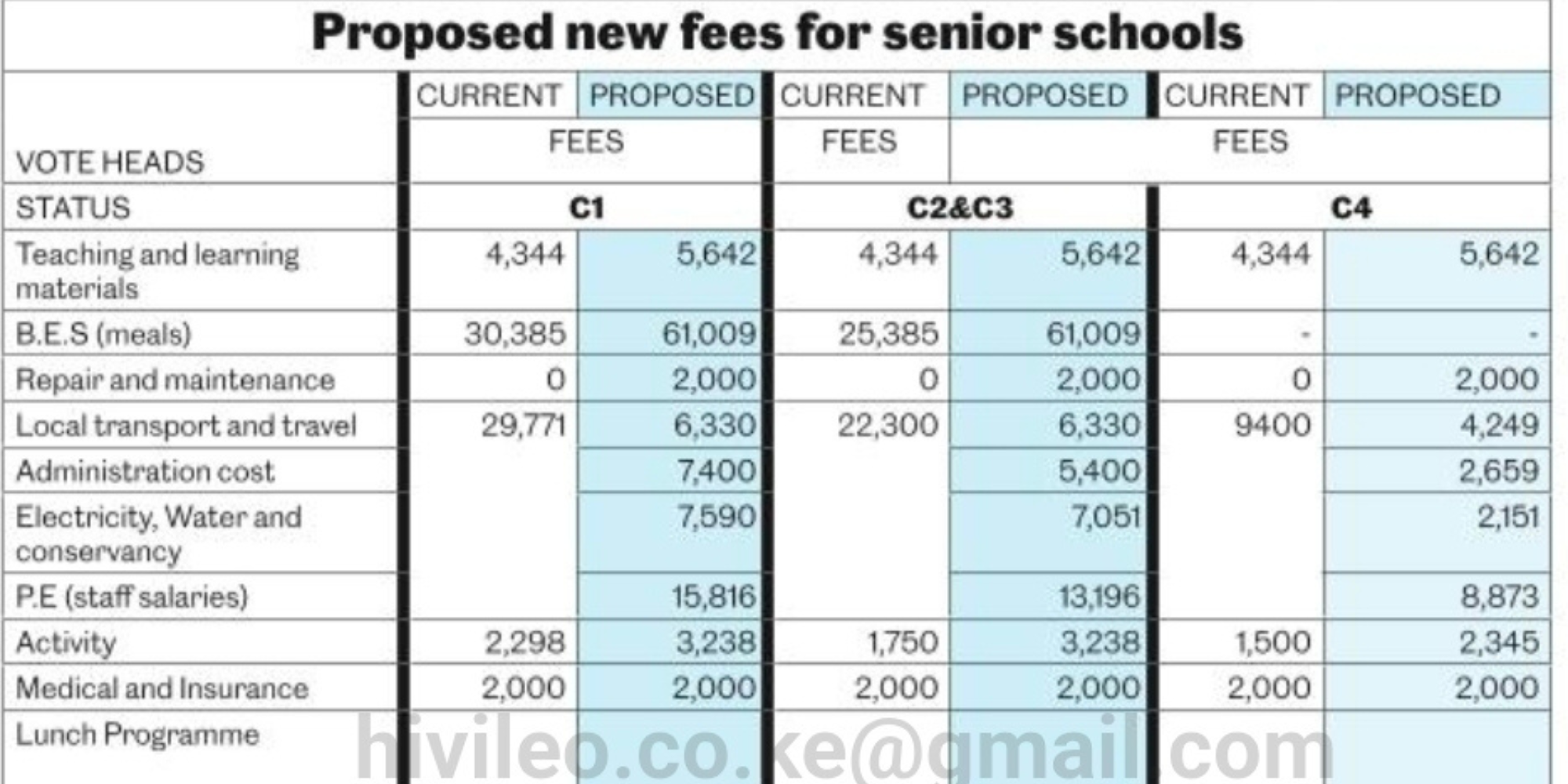
The proposed school fees structure, presented by school heads, outlines significant changes in the amount parents would contribute across different categories of senior schools, with boarding and day schools expected to record new charges. PHOTO/ File