Treasury Clarifies Proposals on Mobile Phones, Card Payments and Taxation of Content Creators in Finance Bill 2026
Share

The National Treasury has moved to calm growing public concern over the controversial tax proposals in the Finance Bill, 2026.
In a press release issued on May 25, 2026, the Treasury said public debate around the Bill had mixed current proposals with withdrawn measures from previous finance laws, especially the rejected Finance Bill, 2024.
“The National Treasury welcomes public participation and stakeholder engagement on fiscal policy matters as part of the constitutional legislative process,” the statement read.
“National Treasury, however, notes that some commentary has mixed proposals contained in the current Finance Bill with past proposals and interpretations that do not accurately reflect the contents and intent of the Finance Bill, 2026,” the Treasury added.
Treasury Cabinet Secretary John Mbadi maintained that many of the claims circulating online were either incomplete or false.
Treasury Defends Mobile Phone Tax Proposal
At the centre of the public uproar is the proposed 25 per cent excise duty on mobile phones.
However, the Treasury argued that the proposal was not a new tax but a restructuring of the current taxation framework governing mobile phone imports and sales.
“Mobile phones are currently subject to multiple domestic taxes and levies during their importation and along the supply chain,” the Treasury stated.
“16% VAT; 10% excise duty; 25% import duty; 2.5% Import Declaration Fee; and 2% Railway Development Levy,” the Treasury declared.
According to the ministry, the existing taxes cumulatively create an aggregate tax burden of approximately 55.5% within the current mobile phone taxation framework.
Treasury said the Finance Bill seeks to simplify the tax regime by replacing the fragmented taxes with a single 25 per cent excise duty charged upon activation of the device.
“If enacted, mobile phones will no longer be subject to 16% VAT, 2.5% Import Declaration Fee, and 2% Railway Development Levy under the proposed framework,” the statement said.
“The 25% import duty will also be removed upon implementation of the new tax regime, thereby simplifying the tax structure and lowering the overall domestic tax burden applicable to mobile phones,” the statement added.
The ministry added that the proposal was intended as a tax simplification and rationalization measure rather than the introduction of a new tax on digital access.
Treasury further acknowledged the significance of mobile devices in Kenya’s digital economy.
“Phones now serve as essential tools for communication, education, financial access, online business, digital work, and youth economic participation,” Treasury noted.
Also Read: Kenyans Face Higher eCitizen Charges Under New Treasury Proposal
Clarification on Digital Payments and Card Fees
The Treasury also sought to clarify concerns surrounding proposed taxation measures on digital payments, card transaction services, and money transfer platforms such as Safaricom’s M-Pesa and PayPal-linked transactions.
“Whereas the VAT Act expressly exempts listed financial services, it does not address the VAT treatment of modern digital intermediaries such as Payment Service Providers and other technology-based platforms that facilitate money transfer and financial transactions,” the statement explained.
The Treasury emphasized that the target was digital services that are ICT-driven as opposed to the traditional financial services, such as cash deposits, withdrawals, and foreign exchange.
“It is worth noting that we had a meeting with Safaricom on Friday last week and explained that they are not amongst those we are targeting,” the ministry stated.
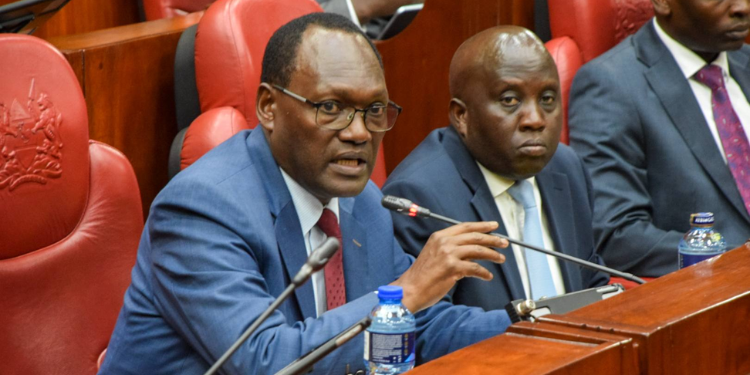
Treasury PS Dr Chris Kiptoo. PHOTO/Parliament
On card payment systems such as Visa and Mastercard transactions, Treasury said the Finance Bill seeks to resolve legal ambiguity that emerged after a recent court ruling.
“Interchange fees and fees paid by banks to card companies are not considered management, professional or royalties under the current law,” the statement said.
“A recent court ruling pronounced that these payments do not attract withholding tax, creating a gap in taxing income from card payments,” the Treasury added.
The ministry said the Bill proposes to redefine management, professional, and royalty fees to include card transaction-related payments.
“This therefore provides clarity following judicial interpretation as well as enhances revenue collection through expansion of the tax base,” Treasury said.
Also Read: Will Finance Bill 2026 Make Bottled Water Expensive? Mbadi Clarifies
Virtual Assets and Digital Monetisation
The Finance Bill, 2026, also introduces new reporting obligations for virtual asset service providers as the government moves to regulate the rapidly growing digital asset economy.
“The rapid growth of digital and virtual asset transactions has, however, created a gap within the existing legal framework due to the absence of clear reporting obligations governing such transactions,” the statement noted.
At the same time, Treasury dismissed reports claiming that the Bill introduces a 5 per cent withholding tax on digital content monetisation.
“The National Treasury further wishes to clarify that the Finance Bill, 2026, does not contain a proposal introducing a 5% withholding tax on digital monetisation contrary to some media reports and commentary,” the statement said.
Treasury also clarified that controversial measures associated with the withdrawn Finance Bill 2024, including VAT on bread, eco levies on phones, motor vehicle circulation tax, and access to mobile money transaction data, are not part of the current Bill.
On PAYE reforms, the Treasury disclosed that a proposal to exempt the first Ksh 30,000 of employment income from taxation remains under consideration by technical teams but was not included in the Finance Bill, 2026.
“The National Treasury remains committed to maintaining a balanced fiscal framework that supports revenue mobilisation, economic growth, investment, innovation, and long-term economic sustainability while taking into account prevailing economic conditions and public concerns,” CS Mbadi stated.
Follow our WhatsApp channel for instant news updates

A Picture of the National Treasury Office