
Employers Advised to Embrace Work-From-Home Amid Fare Increases
Share
The National Taxpayers Association (NTA) has urged stakeholders in the transport sector to refrain from imposing exorbitant fares following the recent fuel price hike, warning that commuters are increasingly being pushed to the edge by rising transport costs.
The association stated that some transport operators are taking advantage of the situation, thereby worsening the financial pressure on Kenyans who are already grappling with a high cost of living driven by inflation and volatile global energy markets.
According to the NTA, the ongoing adjustments in fuel prices have triggered a ripple effect across the economy, with transport costs directly feeding into the prices of basic goods and services, further straining household budgets and business operations.
NTA Chief Executive Officer (CEO), Patrick Nyangweso, urged both public and private sector employers to adopt flexible working arrangements, including remote work, as a temporary measure to cushion workers from escalating commuting expenses.
“This is the time that this increase in fuel prices does not really commensurate to the salaries increment. You know what all Kenyans are going through,” he said.
Request For Remote Working And Policy Interventions
Nyangweso said there is need for immediate actions from the employers within different industries in response to the current economic challenges.
“I will strongly advise the government to look into a policy whereby the public sector and even the private sector or the PBOs can be able to facilitate work-from-home policies,” he noted.
According to him, the cost of commuting has become unbearable for most families, especially when looking at the increasing daily burden that workers incur.
“In fact, you can see that I have put this into practice where, instead of using the ones who use public transport,” Nyangweso explained the situation.
“You find that they pay 300 each day, and therefore you will find that after a month, it comes to more than 6,000, which is unplanned prior,” he added.
Concerns about Supply Chain and Market Stability
In addition to warning about the impact of the rise in fuel prices in the sector of transportation, the CEO of the NTA has also highlighted the disruption caused by rising fuel prices to the supply chain and market.
“Looking at the supply chain side of things, this is the time when everybody needs to sit down and be honest,” he stated.
He underlined the necessity for collaboration between the policymakers in the government and other stakeholders involved in the industry.
“For us to find out how they can implement this, how to regulate the rate of market system so that we do not disrupt the supply chain,” he added.
Also Read:Ruto Explains Why Kenyans Pay More for Fuel Than Neighbouring Countries
Global Oil Shocks And Structural Taxation Challenges
According to another report on Fuel Taxation, Global Oil Shocks, and Fiscal Justice in Kenya, the NTA emphasized that global dynamics have been increasing the country’s economic pressure.
“Driven by geopolitical tensions in the Middle East, global oil prices have surged by over 30%, with Kenya—an import-dependent economy—feeling the full impact,” the statement read.
It further noted that even with tax adjustments, structural issues remain in fuel pricing.
“Despite recent VAT reductions, taxes and levies still account for nearly 45% of the pump price, amplifying external shocks and exposing structural weaknesses in the country’s fuel pricing framework.”
The association warned that the economic ripple effects are widespread and severe.
“NTA’s analysis underscores the far-reaching economic effects, including increased transport costs, inflationary pressures, strained supply chains, and shrinking margins for MSMEs.”
Also Read:Easy Coach Announces New Bus Fares After Fuel Price Hike
It also raised concern over unfair cost transmission to consumers.
“The statement also raises concerns over disproportionate fare hikes, where cost increases are being passed on to consumers beyond actual fuel price impacts.”
In addition to that, the NTA made several proposals on how to create stability and ensure taxpayers will be insulated from similar crises in the future.
“The Association urges the government to make necessary and proactive reforms in its approach to the issue, including consistent fuel taxation, maintaining fuel reserve stocks, investing in energy security, local exploration and e-mobility, to prevent any shocks to taxpayers.”
Finally, NTA concluded with a firm message for reform of the current policy regime.
“Kenya must go from firefighting policy to proactive evidence-based fiscal policymaking.”
Follow our WhatsApp channel for instant news updates
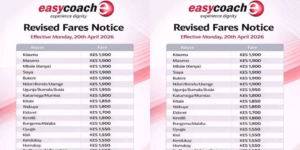
Easy Coach informs passengers of revised bus fares effective April 20, 2026, following EPRA fuel price increase. PHOTO/ EASY COACH LTD FB.
You Might also Like