Zelensky Offers Drone Defense Aid to Middle East
Share
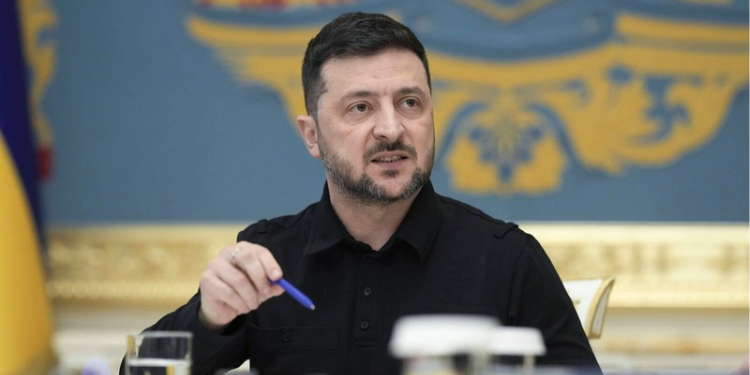
Ukrainian President Volodymyr Zelensky has proposed deploying his country’s most experienced drone defence specialists to Middle Eastern capitals to help protect civilian populations from Iranian attacks, on the condition that regional leaders secure a temporary ceasefire with Russia in Kyiv’s protracted war.
Zelensky made the offer in an interview with Bloomberg News, in which he framed it as a diplomatic and strategic initiative designed to reinforce regional security while advancing peace prospects in Eastern Europe.
“I would suggest the following,” Zelensky said, referring to the dual-track proposal.
“Leaders of the Middle East have great relations with Russians. They can ask Russians to implement a month-long ceasefire, then we will send our best operators of drone interceptors to the Middle East countries to protect civilians,” Zelensky lamented.
His remarks underscore Kyiv’s belief that its four years of defending against waves of Russian and Iranian-made drones, including thousands of Iranian-designed Shahed unmanned aerial vehicles (UAVs), have yielded a unique defensive expertise that could be exported to other theatres of conflict.
Zelensky’s gambit arrives as the Middle East reel under an unprecedented escalation of hostilities between the United States, Israel, and Iran, a conflict that has widened dramatically in recent days.
Iranian military forces and their affiliates have attacked both U.S. military installations in the Gulf Region as well as those in Israel.
They performed these attacks to retaliate against the combined forces of the United States and Israel who conducted a joint military operation which included, but was not limited to, the reported killing of Iran’s supreme leader.
Middle East Conflict Escalates: Causes and Regional Impact
Both confrontations between Israel and US, as well as the conflict being stimulated by crisis and instability related to Irans nuclear program and its affect on Syria’s regional power, both missile development and other forms of attacking and remises for Israel on the one hand and US-NATO alliances to provide support to ensure their national security are the key components that represent the essence of regional instability.
In February 2026, a joint operation between the United States and Israel struck Iran, prompting retaliation by Iran.
Iran claims that the retaliation is directed at the United States military bases and allied forces in the region.
However, the United Arab Emirates, Saudi Arabia, Qatar, Kuwait, and Bahrain, which are all neighbors of Iran, have condemned the attacks carried out by Iran on their territory and claim that the actions of Iran are disrupting stability and are illegal.
The ongoing conflict has also had a major impact on the global economy.
Some of the major global energy infrastructure, which includes transportation through the Strait of Hormuz, through which one out of every five barrels of oil is transported, has been affected, leading to a sharp escalation in the price of crude oil.
Also Read: Iran Won’t Strike US Bases in Kenya, Ambassador Assures
Russia-Ukraine War Context and Zelensky’s Calculus
Zelensky’s offer to send defence specialists comes against the backdrop of Russia’s four-year assault on Ukraine, which has left Kyiv militarily strained but diplomatically active on multiple fronts.
While Russia continues operations on Ukrainian soil, Zelensky has sought to leverage Ukraine’s experience against Iranian systems, supplied in part to Moscow’s forces, to build strategic linkages with Western and regional partners.
Tehran’s provision of drones to Moscow has been a persistent irritant in Ukrainian-Iranian relations, and Kyiv has publicly highlighted this issue to justify deeper cooperation with U.S. and NATO allies.
Also Read: Govt Addresses Potential Fuel Price Hikes as Israel-Iran Tensions Disrupt Oil Markets
International Responses and Broader Implications
U.S. and Israeli leaders have signalled resolve to degrade Iran’s capabilities while managing the scope of the war.
As Israeli Prime Minister Benjamin Netanyahu said, the current campaign “is not going to take years,” although the scale of Iranian retaliation indicates that the confrontation could be a long one.
Russia has condemned the strikes by the USA and Israel as “unprovoked,” threatened a humanitarian and economic crisis, and offered to mediate a resolution to the crisis.
Sustained conflict in the Middle East jeopardizes world entitlement networks, interrupts market logistics, and creates commodity markets additional ‘war processing costs’ towards commodities.
All of these have significant social and economic effects that go much beyond just local battlefields.
Follow our WhatsApp channel for instant news updates
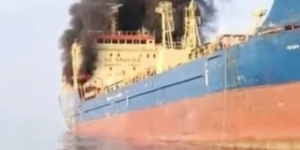
Damaged oil tanker in Gulf waters due to Middle East conflict
PHOTO/File