Dreams on Hold: Kenyan Students Stranded as University Funding Crisis Deepens
Share

The suspension has left hundreds of students stranded, while first-year learners who have already reported to universities struggle to access loans and scholarships.
As the new academic year begins, students from vulnerable households continue to bear the brunt of the uncertainty. Some have also failed to report to campus because they cannot raise the required fees.
“I had been called to join Kisii University, but my parents could not afford it. They could not manage to deposit Ksh 20,000 for me to join, and I do not know whether the funding model can help me study for free. I was going to study secondary school teaching,” Kemunto said.
Students Struggle as Funding Model Remains Suspended
Meanwhile, first-year students at Machakos University who reported about a week ago have also struggled to meet their basic needs as they wait for financial support.
At Kisii University, continuing students have raised concerns over delayed disbursements and uncertainty about the fees they are expected to pay.
“There is still some confusion. We have tried to access the portal to check the fee structure, but it has been difficult,” Kisii University student Griffins Ouma said.
Similarly, Davis Orina said the uncertainty had made it difficult for students to determine how much they should pay and whether the government would provide financial support.
“If things were as they used to be, someone would know what they are supposed to do. Right now, I am confused. I do not know how much I am supposed to pay in fees, and I do not know whether the government funding is available or what has happened to it. I am confused,” Orina said.
The confusion follows the government’s decision to suspend the previous funding model as it waits for Parliament to consider the proposed legislation.
Also Read: Govt Reveals Changes to University & TVET Funding in New Higher Education Bill
Inyangala Explains Government’s Position
Speaking during a meeting with university chancellors on Monday, August 31, 2026, Higher Education Principal Secretary Beatrice Inyangala said parents should take responsibility for students’ upkeep and accommodation as the government works on the new funding framework.
At the same time, Inyangala said the government would disburse funds to university students once Parliament passes the proposed Tertiary Education Placement and Funding Bill.
She added that universities had supported needy students through their existing assistance programmes as they await the new framework.
“The message that students join universities while we await the processing of the bill has been taken very positively. And students with who are very needy have been supported by universities to settle down because most of the universities run a needy kitty,” Inyangala said.
However, the Bill remains at an early stage in Parliament. It has only gone through the First Reading and is currently at the committee stage.
Also Read: How To Check HELB Loan Application Status
Proposed Authority to Expand Student Funding
The proposed legislation would also establish a Tertiary Education Funding Authority to take over student financing functions currently handled by HELB and expand the sources of funding available for higher education.
Under the proposed framework, the authority could raise money through government allocations, Treasury bills and bonds, concessional loans and other financing arrangements.
It could also access private capital, pension funds, collective investment schemes, sovereign wealth funds and climate-finance resources.
For now, students remain in limbo as universities begin the academic year amid uncertainty over fees, loans and scholarships.
Follow our WhatsApp channel for instant news updates
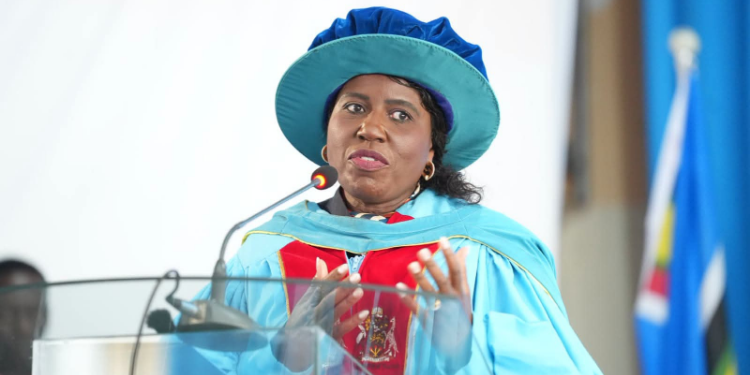
A photo of Principal Secretary Beatrice Inyangala during the installation ceremony of the 9th Vice-Chancellor of the University of Nairobi, Eng. Ayub Njoroge Gitau, on July 17, 2026, at Taifa Hall. PHOTO/ University of Nairobi Facebook