The Quiet Clause in the Finance Bill That Will Raise the Cost of Every Business Payment in Kenya
Share

Most of the public conversation about the Finance Bill 2026 focused, understandably, on what touches households directly, like smartphone excise duty, betting taxes, and even the mitumba levy.
That is the version of the bill that filled WhatsApp groups and trended on social media.
But there is a quieter set of clauses in this bill that did not generate the same noise, and that is precisely why they deserve more scrutiny now that Parliament has passed them.
Buried inside the Income Tax and VAT amendments is a redefinition of two words, “royalty” and “management fee” that reaches into the infrastructure layer underneath nearly every digital payment made in Kenya.
Now that Parliament has passed this bill by 122 votes to 40 on 18 June, the businesses that will feel it first are not the ones that made headlines during the debate.
They are the manufacturers paying suppliers in Kampala, the exporters settling invoices in Lagos, and the mid-sized companies that have spent the last decade building cross-border operations on the assumption that Kenya’s payment infrastructure would keep getting cheaper, not more expensive.
The quiet Finance Bill tax Change Targeting Kenya’s Payment Infrastructure
While the change may appear technical, its implications extend far beyond tax law.
For businesses that depend on efficient cross-border payments, treasury management, and international settlement infrastructure, it will materially increase the cost of moving money across borders, pending only presidential assent.
This amendment follows a Supreme Court decision delivered in late 2025, which held that fees paid to access international payment networks and certain interbank transaction arrangements did not qualify as royalties or management fees for withholding tax purposes.
Rather than appeal that interpretation, Parliament amended the underlying law itself.
The revised definition of royalty now explicitly covers payments made for the use of proprietary digital platforms, payment networks, payment processing systems, switching systems, clearing systems, and settlement systems.
Importantly, the bill states that the tax treatment applies regardless of how such charges are labelled, whether as service fees, transaction fees, processing fees, network fees, or otherwise.
Also Read: Ruto Issues Several Clarifications After Signing the Finance Bill into Law
How the Royalty Redefinition Could Affect Cross-Border Payments
For enterprise treasury teams, this is where the conversation becomes significant.
Modern cross-border payments rely on multiple layers of infrastructure operating behind the scenes.
Whether a Kenyan manufacturer is paying suppliers in Uganda, an exporter is receiving funds from Nigeria, or a regional business is managing liquidity across several African markets, transactions pass through payment rails, settlement networks, foreign exchange systems, and compliance platforms that make fast and secure movement of funds possible.
The royalty expansion, now passed by Parliament, reaches directly into that infrastructure layer.
While the tax may technically apply to fees charged between payment providers and network operators, the economic reality is that increased costs within the payment ecosystem are rarely absorbed indefinitely by infrastructure providers.
Over time, they tend to be reflected in the pricing paid by businesses using those services.
The Ripple Effect on Businesses and Treasury Operations
For corporate treasurers, this creates several potential challenges.
First, settlement costs could increase across a range of cross-border payment activities.
Businesses that have spent years digitising treasury operations and reducing friction in international payments may face higher transaction costs for the same services.
Second, forecasting and cash-flow planning become more difficult.
Treasury functions increasingly depend on predictable payment costs to manage working capital efficiently.
Any additional tax burden on settlement infrastructure introduces another variable into cost calculations.
Third, there is a broader competitiveness consideration.
Kenyan businesses are operating in an environment where regional trade integration is accelerating through initiatives such as the African Continental Free Trade Area (AfCFTA).
Policymakers across the continent are working to lower barriers to trade and make cross-border transactions faster and cheaper.
Measures that increase the cost of payment infrastructure risk move in the opposite direction.
For companies such as Verto, which help businesses manage cross-border payments, foreign exchange, and treasury operations across multiple markets, the efficiency of payment infrastructure is fundamental to enabling seamless trade.
As more African businesses adopt digital treasury and payment solutions to support regional expansion, increases in the underlying cost of settlement and payment networks will affect the affordability and accessibility of the services they rely on.
Also Read: Matatus to Operate Normally Nationwide as Owners Urge Calm Amid Expected Demonstrations
Why Businesses Are Watching the New Tax Framework Closely
This is not an argument against taxation. Governments require revenue to fund public services and national development.
However, policymakers must carefully consider where taxes are applied within the economy.
Payment infrastructure functions much like transport infrastructure. Businesses may not see it directly, but it underpins commercial activity.
When the cost of that infrastructure rises, the effects can cascade through supply chains, treasury operations, and ultimately the prices businesses charge customers.
There is also an important question around certainty.
The broad drafting of the royalty clause creates the possibility that future disputes may arise regarding which digital services fall within its scope.
While the immediate focus is on payment networks and settlement systems, businesses will be watching closely to understand how tax authorities interpret the final language once enacted.
Companies Urged to Assess Exposure Before Implementation
For enterprise finance leaders, now is the time to assess exposure rather than wait for implementation.
Companies should engage their banking, payments, and treasury partners now to understand how the changes will affect transaction costs from 1 July.
They should model impacts on cross-border payment volumes and revise financial plans accordingly.
The Consumer Federation of Kenya has filed a High Court petition challenging the digital payment provisions, specifically, with the matter listed for mention on 25 June.
While that legal process plays out, businesses cannot afford to assume implementation will be delayed.
Presidential assent, the final step before the bill becomes law, is expected before 30 June.
Kenya has built one of Africa’s most respected digital payments ecosystems by consistently reducing the cost and complexity of moving money.
That success has supported trade, investment, and regional business expansion.
Now that Parliament has spoken, the question shifts from whether this framework will be enacted to how it will be administered, challenged, and absorbed by the businesses that depend on Kenya’s payment infrastructure.
The royalty clause will face legal scrutiny, and how the Kenya Revenue Authority interprets its scope will determine the full extent of the impact.
But businesses cannot wait for that clarity before acting.
For businesses with regional ambitions, the answer matters far more than many may yet realize.
Follow our WhatsApp channel for instant news updates
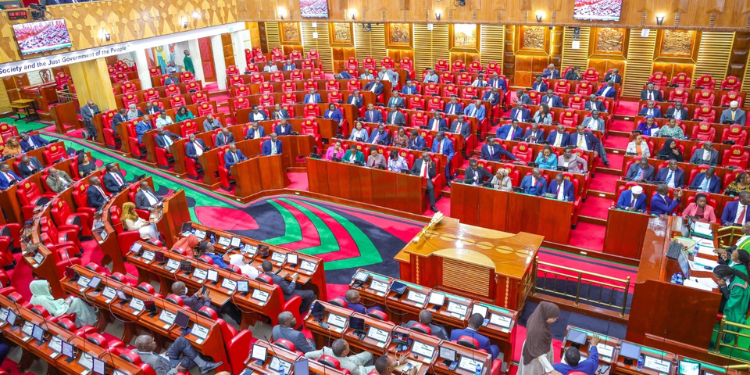
Members of Parliament in a past National Assembly session. PHOTO/ PoK