When Schools Burn: The Psychology Behind Student Arson and the Battle Between Safety and Privacy
Share

By Francis Mwaura
At roughly 12:10 in the morning on May 28, 2026, five girls walked quietly through the dormitory corridors of Utumishi Girls Academy in Gilgil, Nakuru County. Most of their fellow students were fast asleep.
The night air was still. Nothing in the footage captured silently by CCTV cameras mounted along the corridor suggested anything was wrong.
The girls moved in silence. They did not speak to each other. They made their way to Cube 11, paused briefly, then moved further into the darkness. Minutes later, sixteen of their classmates were dead.
The fire that tore through the dormitory that night left 79 others injured, some of them trapped inside and forced to leap through windows as smoke overwhelmed the building. One survivor,
Hilda Njeri described the desperate scramble in an interview with Al Jazeera. “The fire was very big; we could not pass through it because we had no water to put out the fire, so we had to jump through the window,” she said, adding that she struggled to breathe while still inside the building.
For Kenya and for the world, the Utumishi disaster was not just a tragedy. It was a reckoning.
A Wound That Keeps Opening
Kenya has been here before. In 2024, a dormitory fire at Hillside Endarasha Academy in Nyeri County killed 21 students.
In 2001, the Kyanguli Secondary School fire claimed the lives of 67 boys, making it the deadliest school fire in the country’s history.
The pattern is so well established that authorities have come to expect it: a night fire in a boarding school dormitory, reports of overcrowding, a locked emergency exit, and the slow, agonising revelation that someone, most often a student, struck the match.
What makes these fires uniquely devastating is the context in which they happen. Boarding schools in Kenya are not merely places of education.
Also Read: Fresh Twist as Court Rules on Nine Students in Deadly Utumishi Fire Case
They are, for hundreds of thousands of children, their entire world for nine months of the year. The dormitory is their bedroom, their sanctuary, their home. And when that space becomes a killing ground, it fractures something deep in the national psyche.
At Utumishi, the Education Cabinet Secretary Julius Ogamba said something that stopped many Kenyans in their tracks: two teachers had been aware that students were planning something, and failed to act.
The school had also been overcrowded, with 715 students admitted in a facility not designed to hold that many. Some beds were placed in corridors. When the fire started near the exit points, there was nowhere to run.
The Psychology Behind School Fires
To understand why a student would set fire to a building full of sleeping classmates, you have to resist the temptation to reach for simple explanations, evil, madness, pure cruelty.
The truth, as psychologists who work with young arsonists will tell you, is both more troubling and more human than that.
Investigators probing the Utumishi fire uncovered a motive that, in retrospect, seems almost heartbreakingly mundane.
Reports suggest that a decision by the school administration to move examination dates forward, from June 16 to June 2, had sparked significant discontent among Form Four students. There were also tensions over contributions toward a cultural event.
In other words: the fire that killed sixteen girls may have been ignited by frustration over an exam schedule.
This is not unusual. Historically, multiple cases of school arson in Kenya have been perpetrated by students with similar motivations, frustration with the school system, disagreements with teachers, or specific grievances against the administration.
Fire, it seems, becomes the language when all other channels of communication have failed or been ignored.
Psychologist Alan Feldberg, who counsels young arsonists, has described the pattern with painful clarity. When his patients are asked why they set fires, the first answer is almost always the same: “Because I have an anger problem.” Fire, for these young people, is not primarily about destruction. It is about expression.
It is the loudest possible way to say: I am not okay. I am not being heard.
The profile of the school arsonist is notably different from the adult fire-setter. According to research by the National Center for the Analysis of Violent Crime, the motivations behind arson break into recognizable categories: revenge, excitement, vandalism, and what psychologists call psychodynamic motivators, the setting of a fire as a release valve for psychological pressure that has built up over time with no other outlet. In school settings, the vandalism and revenge categories dominate. The target is never random. It is always personal.
What is chilling about the Utumishi CCTV footage, and what moved Interior CS Kipchumba Murkomen to say he “struggled to sleep” after watching it, is the silence of those who walked through the dormitory.
There was no agitation, no rushing, no apparent panic. Forensic psychologists call this “organized affect”: the ability to suppress emotional response in the execution of a plan. It speaks to premeditation, to a decision that had been made and accepted before that midnight walk began.
But it also speaks to something else, to how profoundly disconnected those girls had become from the reality of what they were about to do.
Adolescent brains, still developing the neural architecture of empathy and long-term consequences, can enter a kind of tunnel vision under stress.
A grievance that feels unbearably large can compress the imagination until it cannot see past the act of protest itself, cannot see the sleeping bodies in the next cube, cannot see the smoke, cannot see the grief that is about to radiate outward in every direction from that one moment.
This is not an excuse. It is an explanation. And explanations are the only tools we have for prevention.
The Camera That Saw Everything — And the Question It Raises
Here is the paradox at the center of the Utumishi tragedy: the very cameras that enabled investigators to identify the suspects and bring them toward justice are now at the center of a fierce national debate about whether they should have been there at all.
After CCTV footage from inside the dormitory was released publicly, aired on national television, shared on social media, dissected frame by frame, Kenyans began asking a question that had nothing to do with the fire: Who has been watching these girls all along?
A school dormitory is not a corridor. It is not a gate or a parking lot. It is, as one commentator put it, “effectively a child’s temporary bedroom.” Students sleep there.
They change clothes there. They have private conversations, private moments, private lives. The installation of cameras in that space, regardless of intent, invites serious questions about consent, dignity, and the limits of institutional authority over children.
Activist Hanifa Adan was among those who challenged the presence of cameras in dormitory spaces, asking pointedly why such equipment had been placed where girls sleep and change. Others questioned who had access to the footage, how long recordings were stored, and whether parents had genuinely understood what they were consenting to when cameras were installed.
But a parent whose daughter was among the injured offered a counterpoint that is equally difficult to dismiss.
The cameras, she explained in an anonymous post, were installed after repeated reports of theft, bullying, and misconduct, including incidents of older students mistreating younger girls in shower areas.
The surveillance system was introduced with parental approval, as a protective measure. It was, from one perspective, the school trying to keep its students safe from each other.
Kenyan lawyer Dr. Vellah Kigwiru has attempted to thread this needle legally, noting that while Kenya’s Constitution protects the right to privacy, that right can be limited when there is a legitimate public interest and the limitation is reasonable and justifiable under law.
Legally, she argued, CCTV is permissible in perimeter walls, entry and exit doors, and common areas like dining halls, but not in spaces where students have a reasonable expectation of privacy, such as sleeping quarters.
The problem is that in this case, the cameras in sleeping quarters are precisely what solved the crime.
The Impossible Balance
Interior CS Murkomen, speaking at Kipsigis Girls’ High School just days after the tragedy, called on school administrators across the country to install CCTV cameras, including in dormitories.
“We need to ensure that all schools have properly installed CCTV cameras covering critical areas, as well as a central control room for effective monitoring and response,” he said.
Also Read: Alliance High School Closes Temporarily After Fire Incident
His position is understandable. The surveillance footage did not just help identify suspects; it may ultimately bring justice to sixteen families who are now planning funerals instead of end-of-year celebrations. John Muiruri, who lost his daughter Nicole in the fire, arrived at Naivasha Funeral Home clutching a photograph of her. He is one of sixteen fathers, sixteen mothers, in that position. Against that grief, arguments about privacy can feel abstract.
Yet the privacy question is not abstract at all. It is deeply, viscerally real. The girls at Utumishi, all of them, suspects and victims alike, are children. Minors. Wards of the state in the hours between lights-out and breakfast. The footage broadcast on national television, showing their movements inside a dormitory, some asleep, was of children in what should have been their most protected space. The question of who else watched that footage over the months or years it was recorded, and for what purposes, remains unanswered.
The tension here is not between safety and privacy as abstract values. It is between two concrete groups of children: those who need to be protected from their peers, and those who need to be protected from surveillance. They are, in most cases, the same children.
What Needs to Change
The Utumishi fire, like every school fire before it, has produced the familiar cycle: shock, mourning, anger, promises of inquiry. The Education Ministry has pledged to review fire safety regulations in boarding schools. The Interior Ministry has called for CCTV installation.
The DCI has used forensic imaging to identify suspects. The government has pledged to foot the medical bills of survivors.
These are all necessary responses. None of them are sufficient.
What the Utumishi fire makes undeniably clear is that the grievances of students in boarding institutions, about academic pressure, about administrative decisions that feel arbitrary and authoritarian, about feeling unheard and unseen, do not disappear when they are ignored. They compress. They find other forms.
The two teachers who knew something was being planned and said nothing raise perhaps the most disturbing question of all. Not the legal question of their culpability, but the human one: what kind of school environment produces students who would plan this, and adults who would look away?
The answer to school fires is not more cameras. It is not more locks, more rules, more surveillance. Those things have their place, but they address the symptom, not the source.
The answer is schools that know their students well enough to hear distress before it becomes destruction, institutions where a Form Four student with a grievance about an exam schedule has somewhere to take that grievance and some reason to believe she will be heard.
Sixteen girls died at Utumishi because a door was locked when it should have been open, in more ways than one.
A Note on the Suspects
The eight young women arrested in connection with the Utumishi fire are also children. They are being arraigned in court, their fates to be determined by a system that will need to reckon with the gap between the gravity of what happened and the complexity of why. Criminal justice, in cases like these, is a blunt instrument applied to a very fine and terrible tangle.
Kenya’s Constitution and its Children’s Act both recognise that the well-being and rehabilitation of minors should be central to any legal response to juvenile crime.
Whatever punishment comes, it will not bring back Nicole Muiruri, or the other fifteen girls who did not wake up in time. It will not give her father back his photograph, made flesh.
What it might do, if the system works as it should, and if Kenyans are honest about what needs to change, is ensure that the next generation of children in Kenya’s boarding schools inherits something better than locked fire exits, overcrowded dormitories, and the particular silence of grievances that have run out of other ways to speak.
Follow our WhatsApp channel for instant news updates
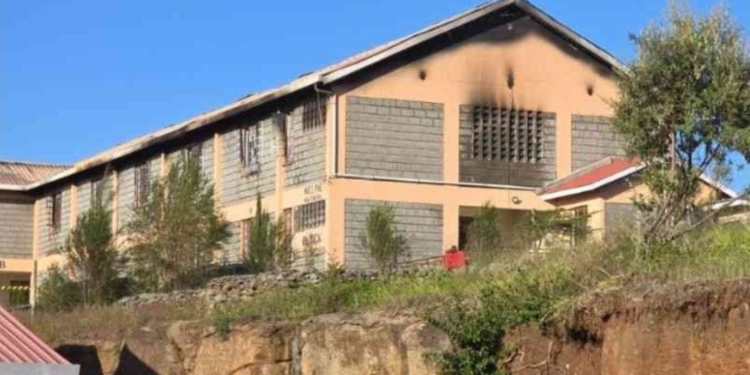
Utumishi Girls Academy Dormitory that Caught fire. PHOTO/ The Standard.Utumishi Girls Academy Dormitory that Caught fire. PHOTO/ The Standard.