
OPINION: The Fall of Sifuna, a Warrior Who Now Begs for Mercy
Share
By Angie Elat Achieng
The man who once looked like fresh hope, the young gun with a sharp tongue and fearless energy. The one who struck without overplaying his hand yet still commanded attention stood at a podium and said something that should make every young Kenyan who ever believed in him pause and ask, “Where did the fire go?”
At a funeral, Sifuna looked at Rigathi Gachagua, the same man he voted to impeach and the same man his party helped push out of office, and spoke words that sounded less like strategy and more like surrender.
“Mheshimiwa Riggy G, let me tell you. We are convinced that there is no other formula. Before God, there is no other formula other than a united ticket against William Ruto,” he said.
He then asked for forgiveness, called for unity and urged the opposition to do whatever needs to be done to remove the President. That moment did not land as a tactical call alone; it landed as a shift in posture, a turn from defiance toward dependence.
When No Other Formula Became a Trap
The phrase no other formula reshaped the entire argument because it shut down alternatives, forced agreement and reduced political competition into a single predetermined outcome.
From there, he intensified the claim by saying, “Before God, there is no other formula other than a united ticket.” He invoked God to strengthen his point, yet that move narrowed the debate instead of opening it.
After that, he softened the political tension by calling for forgiveness: “Let us forgive each other.” However, politics does not run on emotional reconciliation alone. It runs on interests, structures and competing ambitions that no handshake can erase.
Finally, he warned against allowing Gachagua back into power and framed the stakes as urgent and final. That contradiction exposed a deeper tension between reconciliation and resistance in his message.
Also Read: OPINION: A Nation Campaigning Itself into Collapse
From Defiance to Dependence
Sifuna once carried himself like a political disruptor who looked ready to reshape the system rather than adjust to it. He challenged authority inside his party and outside it, and he spoke like a leader willing to break political repetition.
Over time, his tone and posture shifted. He reached out to rivals he once opposed and embraced coalition talk that depended on compromise with the same figures he helped fight politically. That shift did not resemble evolution. It reflected pressure, isolation, and shrinking political room.
In February 2026, ODM removed him as Secretary General after it accused him of indiscipline and parallel political activity, a decision that pushed him into open confrontation with both his party and the national government.
He responded by repositioning himself as a national opposition voice, but he never anchored that role in a solid power base. He called for unity, yet he did not control its direction. He invited alliances, yet he did not define their structure.
He also signaled willingness to work with Gachagua’s DCP, even as he admitted that his support for Gachagua’s impeachment contributed to political fractures in government. That contradiction now sits at the center of how many read his latest move.
Also Read: OPINION: 2027 Power and Pressure-Why William Ruto Leads, but the Race Is Far from Safe
The Hard Reality of Opposition Politics
Across the political landscape, fragmentation defines the opposition. Gachagua leads his base through DCP. Kalonzo anchors Wiper. Martha Karua holds her own political structure. ODM remains divided internally.
If these blocs enter 2027 separately, they lose. Numbers favor the incumbent, while Ruto holds state power, resources, and institutional reach that no single opposition faction can match alone.
So Sifuna’s logic of unity makes political sense, and the arithmetic supports it clearly. However, politics does not run on arithmetic alone.
Every coalition demands sacrifice, yet not every actor sacrifices equally. Gachagua shows no intention of stepping aside. Kalonzo has waited for national leadership for decades and does not signal withdrawal from that ambition. Martha Karua maintains a distinct political identity that does not depend on concession at the top.
That leaves Sifuna in a weaker negotiating position. He lacks a dominant party structure and a strong regional bloc. Instead, he relies on visibility, rhetoric, and urban support that cannot deliver national victory on its own. For that reason, unity becomes less of a choice and more of a necessity.
Even if a united opposition wins, leadership inside that coalition will depend on bargaining strength rather than shared ambition. Those who bring stronger bases dictate terms, while those who depend on coalition structures adjust to them. In that structure, Sifuna risks losing the independence that once defined his political appeal.
In the end, this reaction does not come from anger because anger targets opponents. Instead, it comes from disappointment, because disappointment belongs to those we once believed would hold their line when pressure rises.
Follow our WhatsApp channel for instant news updates
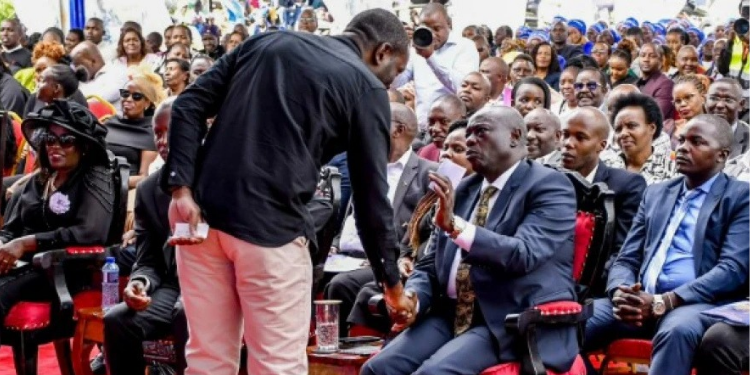
Democracy for Citizens Party (DCP) leader Rigathi Gachagua greets Nairobi Senator Edwin Sifuna in Kieni, Nyeri County on May 14, 2026. Photo/Pauline Njoroge