Arsenal FC Club Profile: Big in England but Still Missing in Europe
Share
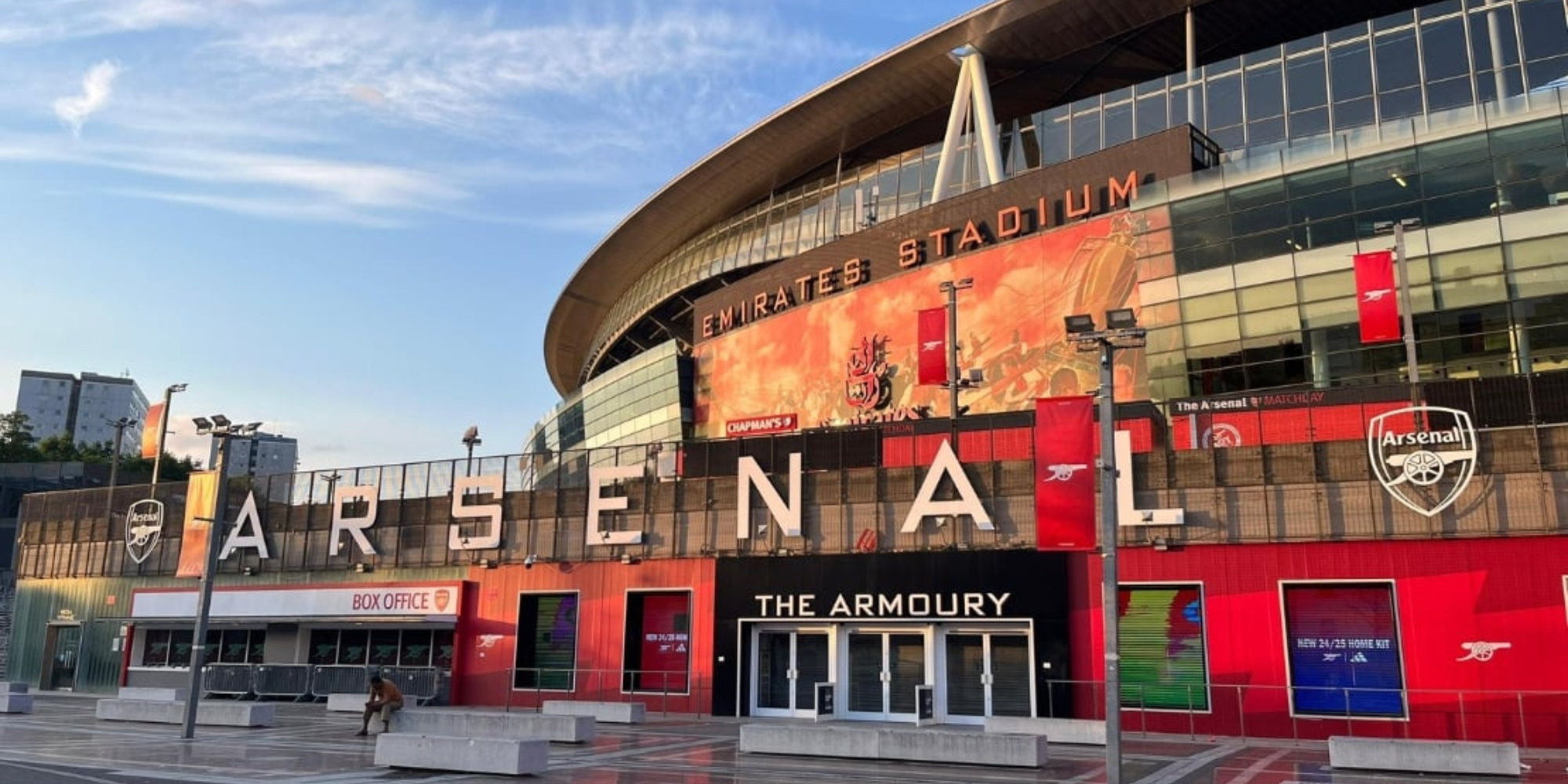
Arsenal F.C. is one of the most successful football clubs in England, with a rich history and traditions.
Located in Islington, North London, the club takes part in the top English league, the Premier League.
Founded in October 1886 as Dial Square by the workers of the Royal Arsenal in Woolwich, Arsenal became a world-famous football team with millions of supporters all over the globe.
“Gunners” and “Gooners” are the popular names for the Arsenal team and its fans, respectively.
Being famous for their success, innovations, attacking style of play, and stability, Arsenal plays its home games in the modern stadium Emirates, which can hold up to 60,704 people.
The owners of Arsenal are Kroenke Sports & Entertainment company; Stan and Josh Kroenke are the co-chairs of the club, and the manager is Mikel Arteta.
Arsenal has 14 titles, including the undefeated season of 2003-04, which is known in the club’s history as “The Invincibles.”
In addition, the club owns a record 14 FA Cups, two League Cups, 17 FA Community Shields, and the Football League Centenary Trophy.
In the international competitions, Arsenal has managed to win the UEFA Cup Winners’ Cup and the Inter-Cities Fairs Cup.
The club was the first in the South of England to join the Football League in 1893 and became a member of the First Division in 1904.
Arsenal boasts the most prolonged membership in the English Premier League, which is more than 105 years long, as well as one of the best averages of league positions in the history of English football.
From 1998 to 2017, Arsenal played in the UEFA Champions League for 19 consecutive seasons.
From Dial Square to Woolwich Arsenal (1886–1912)
Arsenal’s origins trace back to October 1886, when Scotsman David Danskin and 15 fellow workers at the Royal Arsenal armaments factory formed Dial Square Football Club in Woolwich.
Each player contributed sixpence to establish the club, while Danskin personally added three shillings.
The team played its first recorded match on 11 December 1886 and defeated Eastern Wanderers 6–0.
By January 1887, the club changed its name to Royal Arsenal.
Early home matches were staged at Plumstead Common before moving primarily to the Manor Ground.
Arsenal won its first silverware during the 1889–90 season with the Kent Senior Cup and London Charity Cup, before adding the London Senior Cup in 1890–91.
Royal Arsenal was the first team in London to go professional in 1891.
In 1893, the team was transformed into a limited liability company and renamed Woolwich Arsenal.
It was the first club south of England to join the Football League in 1893.
The club started playing in the Second Division but managed to move up to the First Division in 1904.
The club faced financial difficulties as early as 1910 because of declining attendance and increasing competition from other teams in London.
At this time, businessmen Henry Norris and William Hall intervened to save the club and considered moving the team across the River Thames.
Also Read: Ruto Pays Emotional Tribute to Arsenal After Winning EPL Title After 22 Years
Highbury Era and the Herbert Chapman Revolution (1913-1939)
Arsenal moved to Highbury in North London in 1913 after being relegated to the Second Division.
This move led to the creation of the famous North London Derby rivalry between the club and its local rival, Tottenham Hotspur F.C.
The club was promoted to the First Division in 1919, controversially at the expense of Tottenham, following the expansion of the First Division by the Football League after World War I.
The club also began using the simpler version of its official name, that is, Arsenal.
One of the most important turning points came in 1925, when the great manager Herbert Chapman moved from Huddersfield Town A.F.C. to Arsenal.
Arsenal won their first national trophy under Chapman, the 1930 FA Cup, followed by League Championships in 1930-31 and 1932-33.
Despite Chapman’s sudden death from pneumonia during the 1933–34 season, Arsenal continued its dominance under Joe Shaw and George Allison, winning league titles in 1933–34, 1934–35 and 1937–38, alongside the 1936 FA Cup.
World War II suspended league football for seven years and heavily affected Arsenal.
Arsenal lost a number of players during the war years and was also facing financial difficulties because of stadium redevelopment expenses.
Recovery Post-War & Double Triumphs (1947-1984)
In the post-war era, Arsenal made its comeback as a football giant with the management of Tom Whittaker.
The club won the league title in 1947–48 and added another championship in 1952–53, becoming England’s most successful club at the time.
Arsenal also lifted the FA Cup in 1950.
The following decades proved inconsistent. Former England captain Billy Wright managed Arsenal between 1962 and 1966 but failed to secure major success.
However, Bertie Mee’s appointment in 1966 transformed the club’s fortunes.
Mee guided Arsenal to the 1969–70 Inter-Cities Fairs Cup, the club’s first European trophy.
One year later, Arsenal achieved its historic first League and FA Cup Double during the 1970–71 season.
Former player Terry Neill became manager in 1976 at just 34 years old.
Arsenal reached three consecutive FA Cup finals between 1978 and 1980, winning the memorable 1979 FA Cup final against Manchester United F.C. in dramatic fashion.
George Graham’s Defensive Dynasty (1984–1996)
Former Arsenal player George Graham returned as manager in 1986 and built one of the club’s most disciplined teams.
Arsenal won the League Cup in 1987 before capturing the 1988–89 league title in dramatic circumstances against Liverpool F.C..
Graham constructed the legendary “Back Four” featuring Tony Adams, Lee Dixon, Nigel Winterburn, and Steve Bould.
Arsenal won another league title in 1990–91, losing only one match all season.
During Graham’s era, Arsenal also won the FA Cup and League Cup double in 1993 and secured the UEFA Cup Winners’ Cup in 1994.
However, Graham’s tenure ended controversially in February 1995 after revelations involving illegal payments from agent Rune Hauge.

Former Arsenal Manager Arsène Wenger during a past Arsenal celebration in London. PHOTO/ BBC
Arsène Wenger and the Invincibles Era (1996-2018)
Arsène Wenger was appointed manager in October 1996 and changed the club both on and off the pitch.
Wenger modernised dietary habits, fitness methods, and scouting systems while introducing exciting attacking football.
With stars such as Patrick Vieira, Thierry Henry, Dennis Bergkamp, and Robert Pirès, Arsenal won league and FA Cup doubles in 1997–98 and 2001–02.
The greatest achievement came during the 2003–04 season when Arsenal won the Premier League without losing a single match.
The side became known as “The Invincibles” and completed a record 49-game unbeaten league run between May 2003 and October 2004.
Arsenal moved from Highbury to the Emirates Stadium in 2006 after spending 93 years at the historic ground.
Wenger also guided Arsenal to the 2006 UEFA Champions League final, making Arsenal the first London club to reach the final, though they lost 2–1 to FC Barcelona.
After a nine-year trophy drought, Arsenal won the 2014 FA Cup against Hull City A.F.C. before adding further FA Cups in 2015 and 2017.
Wenger departed Arsenal on 13 May 2018 after 22 years in charge.
Post-Wenger Evolution and Arteta’s Revival (2018–2026)
Following Wenger’s departure, Spaniard Unai Emery became Arsenal’s first head coach from outside the United Kingdom in May 2018.
Emery guided Arsenal to the Europa League final in 2019 before being dismissed later that year.
Former captain Mikel Arteta took charge on 20 December 2019 and immediately won the 2019–20 FA Cup by defeating Chelsea F.C. 2–1 in the final.
Arsenal endured difficult campaigns during the 2020–21 season, missing European qualification for the first time in 26 years.
However, Arteta rebuilt the squad around younger players, including Bukayo Saka, Martin Ødegaard, and Declan Rice.
During the 2022–23 season, Arsenal finished second behind Manchester City F.C. after spending a record amount of time atop the league table without winning the title.
Arsenal again finished second in 2023–24 and 2024–25.
On 19 May 2026, Arsenal finally reclaimed the league title for the first time since 2003–04 after AFC Bournemouth’s 1–1 draw with Manchester City confirmed the championship with one game remaining.
The triumph marked Arsenal’s 14th league title and Mikel Arteta’s first Premier League crown as manager.

Arsenal manager Mikel Arteta celebrates after his team’s win over Fulham in London on Saturday. | REUTERS
Also Read:“This is Our Season” Raila Odinga’s Last Message About Arsenal Resurfaces
Stadiums, Identity and Club Colours
Arsenal has played at several stadiums throughout its history, including Plumstead Common, Manor Ground, Invicta Ground and the iconic Highbury stadium between 1913 and 2006.
Highbury became synonymous with Arsenal’s identity before the club moved to the Emirates Stadium in 2006.
The modern arena was built at Ashburton Grove and officially opened ahead of the 2006–07 season.
Arsenal’s traditional red and white colours originated from a donation by Nottingham Forest shortly after the club’s formation in 1886.
Herbert Chapman later added the iconic white sleeves in 1933, creating one of football’s most recognisable kits.
The club’s famous yellow and blue away strip became legendary after Arsenal won the 1971 FA Cup final against Liverpool.
Arsenal kits are currently manufactured by Adidas after previous partnerships with Nike and Puma.
Ownership, Finances and International Status
Stan Kroenke, an American businessman, acquired a majority ownership in the club by gradually raising his share from 2007.
Kroenke made a complete takeover in August 2018 by acquiring Alisher Usmanov’s shares worth £550 million.
Arsenal Football Club is still one of the richest football clubs in the world.
The club recorded revenue of £616.6 million during the 2023–24 season.
According to Forbes, Arsenal is estimated to be valued at about US$3.4 billion.
Club Motto: “Victoria Concordia Crescit” which means “Victory through Harmony.”
Legendary Players and Club Records
Arsenal has produced and attracted some of football’s greatest players, including Charlie Buchan, Alex James, Cliff Bastin, Tony Adams, Ian Wright, David Seaman, Patrick Vieira, Dennis Bergkamp, Thierry Henry, Cesc Fàbregas, Robin van Persie, Mesut Özil and Bukayo Saka.
Thierry Henry remains Arsenal’s all-time top scorer with 228 goals in all competitions.
David O’Leary holds the record for most appearances with 722 matches, while Tony Adams made 669 appearances.
Arsenal also owns several historic records, including the longest unbeaten league run in English football history at 49 matches between 2003 and 2004.
The club has also won a record 14 FA Cups and became the first English club to complete both the League and FA Cup double and the FA Cup and League Cup double.
Current stars include Martin Ødegaard, Bukayo Saka, Gabriel Martinelli, Declan Rice, Kai Havertz, William Saliba and David Raya, while Mikel Arteta leads a coaching staff featuring Albert Stuivenberg, Gabriel Heinze and Nicolas Jover.
Follow our WhatsApp channel for instant news updates

Arsenal players celebrate after winning the English Premier League 25/25 trophy at Emirates Stadium on Wednesday, May 19, 2026. PHOTO/ Arsenal X