
Principals Reject Standardized Uniforms as School Fee Debate Intensifies
Share


Secondary school principals have rejected a proposal to introduce standardized uniforms in schools, arguing that the move would undermine school identity and discipline while failing to consider Kenya’s diverse climatic conditions.
According to the Kenya Secondary School Heads Association (KESSHA), uniforms are more than just dress codes; they foster a sense of pride, belonging, and institutional identity among learners.
KESSHA maintained that each school should preserve its unique identity rather than adopt a single national uniform design.
The debate comes at a time when parents are already grappling with the rising cost of education, with proposed senior school fee adjustments indicating increases in several expenditure areas.
The proposed fee structure includes higher allocations for learning materials, meals, maintenance, and other school-related requirements.
“We believe each school should retain its identity, culture, and heritage as reflected in its uniform,” Willie Kuria said as quoted by Nation.
Principals Defend Identity As Uniform Costs Become a National Debate
KESSHA chairman Willie Kuria said schools should not lose their traditions in the name of standardization, adding that uniforms help strengthen the relationship between learners, parents, and alumni.
Uniforms, he said, promote pride and belonging among students while supporting discipline because learners can easily be identified by their institutions.
The principals warned that replacing unique uniforms with one national design could make it harder to identify students involved in misconduct.
The association said it supports affordability but does not support removing school-specific designs.
It argued that uniforms should remain linked to institutional culture while efforts are made to lower prices.
“Rather than a national dress code, we support efforts to make uniforms affordable while retaining identity,” the association said as quoted by Nation.
Also Read:REVEALED: Fees Parents Could Pay in Senior Schools if Govt Adopts New Proposal
Kuria, speaking during a conference opened by Chief of Staff Felix Koskei, said the cost of uniforms has often been misunderstood.
He stated that average expenses stand at about Ksh 9,562 for boys and Ksh 10,182 for girls, covering items such as shirts, skirts or trousers, sweaters, socks, and games kits.
Kessha further proposed a cost-sharing model involving the government, parents, and suppliers to reduce expenses without forcing schools to abandon their designs.
Fee Proposals Raise Fresh Concerns Among Parents
The uniform debate has emerged alongside discussions on proposed senior school fees, with the new structure showing increases in several areas of school expenditure.
Also Read: Senate Tables Plan to Replace Boarding Schools
The proposed fees indicate that teaching and learning materials could rise from Ksh 4,344 to Ksh 5,642, while some categories show meals increasing from Ksh 30,385 to Ksh 61,009.
Repair and maintenance, which were previously listed at zero in some categories, have been proposed at Ksh 2,000.
The figures also show proposed parent contributions increasing significantly, with one category moving from Ksh 53,554 to Ksh 87,781, while another rises from Ksh 40,535 to Ksh 83,622 after adjustments and grants.
The changes have renewed debate on the financial pressure facing families as schools grapple with the senior school transition.
The association said a single uniform would also fail to address Kenya’s varied weather conditions, arguing that learners in colder regions require heavier clothing compared to those in warmer areas.
Student comfort, KESSHA said, affects concentration, well-being, and learning outcomes.
The principals urged policymakers to avoid a one-size-fits-all approach and instead focus on solutions that balance affordability, school identity, and learner needs.
President William Ruto had earlier raised concerns over high uniform costs during the transition of about 1.1 million Grade 10 learners in January, who were allowed to continue using junior school uniforms.
Follow our WhatsApp channel for instant news updates
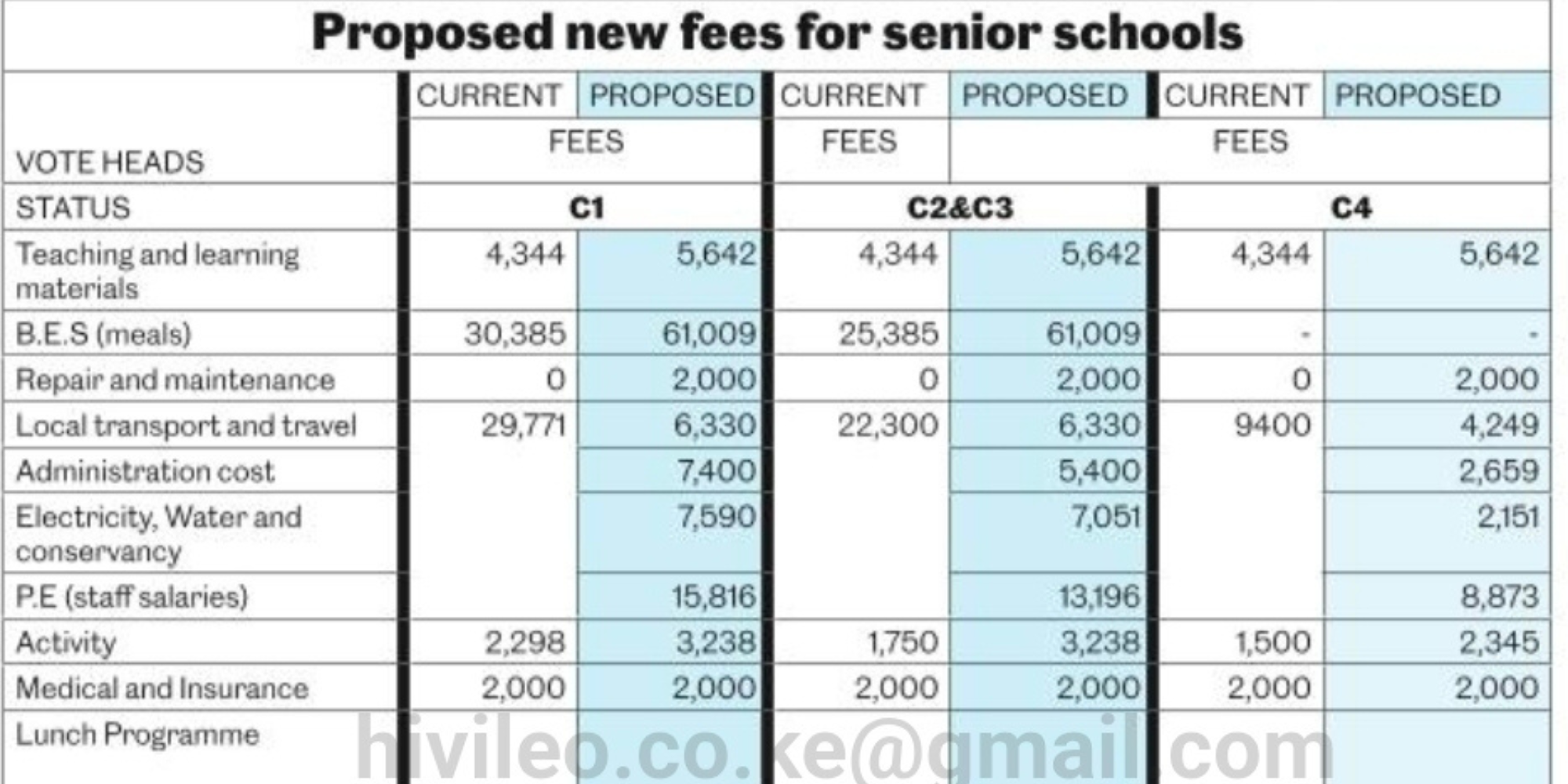
The proposed school fees structure, presented by school heads, outlines significant changes in the amount parents would contribute across different categories of senior schools, with boarding and day schools expected to record new charges. PHOTO/ File