
The Milk Squeeze: How Rising Prices Are Hitting Small Businesses
Share

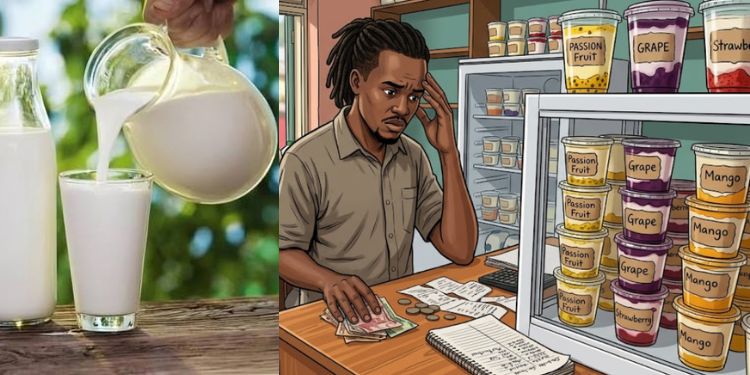
For small businesses built around milk, rising prices are no longer just eating into profits—they are forcing owners to cut production, stay closed on some days, and absorb costs they can no longer pass on to customers.
Jose, who makes Greek yogurt, has already cut his milk purchases from 15 litres to 10 litres as the price of a litre climbed from Sh65 to Sh80.
“I noticed like a month ago, so I had to reduce the amount of milk I was buying from 15 litre to 10 litre,” Jose said.
But cutting back has not solved the problem. With customers resisting a price increase on his yogurt, Jose says he is now absorbing higher costs while selling at the same price he has charged since starting the business.
When higher costs eat into small business
For a business built around milk, reducing the quantity purchased is not simply a cost-cutting measure. It directly affects how much product can be made and sold.
Jose says raising the price of Greek yogurt would appear to be the obvious solution, but customers have already pushed back against the idea.
“I haven’t changed yet because I tried to tell them about the thought of increasing the price and they wouldn’t agree. So I have to retain the price,” Jose said.
Also Read: Milk Shortage Exposes Traders to New Risk as Businessman Receives Soil Instead of Goods
That leaves Jose absorbing part of the higher cost while keeping the yogurt at the same selling price.
The squeeze comes at a time when Kenya’s dairy sector is already dealing with reduced milk supplies. Kenya Dairy Board figures show formal deliveries to processors fell from 84.4 million litres in June to 81.3 million litres in July, a 3.7 per cent decline.
Preliminary indications pointed to continued supply pressure in August.
For small businesses that rely heavily on milk, every increase in the price of a litre can therefore affect production, margins and ultimately whether a shop opens for business on a particular day.
But the squeeze on businesses like Jose’s starts with dairy farmers, who are themselves struggling with rising production costs.
From expensive animal feed to costly milk
Dairy farmer John Kimani in Kitale has seen milk production on his farm fall sharply as the cost of feeding his cows rises.
“I am now milking between 400 and 460 litres, down from 700 and something litres. Milk production is declining because of the rising cost of animal feed,” Kimani said.
His experience mirrors a wider challenge facing dairy farmers, with prolonged dry conditions reducing pasture while high grain prices push up the cost of commercial feeds. Recent reporting from Trans Nzoia has similarly linked declining milk production to rising feed costs.
Dr Gakuo Mwangi, a member of the Association of Kenya Feed Manufacturers, says Kenya’s feed supply gap is adding to the pressure.
“As a country we have got a feed requirement of about 55 million metric tonnes. We are only able to produce about 40 per cent of that, running a permanent deficit of about 60 per cent,” Mwangi said.
He said high grain prices translate into higher feed prices, creating a need for alternative raw materials that can lower production costs.
In the short term, he said, importing grain could help the feed industry, while a longer-term solution would involve creating another grain basket for the country.
Also Read: Milk Prices Set to Rise as COFEK Warns of Worsening Supply Crisis
For the government, part of the response is focused on making feed more accessible to farmers.
Livestock Development Principal Secretary Jonathan Mueke said the government had agreed to work with animal feed manufacturers to identify areas with excess feed storage and make supplies available to dairy farmers through cooperatives and processors.
“The real issue is fodder pressure due to lack of rain,” Mueke has previously said, as the government seeks measures to restore milk production.
But even as authorities work on the supply side, businesses such as Jose’s are already feeling the effects.
Kenya Dairy Board Chairman Genesio Mugo says importing milk is currently not an easy option because neighbouring suppliers are also experiencing shortages.
“Unfortunately we did not have much milk in the East African region, including our main suppliers Rwanda and Uganda. We are actually having a deficit,” Mugo said.
He expects supplies to improve after the rains, saying significant milk production could return about two weeks after the long rains begin.
Mugo also urged consumers against panic buying, saying the shortage remains minimal and there is no need to stockpile milk.
Also Read: Kenya Dairy Board Explains Constraints Behind Current Milk Shortage
For Jose, however, the squeeze is already real. The business continues to offer Greek yogurt in fruit flavours including passion, grapes, strawberry, mango and orange, with sizes starting from 350ml.
But behind each cup is a business owner buying less milk, holding his selling price steady and accepting slimmer returns to keep customers.
For now, Jose is making do with what he can afford — hoping that when milk production picks up, he will no longer have to choose between buying enough milk and keeping his small business open.
Follow our WhatsApp channel for more updates

Jose’s Greek yoghurt products, made with natural probiotics. PHOTO/ PRECIOUS