
Explainer: Why Customers Abroad Struggled to Access My OneApp
Share

One of the defining features of My OneApp, Safaricom’s new all-in-one platform, is its strong focus on security.
From the outset, the app was designed using the Secure By Design principle, meaning safety measures were integrated from the earliest stages of development rather than added later.
As a result, Safaricom introduced stricter login requirements compared to previous apps. When My OneApp went live on both the Apple App Store and Google Play Store, users were required to connect through the Safaricom mobile network—Not WiFi—to activate their accounts.
In contrast, the earlier M-PESA super app had allowed WiFi-only logins, a feature that later attracted scrutiny.
With My OneApp, however, users had to switch off WiFi, initiate login via mobile data and receive a One Time Password (OTP) sent directly through the Safaricom network.
By doing so, Safaricom ensured that the OTP reaches the SIM card linked to the registered user.
Since SIM registration already captures customer identity details, this process helps the company meet Know Your Customer (KYC) requirements set by the Central Bank of Kenya.
These explanations were provided during Decode, Safaricom’s engineering summit held in early April, where the app was showcased ahead of its official rollout.
Also Read: How to Easily Access a CRB Clearance Certificate Using Safaricom’s My One App
Why Customers Abroad were Locked Out on My OneApp
However, despite the strong security framework, the rollout created unexpected challenges for customers living outside Kenya. Many were unable to complete the activation process due to several key factors:
- WiFi-only usage: Many customers abroad rely heavily on WiFi and rarely use their Safaricom lines on mobile data. Consequently, they could not meet the requirement to log in via the Safaricom network.
- Security verification requirement: activation had to occur on Safaricom’s network to confirm SIM ownership. Without access to that network, users abroad could not receive the OTP needed to complete registration.
- Roaming dependency: accessing the Safaricom network from abroad often requires enabling international roaming. This means users may incur extra costs or go through additional setup steps, making the process inconvenient.
- Multiple line users: customers managing several lines whether personal, family, or business, faced additional verification hurdles. In such cases, users who registered multiple SIM cards under one identity encountered stricter authentication checks.
Also Read: Safaricom Makes Changes to My OneApp Following Public Uproar – What’s New
Response from Safaricom
In response to these challenges, Safaricom has acknowledged the difficulties faced by diaspora users. The company has since set up a dedicated team to address these concerns and improve accessibility.
Ultimately, while the stricter login process strengthens user protection, it also highlights the need to balance security with accessibility especially for customers accessing services from outside the country.
Follow our WhatsApp channel for instant news updates
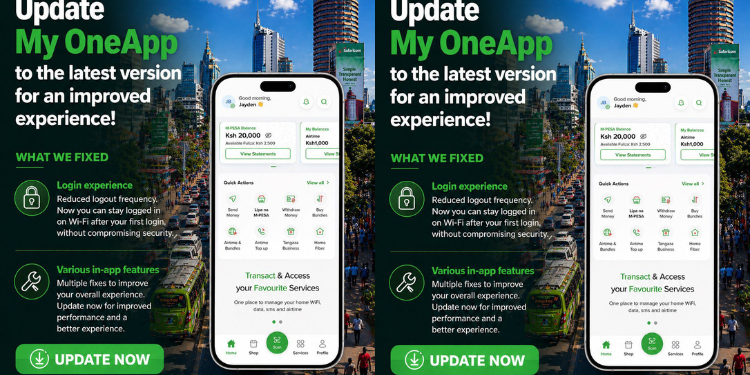
A collage photo of a poster showing the latest version of My OneAPP. PHOTO/Safaricom