Why Kenya’s New Fuel Deal With Rwanda Is a Big Win for the Region
Share

Kenya and Rwanda have signed three key agreements that will allow Rwanda to import bulk refined petroleum products through Kenya under a Government-to-Government (G-to-G) arrangement, in a move expected to strengthen regional trade and energy security.
The agreements, signed on June 29 2026, at KASNEB Tower in Nairobi, include a Memorandum of Understanding (MoU), a Tripartite Agreement (TPA), and a Transport and Storage Agreement (TSA).
The signing was witnessed by Kenya’s Cabinet Secretary for Energy and Petroleum, Opiyo Wandayi, and Rwanda’s Minister of Trade and Industry, Antoine Marie Kajangwe.
The Kenya Pipeline Company (KPC) Acting Managing Director Pius Mwendwa and Rwanda National Energy Company (RNEC) Director Chris Twagirimana, alongside senior government and energy sector officials.
New Framework
The new framework fully opens the Northern Corridor to Rwanda’s petroleum imports under the G-to-G programme.
According to the two governments, the agreements conclude negotiations that began during a bilateral meeting in Kigali in November 2024 and were approved by Kenya’s Cabinet on June 16, 2026.
Also Read: KPC Foundation Expands Clean Energy Programme to Mukuru Viwandani Households
The arrangement is expected to significantly increase Rwanda’s fuel imports through Kenya, with annual volumes projected to rise from approximately 42,000 cubic metres transported in 2025 to more than 500,000 cubic metres.
Rwanda’s first shipment under the new framework, designated RNEC 001/2026, is expected to arrive at the Port of Mombasa between September 4 and 6, 2026.
Secure Supply To Rwanda
Speaking during the signing ceremony, Wandayi said the agreements go beyond legal documents and represent a long-term commitment by Kenya to guarantee a secure and reliable supply of petroleum products to Rwanda.
He noted that the increased trade would not only benefit the two countries but also strengthen economic integration within the East African Community and the wider Great Lakes region.
Kajangwe described the agreements as a major milestone for Rwanda’s energy sector, saying they would enhance access to reliable and affordable petroleum products while deepening cooperation between the two neighbouring countries.
KPC Acting Managing Director Pius Mwendwa said the agreement marks the culmination of more than a decade of efforts to increase Kenya’s share of Rwanda’s petroleum market, which had remained below 10 per cent.
KPC
To support the arrangement, KPC said it has invested in infrastructure including 1.13 billion litres of petroleum storage capacity, a 1,342-kilometre pipeline network, the Kisumu Oil Jetty and the Eldoret-Kampala pipeline corridor. The company has also extended petroleum storage for Rwanda-bound cargo from 35 days to 90 days for an initial two-year period to lower import costs.
Also Read:KCB Facilitates Ksh1.07 Trillion Fuel Imports Under Kenya’s G-to-G Deal
The legal framework has also been completed after RNEC was registered in Kenya and licensed by the Energy and Petroleum Regulatory Authority (EPRA) to import, export and wholesale petroleum products.
Both governments expressed confidence that the partnership would enhance regional trade, improve fuel supply chains and support economic growth across East Africa.
Follow our WhatsApp channel for instant news updates
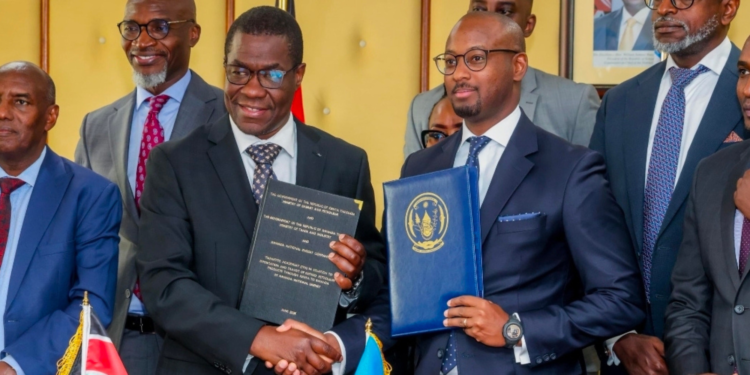
Kenya’s Cabinet Secretary for Energy and Petroleum, Opiyo Wandayi and Rwanda’s Minister of Infrastructure, Jimmy Gasore, hold signed documents during a historic bilateral agreement ceremony in Nairobi
PHOTO/Wandayi X