
Who Controls Safaricom? Inside the Regulators Governing Kenya’s Largest Telecom
Share
Safaricom is the largest telecommunications firm in Kenya, yet despite being a market leader, the firm does not act alone.
Every part of the business, ranging from mobile phone services, internet connectivity, and even M-PESA, consumer information, competition, tax, and the environment, comes under the control of various regulatory agencies created under the laws of Kenya.
However, at the heart of this regulation process is the Communications Authority of Kenya (CA).
This is the ICT regulator for the country.
Yet, because Safaricom has diversified its business beyond traditional telecommunications and has ventured into financial, digital, and public markets, there are other regulatory bodies as well.
Role of the Communications Authority on Safaricom
The Communications Authority of Kenya (CA) regulates Safaricom as the country’s telecommunications sector regulator.
The CA issues licences to mobile network operators (MNOs), manages the radio frequency spectrum, monitors network quality, protects consumers’ interests, and enforces telecommunications laws.
It also oversees licensing, spectrum management, quality of service, Know Your Customer (KYC) requirements, universal service obligations, and interconnection between telecommunications networks.
Safaricom’s future operations have received a major boost after the company secured a 25-year operating licence under the CA’s Unified Licensing Framework.
Safaricom said the new licence increased its licensing costs by Ksh 1.7 billion, bringing its total annual licensing costs to Ksh 16.38 billion.
Also Read:Explained: How Govt Plans to Spend Safaricom – Vodacom Ksh 244.5 Billion Deal
Regulation of M-PESA by the Central Bank
Although Safaricom operates Kenya’s largest mobile money transfer service, the Communications Authority of Kenya (CA) does not regulate M-PESA.
Instead, the Central Bank of Kenya (CBK) regulates M-PESA because it operates as a payment service under the National Payment System framework rather than as a bank.
The CBK requires customer balances to be fully backed by equivalent funds held in trust accounts, preventing Safaricom from using customers’ money for its corporate operations.
In addition to setting transaction and wallet limits, the CBK ensures that M-PESA complies with anti-money laundering (AML) and counter-terrorism financing (CTF) regulations and enforces strict Know Your Customer (KYC) requirements.
Competition Watchdog
Safaricom is also governed by the Competition Authority of Kenya (CAK).
The CAK operates under the Competition Act and regulates the conduct of firms for the purposes of promoting competitive practices and protecting the interests of consumers.
Due to being the largest telecommunications company in the country, the CAK keeps an eye on mergers and acquisitions in Safaricom and addresses any competition issues arising.
The regulatory body also controls consumer welfare issues concerning competition law.
Data Privacy Watchdog
The Office of the Data Protection Commissioner (ODPC) is another key regulator overseeing Safaricom’s operations.
Because Safaricom handles the personal information, call records, financial transactions, and digital data of millions of customers, the company must comply with Kenya’s Data Protection Act.
Also Read: Explained: How Govt Plans to Spend Safaricom – Vodacom Ksh 244.5 Billion Deal
Regulatory Agencies for Areas Outside Telecommunications and Financial Services
Several other regulatory bodies also oversee different aspects of Safaricom’s operations beyond telecommunications and financial services.
The Kenya Revenue Authority (KRA) regulates Safaricom’s tax compliance. The company pays corporate income tax, value-added tax (VAT), excise duty, and other statutory taxes to the authority.
The National Environment Management Authority (NEMA) oversees Safaricom’s environmental compliance, including environmental impact assessments and electronic waste (e-waste) management.
The Kenya Civil Aviation Authority (KCAA) regulates telecommunications infrastructure that could affect aviation safety. It reviews and approves certain base transceiver stations and other structures to ensure they do not pose risks to Kenya’s airspace.
The Capital Markets Authority (CMA) also regulates Safaricom because the company is listed on the Nairobi Securities Exchange (NSE).
Follow our WhatsApp channel for instant news updates
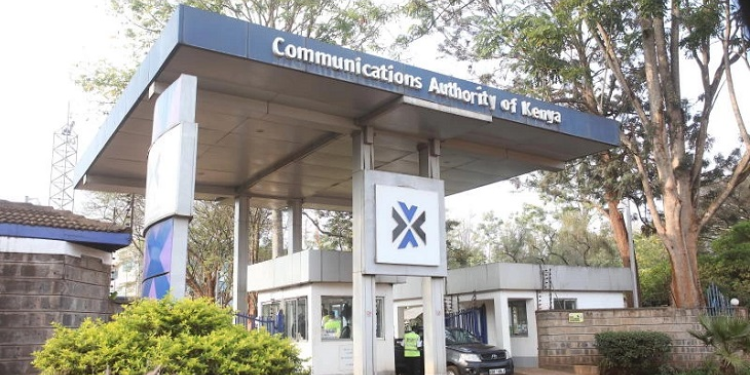
CAK Main gate. PHOTO/ CAK X